

- Bangladesh Eyes Smarter Future With AI-Driven Services |
- Dhaka’s air quality has been recorded ‘moderate’ on Saturday |
- Bailey bridge collapse disrupts direct Dhaka link to Chandpur |
- No role to play in Hasina presser, Not endorse what was said: Delhi |
- Saudi, Turkey, Pakistan sign ‘Mecca Joint Defense Agreement’ |
Colombia’s new President sworn in at Cali ceremony
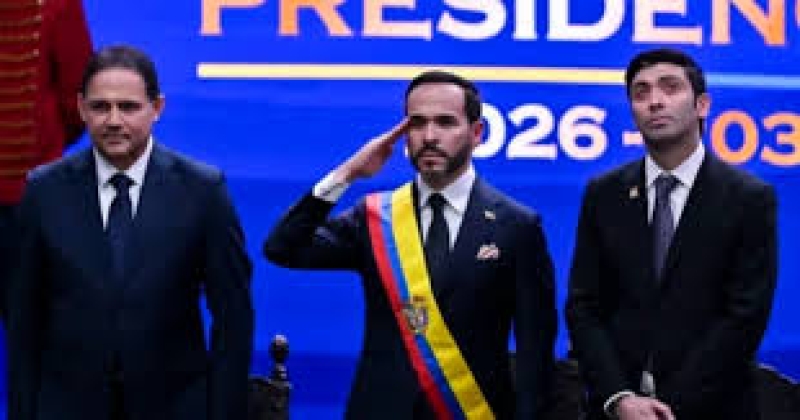
Conservative politician Abelardo de la Espriella was sworn in as Colombia’s president on Friday in the southwestern city of Cali rather than the capital, Bogotá. The unusual choice of location was intended to underscore his determination to take a tougher approach toward illegal armed groups active in the region.
De la Espriella, 48, takes over from Gustavo Petro after narrowly defeating Petro-backed candidate Sen. Iván Cepeda in the June 21 runoff election.
A political newcomer, De la Espriella entered the race as an outsider and financed his campaign largely with wealth earned through his work as a lawyer and businessman. His inauguration took place in a university auditorium in front of Congress, reflecting a broader political shift toward the right in Latin America.
Among the international figures attending the ceremony were Spain’s King Felipe VI, acting U.S. Attorney General Todd Blanche and FIFA President Gianni Infantino. Presidents from across Latin America, including Argentina’s Javier Milei, Ecuador’s Daniel Noboa and Chile’s José Antonio Kast, were also present.
Following the inauguration, De la Espriella planned to visit a military battalion in Cali to speak with troops. His objective was to strengthen the morale of security forces while sending a direct warning to armed groups in the region: surrender or risk being designated as military targets.
Known by the nickname “El Tigre,” or “The Tiger,” De la Espriella has promised to confront Colombia’s long-running security crisis by abandoning Petro’s strategy of negotiating with armed organizations. He has argued that the previous peace efforts have failed to bring lasting security.
Security was a major concern during the inauguration. Authorities established multiple checkpoints throughout the city, inspecting vehicles for possible suspects and explosives.
Control over lucrative illegal activities, including drug trafficking and illegal mining, remains a major source of conflict among several armed organizations. These include dissident groups that rejected the peace agreement signed a decade ago by the Revolutionary Armed Forces of Colombia, the Clan del Golfo criminal organization and the National Liberation Army, or ELN.
Regional Political Impact
De la Espriella, who holds both Colombian and U.S. citizenship, assumes office with support from U.S. President Donald Trump at a time when concerns over crime, migration and economic conditions are influencing politics across Latin America.
Glaeldys González, an Andes analyst with the International Crisis Group, said De la Espriella’s victory could further strengthen the conservative trend across the region and help solidify cooperation among right-wing governments as the number of left-leaning administrations declines.
De la Espriella has also said Colombia will join the “Shield of the Americas,” a regional initiative focused on combating drug trafficking that emerged from a summit hosted by Trump in March.
His foreign-policy plans include restoring diplomatic relations with Israel while cutting ties with Cuba and Nicaragua, countries he has described as “tyrannies.”
Petro Promises Strong Opposition
The new president is expected to encounter determined resistance from former President Petro, who initially refused to accept De la Espriella’s election victory and alleged that the results had been manipulated. Petro claimed that programmers interfered with thousands of vote-counting records. International observers and Colombian electoral authorities rejected those allegations.
Although Petro did not attend the inauguration, he said as he left the presidential palace Friday that he would respect the decision of Colombian voters.
Political analyst Sergio Guzmán said Petro is likely to become a forceful and outspoken opponent of the new administration as he attempts to maintain and expand his political influence.
Petro has called on social movements in southwestern Colombia to establish “people’s militias” to protect themselves against possible attacks by what he described as “fascists.” He has also urged supporters to prepare for a nationwide strike if the new government attempts to imprison him after he leaves office. The Associated Press reported in March that the U.S. Drug Enforcement Administration had identified Petro as a “priority target.”
Analyst Andrés Macías of Externado University warned that Petro’s rhetoric, combined with De la Espriella’s planned hard-line security policies, could increase the possibility of clashes during protests and lead authorities to respond more aggressively.
In Cali, where Petro remains popular and where Cepeda received strong support, student and social organizations held demonstrations. Protests were also reported in Bogotá and Barranquilla.
“We are defending our dignity and continuing the resistance, while making it clear that he did not win here,” 25-year-old Sebastián Ocampo told the AP during a demonstration in Puerto Resistencia, a residential district that became a focal point of the massive anti-government protests of 2021.
Amanda Castro, a 29-year-old merchant from southern Cali, said opinions in the city remain sharply divided, reports UNB.
“There are very divided opinions in Cali,” she said, adding that residents were hoping the demonstrations would remain peaceful.