

- Dhaka ranks 4th among world's most polluted cities this morning |
- Dhaka Launches Company-Operated Buses on Six Routes Today |
- FBI Blames North Korea for Record $6.3bn Binance Hack |
- Wage Board for Garment Workers to Be Formed Sunday |
- Mass mobilisation to secure river-water rights urged |
Protests Spread From France to Germany, Thousands Take to Streets
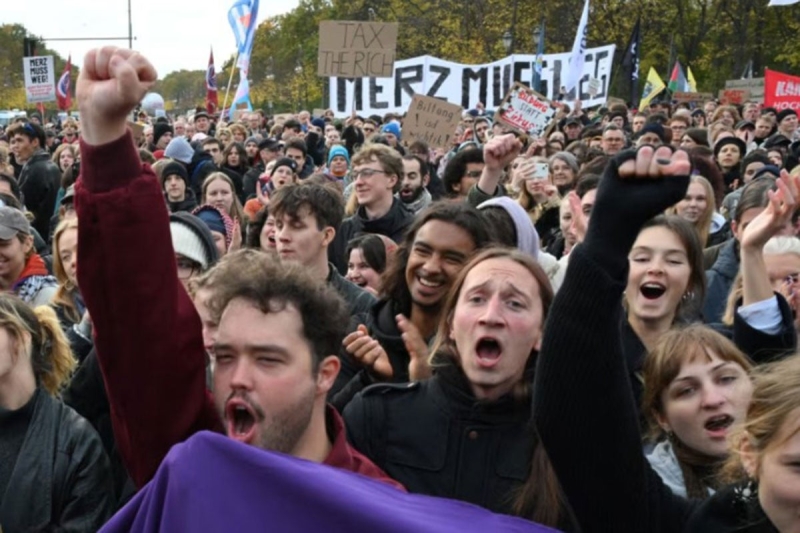
On Saturday in Berlin, participants chant slogans during a protest organized under the banner of the ‘Gen Z Has Got This!’ movement.
Protests over the rising cost of living, education funding shortages and government policies have spread across Europe, with mass demonstrations taking place in Germany and France on Saturday.
After weeks of unrest in France, the protest movement reached Germany, where around 120,000 people took part in demonstrations across several cities, according to organisers. Hundreds of thousands also took to the streets in France on the same day.
In Germany, the demonstrations were organised under the banner of a new youth-led movement called “Gen Z Has Got This!” Protesters voiced concerns over rising living costs, inadequate funding for schools and universities, environmental issues and the possibility of reintroducing compulsory military training.
Demonstrations took place in major cities, including Berlin, Frankfurt, Cologne and Munich.
While protests in Berlin remained largely peaceful, tensions escalated in Cologne and Hamburg. Police used water cannons in Cologne after fireworks were set off during a demonstration. In Hamburg, riot police were deployed following reports of barricades being set on fire and emergency workers being attacked.
In Frankfurt, petrol bombs were reportedly thrown at emergency personnel and shop windows were smashed. Police closed part of the city’s Zeil shopping street to contain the unrest. One suspect was detained after the window of a gun shop was broken, and two firearms were seized.
Organisers said around 120,000 people participated in demonstrations across Germany. Halloween was chosen as the date to encourage wider participation and increase public attention to the movement.
Meanwhile, France witnessed the third nationwide round of demonstrations under the Yellow Vest movement on Saturday, following earlier protests on October 17 and 24.
According to France’s Interior Ministry, around 320,000 people took part in Saturday’s demonstrations, including approximately 70,000 in Paris. The previous two rounds had drawn an estimated 550,000 and 410,000 participants, respectively.
The ministry said 296 people had been detained nationwide by 6pm on Saturday. An additional 70,000 security personnel were deployed across the country amid concerns about disorder.
Interior Minister Laurent Nuñez had announced that demonstrations would be permitted outside city centres.
Although most protests remained peaceful, clashes and vandalism were reported in several cities, including Bordeaux, Toulouse, Rennes, Lille, Nantes, Marseille and Lyon. In Rennes, reports included attacks on police, stone-throwing and arson.
France’s Interior Ministry said at least 1,193 police officers had been injured in the ongoing protests as of October 29.
The demonstrations in France began in late September with protests by school students demanding improvements to deteriorating educational facilities, action on teacher shortages, adequate learning materials and reforms to university admissions. The movement later expanded as people from different backgrounds, including participants in the Yellow Vest protests against rising fuel prices, joined the demonstrations.
During the October 17 protests, around 550,000 people reportedly took to the streets nationwide. More than 3,000 shops were attacked or looted, while over 2,700 people were arrested, according to the supplied account. President Emmanuel Macron described the situation as a “collective failure”.
Meanwhile, a coalition of labour organisations has called for a nationwide strike and demonstrations on November 5 to protest the rising cost of living, raising concerns that unrest in France could intensify further.