

- Republicans face midterm backlash over Trump's economic policies, Poll reveals |
- Waterlogging in Kumarkhali: Potential farm loss Tk35 crore annually |
- Substitute Ibrahim powers Bangladesh to 1-0 win over Bhutan in SAFF |
- Trump Threatens to ‘Destroy’ What Remains of Iran |
- Dhaka Among World's Four Most Polluted Cities on Friday |
Trump’s Economic Policies Fuel Republican Midterm Losses
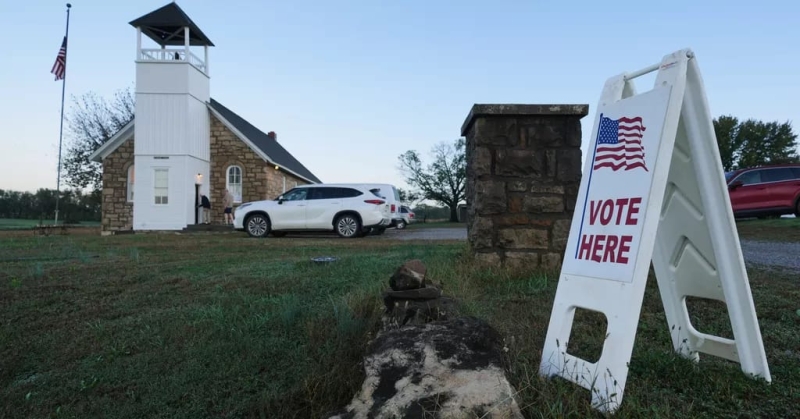
People arrive at a 148-year-old former one-room school house to vote Tuesday, Nov. 3, 2026, near Perry, Kan.
US President Donald Trump faced a major voter backlash over inflation and rising living costs as Republicans suffered significant losses in House, Senate and gubernatorial races in the midterm elections.
Most voters blamed Trump's policies for worsening inflation and increasing living costs, according to a nationwide survey of roughly 100,000 midterm voters.
The findings showed that the president's efforts to blame his predecessor, Democrat Joe Biden, for economic problems failed to convince many voters. Respondents expressed concern over the impact of Trump's tariffs and the rise in energy costs following the US war with Iran in February.
About two-thirds of voters said Trump's policies had contributed to inflation. By comparison, around half of voters in the 2022 midterm elections blamed Biden's policies for rising prices.
Voters across states from California to Mississippi broadly believed that Trump's tariffs on foreign imports had done more harm than good.
The election results reflected concerns that had been evident in opinion surveys for months, despite Trump's repeated claims that prices were falling.
“I’ve done a great job,” Trump said at one of his final midterm campaign rallies in Iowa. “Prices are coming way down.”
Voters express regret over Trump
Democratic victories in Tuesday's midterm elections indicated that many voters were dissatisfied with both the economy and Trump's leadership.
Consumer prices had risen 3.7 percent over the previous 12 months, compared with an inflation rate of 3 percent when Trump began his second term.
On Wednesday, Trump told reporters that the war with Iran had pushed up gasoline prices in the short term. However, he defended the decision to launch the war, citing Iran's nuclear ambitions.
“If I had to do it again, I'd have to do it again,” he said.
A Democratic majority in both chambers of Congress is not guaranteed to resolve the country's inflation problems. Addressing the issue could require bipartisan cooperation or policies that allow the Federal Reserve to continue bringing inflation under control through interest-rate decisions.
Nevertheless, voters showed a preference for Democratic candidates over the existing political arrangement, in which Republicans had controlled Congress with little resistance to the president.
Around nine in 10 voters said the cost of living was a crucial or major factor in their congressional vote. Approximately six in 10 of those voters supported Democratic candidates in their local House races.
Economic growth fails to ease concerns over AI
Despite widespread concerns about living costs, several indicators suggested that the US economy remained relatively strong. The S&P 500 stock index had gained more than 10 percent during the year, while unemployment stood at 4.2 percent.
Investors also reacted positively to news of Democratic victories, with stocks rising on Wednesday.
However, much of the economy's growth had been driven by investment in artificial intelligence, a sector that continued to raise concerns among voters.
Around six in 10 respondents said artificial intelligence would do more harm than good to society, reflecting fears that automation could eliminate jobs and that an AI investment bubble could threaten retirement savings.
Despite these concerns, only about one-quarter of voters considered AI a crucial factor in their election decisions.
Voters say economy favours the wealthy
The growing concentration of wealth among technology billionaires and other affluent Americans also emerged as a major concern.
Around seven in 10 voters said the economy favoured wealthy people, while only about three in 10 believed it was fair to ordinary Americans.
Even a majority of voters earning at least $300,000 annually in California, a major technology hub, felt that the economy was tilted towards the rich.
Despite concerns over inequality, a slight majority of voters held a somewhat or very favourable view of capitalism, compared with roughly one-third who expressed support for socialism.
Healthcare costs were another major issue. Around six in 10 voters said they wanted the government to play a bigger role in addressing medical expenses. Most respondents also believed Trump's policies had made healthcare more expensive.
Economic concerns vary by income
Voters' views of the economy differed significantly according to their income levels.
Among people earning less than $50,000 annually, around six in 10 said they were financially worse off than they had been two years earlier, before Trump began his second term.
Higher-income voters generally expressed more positive views of their financial situation. However, they were more concerned about the state of American democracy.
Around four in 10 households earning more than $200,000 annually identified democracy as their top issue, placing it roughly on a par with the economy.
By contrast, voters in most lower-income groups gave greater priority to economic concerns.
Government corruption was also a significant issue, with a slim majority of respondents saying it was a crucial factor in their congressional vote. Around half identified high prices as a crucial consideration.
Overall, most voters believed Trump's priorities were misplaced and said he was not fighting for people like them.