

- No Plan for Operation Clean Heart-Style Drive Now: Home Minister |
- Bangladesh Eyes $10b in UK Exports Through Diversification |
- 20 Bangladeshis Killed After Trafficking to Russia for War |
- Guterres proposes slimmer $3.3 billion UN budget for 2027 |
- President Proposes National Committee to Protect Minority Rights |
Jute harvesting progressing fast in Netrakona
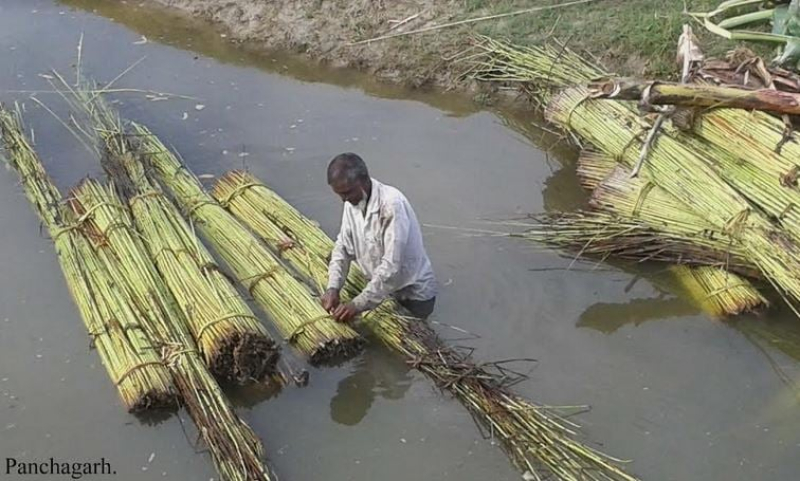
Harvesting of jute has atarted in 10 upazilas of Netrakona.
Harvesting of jute, the golden fibre of Bangladesh, in the current season is progressing fast in all 10 upazilas of Netrakona district.
The district is widely known as "huge jute producing region" of the country.The cultivation of jute has been increasing every year here and the growers are getting fair prices for their products.
Officials of Department of Agricultural Extension (DAE) told BSS that the jute cultivators are expecting satisfactory output as they are getting better yielding rates in everywhere of the district.
"Jute growers are not facing any problem or barriers for rotting their jute plants as all the natural water bodies including canals, beels, rivers and haors in the district are now full of waters due to widespread rainfall for the last fortnight," the official said.
Farmers could cultivated jute on 4,767 hectares of land in the district with the target for producing 48,180 bales of jute.
Of the total land, 764 hectares were brought under capsularies variety of jute, 421 hectares under Olitorious variety, 3,157 hectares under Kenaf
variety and 425 hectares of land under Mesta variety of jute, they added.
Meanwhile, jute growers have completed cutting of 35 percent of jute plants in the district and have drowned those into different water-bodies for
rotting the jute plants and collecting jute fibers, Mohammad Nuruzzaman, deputy director of the DAE, Netrakona, said while talking to BSS
correspondent.
Farmers could run their jute cultivation networks successfully as the weather condition was favorable and the different state-run agencies including BADC,
BCIC ensured supply of improved quality seeds and fertilizers to the door- steps of the cultivators following directives of the government, he said.
Apart from this, the corps specialists and field workers of the DAE here rendered their field-level service to let the jute growers know the modern
methods of jute cultivation and boosting jute production reducing the production costs, he informed.
"Ninety per cent of jute plants have already been harvested so far, and the rest of the jute plants will be harvested within a week," the DAE deputy
director said, adding that the newly-produced jute fibers will appear in different hat-bazers and markets of the district during the time.