

- Dhaka ranks world's third most polluted city this morning |
- Soldiers Guard Milan as Thousands Protest Across Europe |
- Cheese Industry Thrives In Thakurgaon Villages |
- Guterres alarmed at Israel’s sweeping closures after deadly Hebron attack |
- Bangladesh to Introduce New Law to Curb Extortion, IGP Says |
Jashore emerges as winter vegetable seedling hub
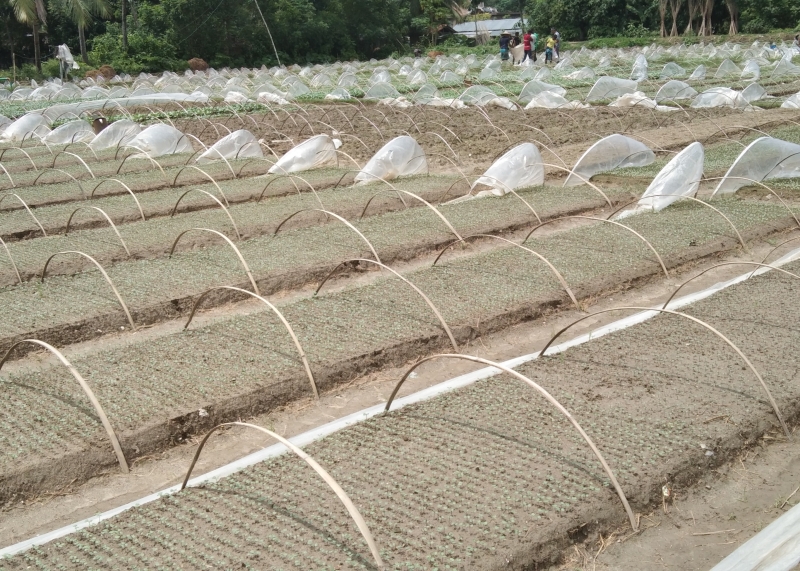
Jashore winter vegetable seedling hub.
Jashore, Oct 19 - At first glance, the white polythene canopies stretching across both sides of the road just 10 kilometres west of Jashore town resemble festive tents set up for a grand wedding.
A closer look, however, reveals a different celebration — one of soil, sweat and seedlings.
This vibrant landscape belongs to Abdulpur and Bagdanga villages in Jashore Sadar upazila, widely recognised as the country’s winter vegetable seedling capital, where a quiet agricultural revolution is underway.
As evening falls or rain begins, farmers cover the seedbeds to protect young plants. Some are busy sowing seeds, others watering the sprouts, while some uproot mature seedlings for sale.
Between 250 to 300 growers in Abdulpur and Bagdanga produce 20 to 25 crore vegetable seedlings over a six-month season, generating sales worth Tk 20 to 30 crore, according to local farmers.
These seedlings, including cauliflower, cabbage, broccoli, beet, turnip, tomato and chili, are distributed to nearly all 64 districts of Bangladesh.
From morning to dusk, farmers and traders from across the country flock to the area to collect high-quality seedlings, which have gained a reputation even in the most remote corners of the country.
Rekan Mia, a grower from Abdulpur, said seedling production began in the area around 20 years ago, but commercial-scale production has accelerated over the past decade.
He, however, noted that excessive rainfall this year disrupted several planting cycles, causing significant losses.
The rising prices of seeds, fertilisers, labour and polythene have added to farmers’ financial strain, he said, urging the government to provide financial assistance to help recover the losses.
Saddam Hossain, another grower from Bagdanga, pointed out their seedlings are sold both online and offline across the country. “Traders from different districts come to purchase seedlings directly. There’s also a dedicated seedling market at the Churamankathi bazaar in Sadar upazila, which attracts buyers nationwide,” he said.
Mamun Hossain shared current rates, noting that good-quality cauliflower seedlings sell for Tk 1,000–1,500 per thousand, while cabbage seedlings range from Tk 800-1,100 depending on quality.
“We produce all types of winter vegetable seedlings here. Commercial seedling cultivation has created employment for many locals. With proper government support, this sector can see further growth,” he added.
Women also play a key role in seedling production.
Sohana Khatun, a female worker in the sector, said many women like her work in the field for six months each year. Sowing begins in early July, and seedlings are ready for sale after about 45 days, continuing until February.
“We are paid Tk 35 for sowing each seedbed. On a full workday of 8–10 hours, we can earn Tk 500–700. For the seedling collection, we get Tk 550–600 per day,” she said.
Md Mosharraf Hossain, Deputy Director of the Department of Agricultural Extension (DAE) in Jashore, praised the seedlings from this region as “highly regarded nationwide.”
He said Abdulpur and Bagdanga alone produce Tk 20–30 crore worth of seedlings in just six months, with farmers earning Tk 20–25 crore during this period.
Dismissing allegations of official negligence, Mosharraf Hossain said the department actively provides technical assistance and market linkage support to seedling producers in the region. - UNB