

- RMG Unrest Costs 317 Factories $428m in 18 Days: BGMEA |
- Bangladesh Urges India to Begin Ganges Treaty Talks |
- COP31: A Failure of Climate Leadership in a Warming World |
- UN Climate Talks collapse over fossil fuel phaseout, warming limit deadlock |
- Bangladesh Plans Major Changes to Bank Board Rules |
Dhaka ranks 6th globally in air pollution Thursday morning
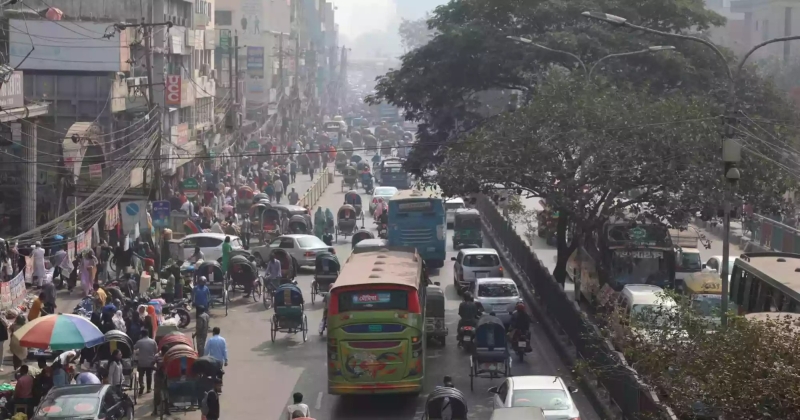
Air pollution in Dhaka on Thursday 8 October 2026.
Dhaka ranked 6th among the world's most polluted cities on Thursday morning, recording an Air Quality Index (AQI) score of 168 at 09:10am.
The air quality was classified as ‘unhealthy’, meaning the concentration of pollutants in the air had reached a level that could pose health risks to the general population, according to the AQI scale.
Kuala Lumpur in Malaysia ranked first with an AQI score of 225, while Lahore in Pakistan ranked second with a score of 207, followed by Kinshasa in the Democratic Republic of Congo in third place with an AQI score of 193.
According to AQI standards, a reading between 101 and 150 is considered 'unhealthy for sensitive groups', while 151 to 200 is classified as 'unhealthy'. A reading between 201 and 300 is considered 'very unhealthy', while levels above 301 are deemed 'hazardous', posing serious health risks.
The AQI provides daily updates on air quality, indicating how clean or polluted the air is and highlighting potential health impacts.
In Bangladesh, the AQI is calculated based on five major pollutants: particulate matter (PM10 and PM2.5), nitrogen dioxide (NO2), carbon monoxide (CO), sulfur dioxide (SO2) and ozone.
Dhaka has long struggled with air pollution, with air quality typically deteriorating during winter and improving during the monsoon season.
The World Health Organization estimates that air pollution causes around seven million deaths globally each year, mainly from stroke, heart disease, chronic obstructive pulmonary disease, lung cancer and acute respiratory infections. - UNB