

- Around 7,500 Bangladeshis imprisoned in Saudi Arabia: Shama Obaed |
- Bangladesh Outperforms India in Global Hunger Index 2026 |
- Covered van hits Gazipur police patrol team, killing SI, BNP leader |
- Korean City scrambles to rescue dusky shark after it returns to canal |
- PM inspects Mongla Port, Sundarbans, proposed economic zone |
Major Nature Finance Shift Needed to Protect Ecosystems
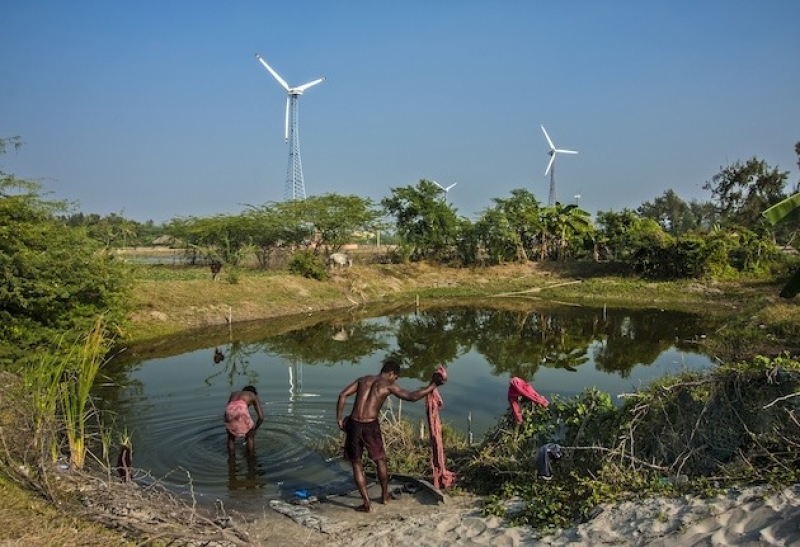
Two men at a pond wash and bathe in the shadow of wind energy in West Bengal Country, India.
The world is pouring trillions of dollars each year into activities that destroy nature while investing only a fraction of that amount in protecting and restoring the ecosystems on which economies depend, according to a new United Nations report released today (January 22).
The State of Finance for Nature 2026 report by the United Nations Environment Programme finds that finance flows directly harmful to nature reached USD 7.3 trillion in 2023. By contrast, investment in nature-based solutions amounted to just USD 220 billion in the same year. The imbalance means that for every dollar invested in protecting nature, more than USD 30 is spent degrading it.
“Globally, finance flows continue to be heavily skewed toward negative activities, which threaten ecosystems, economies and human well-being,” the report, titled Nature in the Red: Powering the Trillion-Dollar Nature Transition Economy, says. Nearly half of global economic output depends moderately or highly on nature, yet current financial systems continue to erode what the authors describe as humanity’s collective nature bank account.
Nathalie Olsen of UNEP’s Climate Finance Unit and the report’s lead author said the barriers to reforming environmentally harmful subsidies are primarily political and structural rather than economic.
“Our report identifies several key challenges in this regard. On the political front, entrenched interests pose a significant obstacle. Many harmful subsidies benefit powerful industries, such as fossil fuels and industrial agriculture, which actively resist change,” she said in an exclusive interview with IPS.
She added that subsidy reform often leads to increased costs for consumers or producers in the short term, making such reforms politically unpopular even when the long-term benefits are clear. Furthermore, many subsidies are deeply embedded within tax codes and budget structures, making them difficult to isolate and reform.
According to Olsen, structural challenges also play a crucial role. She said subsidies tend to create path dependency, establishing business models and infrastructure investments that lock in nature-negative practices.
“For instance, free or underpriced water can lead to the depletion of aquifers for irrigation, while fossil fuel subsidies artificially lower energy costs across the economy, including for products like fertilizers. Despite international commitments, such as Global Biodiversity Framework Target 18—which aims to reduce harmful incentives by at least USD 500 billion per year—implementation remains weak due to a lack of political will.”
Economically, however, the case for reform is strong, Olsen said. Reforming harmful subsidies would free up government resources for nature-positive investments and reduce economic risks.
“Currently, the USD 2.4 trillion in public environmentally harmful subsidies far exceeds the USD 220 billion invested in nature-based solutions. Successful reform is feasible. As highlighted in our Nature Transition X-Curve framework, it requires just transition strategies to support workers and businesses during the shift, clear communication about long-term economic benefits, concurrent investment in nature-positive alternatives, and gender-responsive approaches to ensure equitable outcomes,” she said.
Olsen said notable examples—such as Costa Rica’s fossil fuel levy financing reforestation and Denmark’s energy taxes supporting the transition to wind energy—demonstrate that reform is politically achievable when accompanied by visible investment in sustainable alternatives.
The report warns that business as usual will deepen ecosystem degradation and expose economies to rising risks. It argues that governments, businesses, consumers and investors still have the power to redirect capital flows and unlock resilience, equity and long-term growth if they act quickly.
In 2023, public and private finance that directly damaged nature totaled USD 7.3 trillion. About USD 2.4 trillion came from public sources, mostly in the form of environmentally harmful subsidies, including USD 1.1 trillion for fossil fuels and around USD 400 billion each for agriculture and water use.
Private finance accounted for about USD 4.9 trillion. Utilities alone received around USD 1.6 trillion, followed by industrials at USD 1.4 trillion, energy at about USD 700 billion, and basic materials—including fertilizers and agricultural inputs—at a similar level.
The report notes that public subsidies and private investment often reinforce each other, locking capital into nature-negative sectors. Below-market prices for water, energy and other government-provided goods encourage overuse of natural resources and increase financial risks over time.
Against this backdrop, finance for nature-based solutions remains limited. Total global spending on nature-based solutions reached USD 220 billion in 2023, a modest five percent increase from the previous year. Public finance dominated, accounting for about USD 197 billion, or roughly 90 percent of the total.
“Our Nature Transition X-Curve framework shows these tools work best when deployed together—combining regulatory ‘push’ with financial ‘pull’. Over 730 organizations representing USD 22.4 trillion in assets have adopted TNFD, showing willingness exists when clear frameworks are provided. The challenge isn’t a lack of tools—it’s political will to deploy them at scale,” Olsen said.
To meet global commitments under the three Rio Conventions, annual investment in nature-based solutions must rise to USD 571 billion by 2030 and reach approximately USD 771 billion by 2050, the report estimates.
The authors argue that increasing investments alone will not suffice unless harmful finance is eliminated. Nature-negative finance, they say, remains the single biggest obstacle to a transition toward nature-positive outcomes.
“This is not just an environmental agenda but an economic transformation,” the report concludes. Without a decisive shift in how money flows through the global economy, the gap between what nature needs and what it receives will continue to widen, with profound consequences for ecosystems, livelihoods and long-term economic stability.