

- ADP Implementation Hits Five-Year Low at 1.85% |
- NYC BNP leaders, activists upbeat ahead of Tarique Rahman’s arrival |
- PM off to New York to attend UNGA |
- 8 Killed in Ashulia Garment Factory Fire |
- Apratim Murder Suspects Confessed, Says Home Minister |
No Indian electricity corridor thru Bangladesh sans reciprocity: CNI
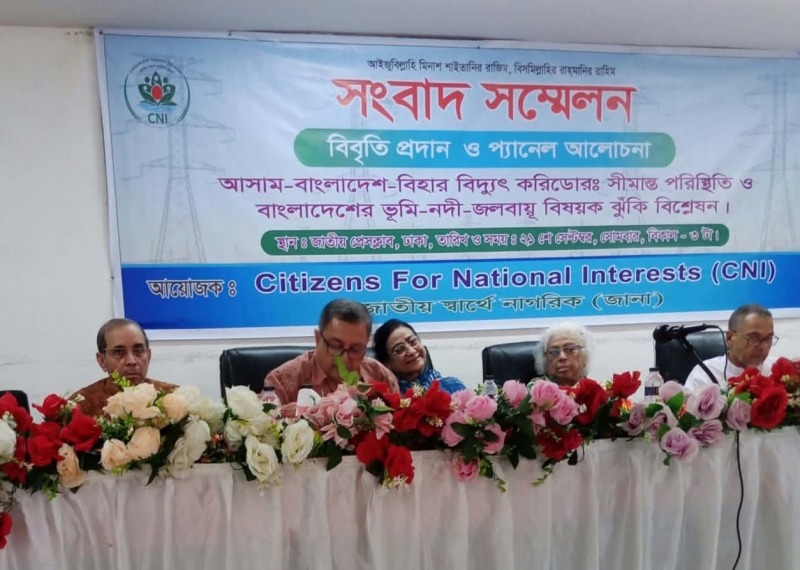
Speakers of the Citizens for National Interests (CNI) at the press briefing held at the National Press Club on Sunday 21 September 2026.
CNI (Citizens for National Interest) on Sunday opposed the proposed 765 kV Indian electricity transmission corridor passing through Bangladesh.
Addressing a press briefing at the National Press Club CNI leaders said they do not oppose regional infrastructure development out of hand. However, they reject asymmetric concessions and demands that do not respect national sovereignty, cross-border water rights, and territorial security.
Reita Rahman, chief of CNI presided over the briefing which was addressed among others by political scientist Prof Dilara Chowdhury, Nurul Huda Chowdhury, secretary general of CNI, Maj Gen Ehteshamul Huq (retd), Dr. Captain M Rezaul Karim Chowdhury (retd), Prof. Abdul Latif Masum, Journalists Mostafa Kamal Majumder and Elahi Newaz Khan, diplimat Sakib Ali and IH Khan of Janata Dal among others.
The press briefing presented a fact-based civil society position on the proposed 765 kV Indian electricity transmission corridor that maps a route across Katihar (Bihar) – Parbotipur (Bangladesh) – Bornagar (Assam).
The project initiated via a joint state statement on October 5, 2019, advanced through Indian Ministry of Power clearances to target a completion timeline of October 2028.
CNI says that this corridor relieves India's strategic bottleneck at the Siliguri Corridor ("Chicken's Neck")—a narrow strip of land 17 to 22 kilometers wide connecting mainland India to its northeastern states. But Bangladesh is essentially to provide a strategic geographical bypass.
CNI highlights a critical gap between infrastructure cooperation and hostile border enforcement. While Bangladesh is to offer its land for Indian power transmission, its citizens face escalating, extrajudicial border actions. According to government data, at least 2,300 individuals were forcibly pushed back into Bangladesh between May 2025 and January 2026, drawing formal protests from the Border Guard Bangladesh (BGB).
Global watchdogs like Human Rights Watch and media outlets like the BBC and Al Jazeera have documented instances of Indian security forces conducting deportations "at gunpoint," targeting individuals without formal legal or judicial verification processes.
Additionally, CNI points out the reality of asymmetric connectivity. While Bangladesh has granted India extensive transit rights and access to the Chittagong and Mongla ports, reciprocal sub-regional connectivity for landlocked nations like Nepal and Bhutan remains structurally blocked by India.
Furthermore, devastating Himalayan flash floods in 2024 and 2025 serve as immediate environmental warnings against centralized grid reliance without climate risk assessments.
CNI demands that the Government of Bangladesh pause all project progression until a Seven-Point Charter is met. These conditions require: halting extrajudicial border pushbacks, transitioning the treaty into a multilateral framework (including Nepal, Bhutan, and China), ensuring absolute sovereign control over the domestic grid, securing unresolved water rights (including the Ganges Treaty expiring in 2026 and the Teesta), mandating the public release of impact assessments, guaranteeing fair transmission fees, and establishing a Himalayan-Bay of Bengal Development Council.
CNI leaders said, "No connectivity without equity, no corridor without security, no decision without transparency." The citizens of Bangladesh retain an absolute right to question and participate in these discourses, and CNI will remain a vocal guardian of that right, they added.
GreenWatch Desk