

- Bangladesh Steps Up Anti-Trafficking Efforts, US Says |
- Cheap reading glasses remain key conduit to better quality of life |
- ডিপি ওয়ার্ল্ডকে বাংলাদেশে বিনিয়োগের আহ্বান প্রধানমন্ত্রীর |
- Putin offers to help end Iran war in meeting with Pezeshkian |
- Fired OpenAI Researchers Say Dismissals Chilled Safety Efforts |
BMU allocates Tk 1,039 cr budget, research gets only Tk 28 cr
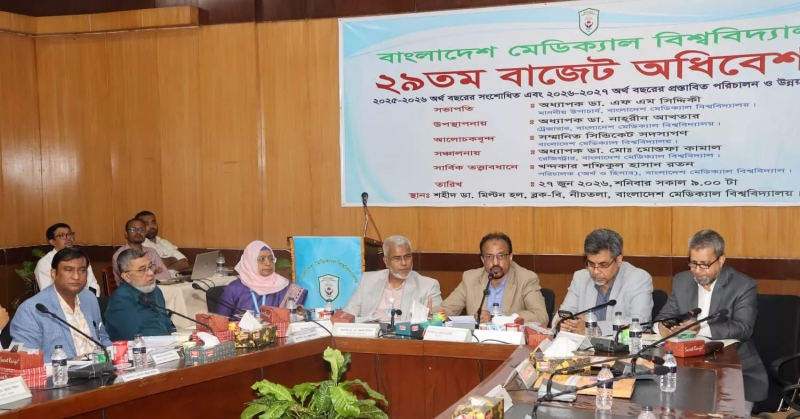
Bangladesh Medical University (BMU) on Saturday announced a Tk 1,039.54 crore budget for the 2026-27 fiscal year, prioritising cancer care, free medicines, quality healthcare, medical education and training, although the allocation for research accounts for only Tk 28.05 crore.
The budget was approved at the university's 100th Syndicate meeting chaired by Vice-Chancellor Prof Dr FM Siddiqui before being announced at a press conference held at Shaheed Dr Milton Hall.
Of the total budget, Tk 634.80 crore will come from the Ministry of Health and Family Welfare, Tk 136.28 crore from the University Grants Commission (UGC) and Tk 163 crore from BMU's own income. The university expects a budget deficit of Tk 105.46 crore, which officials said would be addressed through a revised budget later.
Presenting the budget, BMU Treasurer Prof Dr Nahreen Akhter said the theme of this year's budget is "Building a Healthy Bangladesh for the Future." She said the budget was prepared under a cost-control and cost-reduction policy with emphasis on ensuring healthcare based on need rather than patients' financial capacity.
The budget gives priority to curriculum modernisation, digital classrooms, e-learning, electronic medical records (EMR), modern medical equipment and free medicine distribution.
However, despite identifying research as a major priority, only Tk 28.05 crore has been earmarked for research, significantly lower than several other major expenditure heads.
According to Director (Finance and Accounts) Khandaker Shafiqul Hasan Ratan, the budget allocates Tk 90 crore for modern medical equipment, Tk 76 crore to install and operationalise three linear accelerator machines for cancer treatment, including replacement of a non-functional unit, Tk 20 crore for free medicines, Tk 18 crore for improving patients' nutrition, Tk 7 crore for EMR, Tk 5 crore for information and communication technology, Tk 2.10 crore for training and Tk 227.47 crore for students' scholarships and stipends.
Alongside the operational budget, BMU also announced several development initiatives, including an accredited laboratory and research centre at the old Betar Bhaban, a Bone Marrow Transplantation Centre, a Hepatobiliary and Liver Transplant Centre at the Super Specialised Hospital, a Central Stem Cell and Research Centre, and the second phase of population-based cervical and breast cancer screening with electronic data tracking.
The development budget also includes a proposal to construct a multipurpose residential hall for students, subject to land allocation, reports UNB.