

Wednesday, October 14, 2026
News update
- Disasters Cause $228 Billion in Annual Housing Losses |
- UN Expert Warns Global Action to Protect Children Is Lagging |
- Petrobangla Extends Offshore Oil, Gas Bidding Deadline to 2027 |
- Bangladesh Seeks Additional $10b From World Bank |
- Fire at Chawkbazar market under control, four firefighters injured |
Climate Hazards Disrupt Schooling for 171m Students in 2025
GreenWatch Desk:
Children
2026-09-10, 10:19am
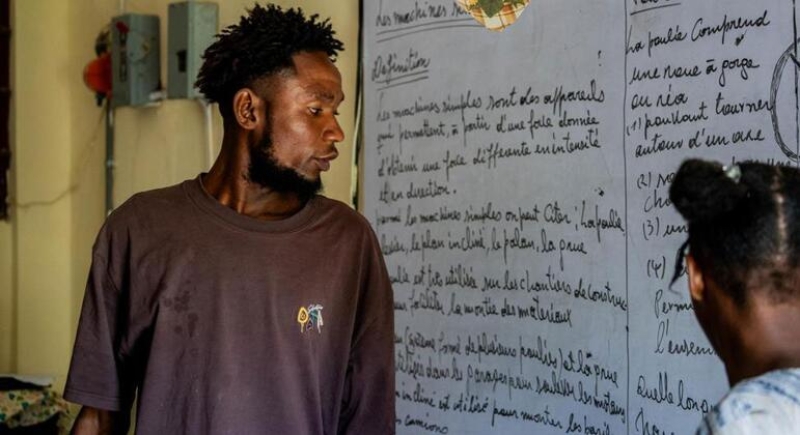
A teacher in Haiti explains a scientific concept to his students.
Climate-related hazards disrupted schooling for an estimated 171 million students worldwide in 2025, affecting roughly one in 10 students from preschool through the end of high school, according to a new UNICEF report.
Storms were the most common cause of disruption, affecting 109 million students, followed by floods and heatwaves.
The hazards forced schools to suspend classes, damaged educational facilities, shifted learning online, reduced instructional time and attendance, and increased the risk of students dropping out.
In Papua New Guinea, 16-year-old Taudibura Garo and her classmates have experienced the effects of flooding firsthand. When a creek beside their school floods, water rises through the school's pit toilets, making the premises unsafe and forcing students to leave before completing their lessons.
“Usually, the water comes up to our knees and floods the pit toilets, then it becomes unhealthy for us to stay at school, and we miss the lessons we are supposed to learn,” she said.
The report warns that the risks could increase as extreme weather intensifies. In Papua New Guinea, for example, a stronger-than-usual El Niño pattern is expected to raise the risk of extreme weather in the coming months.
Poorest countries hardest hit
Although students across all income groups experienced climate-related disruptions, about three-quarters of those affected live in low- and lower-middle-income countries.
UNICEF said education systems in these countries often lack the resources and infrastructure needed to protect learning during climate emergencies.
Pakistan was among the countries most severely affected. Severe monsoon floods in August delayed the return to school for more than 28 million students, making it one of the largest climate-related disruptions to education recorded in 2025.
In Egypt, a powerful Khamsin wind and dust storm led to a nationwide suspension of classes for one day in April, also affecting more than 28 million students.
Girls face greater risks
Girls are more likely than boys to drop out when climate hazards disrupt or close schools, the report found.
When schools and sanitation facilities are damaged and families are displaced or lose income, girls often take on additional caregiving and water-collection responsibilities.
These pressures can also increase the risk of child marriage, making it more difficult for girls to return to school after classes resume.
“For millions of children, climate hazards do more than disrupt lessons, they destroy schools, uproot families, and push the most vulnerable children, especially girls, out of the classroom for good,” said UNICEF Executive Director Catherine Russell.
Long-term consequences
The disruption could have significant economic consequences. UNICEF estimates that students affected by climate-related school disruptions in 2025 could collectively lose at least $200 billion in lifetime earnings.
At the broader economic level, learning losses and increased dropout rates can reduce workforce productivity, slow economic growth and make it more difficult for countries to reduce poverty.
UNICEF is calling on governments to invest more heavily in climate-resilient schools, education systems and infrastructure to protect children's access to learning during increasingly frequent climate emergencies.