

- Japan views Bangladesh as key dev partner: Jamaat Ameer |
- Credit cards emerge as a financial lifeline for middle-class |
- Call for a radical shift to solar, LNG to overcome energy crisis |
- Measles Death Toll in Children Surpasses 350 |
- Global Eid on Same Day ‘Not Practical’: Mufti Malek |
Pacific Communities Blend Tradition for Climate Action
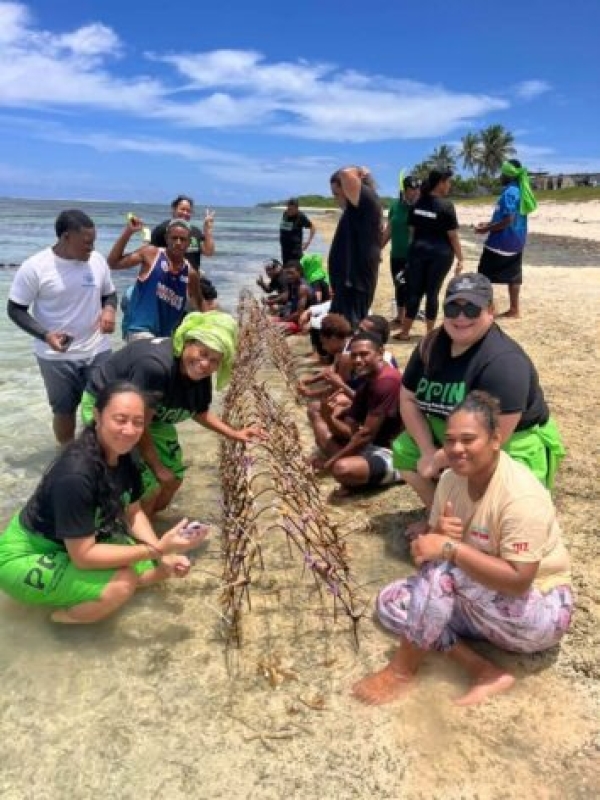
Mangroves, reefs and coastal ecosystems are more than natural assets — they are frontline climate solutions. Across Pacific villages, including Naidiri on Fiji’s Coral Coast, these systems are helping reduce erosion, protect livelihoods and support long-term resilience.
Climate change is no longer a distant threat. Across the Pacific, it is a daily reality reshaping coastlines, livelihoods, and the fragile balance between people and the environment. But in a region long defined by resilience, solutions are not being newly invented. They are being remembered, strengthened, and scaled.
Nature-based solutions (NbS), approaches that use ecosystems to address climate, disaster, and development challenges, have long existed in Pacific communities. For generations, villages have relied on mangroves, agroforestry, and customary practices to protect land and sustain livelihoods. But as climate impacts intensify, the scale and speed of change demand more coordinated action.
A new regional effort is now working to bridge the gap between tradition and modern policy.
The Pacific Community’s Promoting Pacific Islands Nature-based Solutions (PPIN) project is designed to connect community knowledge with the systems that guide development and investment.
Dr Rakeshi Lata, Training and Capacity Building Officer for Nature-based Solutions at SPC, said the project is not about replacing traditional knowledge but elevating it.
“It functions as a bridge, connecting community practices with national policies to secure resources and scale up proven local methods,” Lata said.
At its core, PPIN challenges a long-standing imbalance in development thinking, where engineered “grey” infrastructure is prioritised while nature is treated as secondary.
“More specifically, PPIN addresses the fact that Pacific countries are highly vulnerable to climate change, disasters, and ecosystem degradation, yet development decisions still prioritise grey, engineered solutions while nature is treated as secondary or only an environmental issue,” Lata added.
This disconnect is especially clear in the Pacific, where people’s lives, cultures, and economies are closely tied to the natural environment. When ecosystems fail, communities feel the impact immediately through food insecurity, coastal erosion, and increased disaster risk.
Yet despite the proven value of nature-based solutions, their adoption remains limited, often fragmented, underfunded, and restricted to small pilot projects.
“There is limited policy integration, technical capacity, economic evidence, and financing to make NbS ‘business as usual’ across sectors such as infrastructure, finance, agriculture, forestry, fisheries, and tourism,” she said.
That gap between local success and national scale is where PPIN steps in.
Importantly, the project rejects the idea that traditional knowledge and modern science are in competition.
“The core philosophy of PPIN is that traditional knowledge and modern policy are not opposing forces but complementary strengths. This project aims to formalise what communities have already practised successfully for centuries,” she said.
“PPIN actively incorporates modern science to strengthen traditional approaches.”
Across Fiji, Vanuatu, and Tonga, this integration is already visible not in theory but in practice.
Mangrove restoration, for example, is being used to reduce coastal erosion and storm surges, offering a natural alternative to costly seawalls. During Cyclone Vaiana in Fiji, boats sought shelter within mangrove systems, shielded from powerful winds and waves, an example of ecosystem-based protection delivering real-time resilience.
These mangroves also trap sediment, protecting downstream communities and coral reefs without the need for concrete infrastructure.
In rural areas, traditional agroforestry systems are being strengthened by combining trees and crops to improve soil stability, enhance food security, and build drought resilience. These systems reduce the need for engineered irrigation and land stabilisation while maintaining ecological balance.
Despite these successes, scaling such solutions has historically been difficult. Fragmented governance, siloed implementation across ministries and NGOs, and limited technical capacity have slowed progress.
PPIN is designed to remove these barriers.
“A central pillar of PPIN is targeted capacity-building, which includes training programmes and communities of practice. It also establishes peer-to-peer learning networks across sectors to foster continuous knowledge exchange and collaboration,” she said.
Beyond policy integration, the project is investing in people, particularly those closest to the land.
Training programmes, including Farmers’ Field Schools and coastal resilience initiatives, focus on practical, livelihood-based applications of NbS. Participants gain hands-on skills in climate-smart and organic farming, linking ecosystem health directly to food production and household wellbeing.
The response has been strong. Women make up more than half of participants, with over 80 out of 146 involved, while youth and community practitioners are also actively engaged.
As the project moves toward completion, its legacy is already taking shape not only in outcomes but also in systems designed to last.
“To ensure sustainability and long-term accessibility, materials from trainings, technical guidance, and needs assessment findings are being consolidated and hosted within a regional NbS knowledge hub led by SPREP,” Lata said.
“This hub provides a single, trusted platform where governments, practitioners, communities, women, and youth can access PPIN resources.”
But perhaps its most lasting impact will be less visible and more powerful.
“Beyond materials, PPIN leaves behind strengthened regional networks and communities of practice, which will continue to connect practitioners across countries and sectors.”
In a region on the frontline of climate change, the future may not lie in choosing between tradition and science but in weaving them together.
Because in the Pacific, resilience has never been built on a single system. It is carried across generations, across knowledge systems, and now increasingly, across policy and practice.