

- Increased hilsa arrival brings down its prices in Chandpur |
- Nepal Glacier Collapse Offers Climate Warning for Bangladesh |
- Dhaka air quality remains ‘unhealthy for sensitive groups’ Thurssday |
- Non-performing loans surpass Tk 6 lakh crore |
- Non-performing loans surpass Tk 6 lakh crore |
Nepal Glacier Collapse Offers Climate Warning for Bangladesh
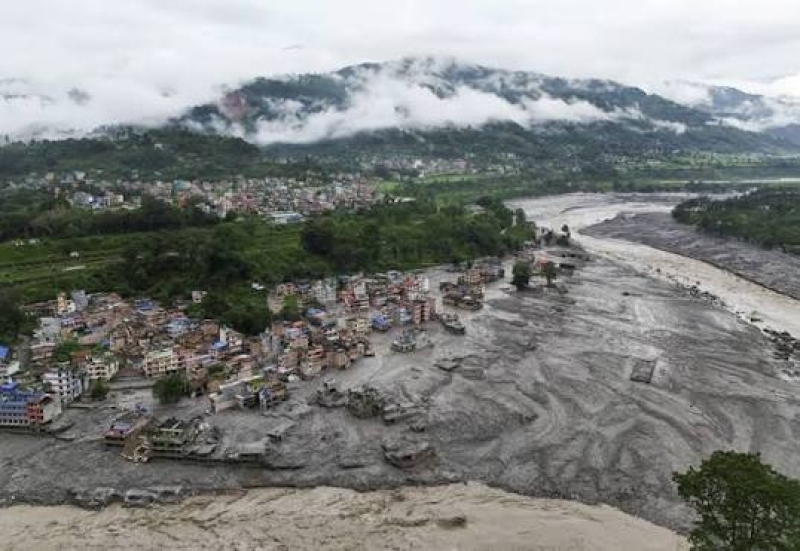
The catastrophic glacier collapse in Nepal’s Himalayan region has highlighted the growing risks posed by a warming climate to mountain ecosystems and downstream communities across South Asia, including Bangladesh.
On August 26, a massive section of ice and rock collapsed near Langtang Lirung along the Nepal-China border, triggering a devastating flash flood and debris flow. The torrent swept through river valleys, destroying bridges, roads, settlements and hydropower infrastructure in parts of Nepal and Tibet. Satellite imagery has since revealed the scale of the destruction.
The disaster occurred after a glacier and the underlying mountain slope collapsed into the Lhende Khola river. The resulting surge of water, ice, mud and rocks travelled for nearly 100 kilometres downstream, dramatically altering river channels and causing widespread destruction.
Although Bangladesh is unlikely to experience a direct repeat of the Nepal disaster, experts say the event offers an important warning for countries downstream of the Himalayas. The region is warming rapidly, increasing the risks associated with glacier retreat, permafrost thaw, landslides and sudden glacial floods.
From Himalayan Rivers to Bangladesh
Nepal’s Trishuli and Bhote Koshi river systems are part of the wider Ganges basin. Water from the Himalayan rivers eventually contributes to the Ganges system, which enters Bangladesh as the Padma.
However, the scale and distance involved mean that the destructive force of a sudden glacier-related flood in Nepal would be greatly diminished before reaching Bangladesh. The more significant concern for Bangladesh is the broader impact of changing Himalayan conditions on the region’s interconnected river systems.
Large quantities of sediment carried downstream can alter river channels and affect riverbank stability and water-carrying capacity. Such processes can contribute to longer-term flood and erosion risks, although the extent of any impact on Bangladesh would depend on the location, scale and hydrological characteristics of individual events.
A Warning About Cascading Disasters
Climate and disaster experts say the Nepal catastrophe demonstrates how several hazards can develop in rapid succession.
A glacier or mountain slope can collapse, blocking a river and creating a temporary natural dam. If that barrier subsequently fails, a powerful surge of water and debris can move downstream within minutes, leaving little time for conventional flood warnings.
The European Space Agency said the August 26 disaster was triggered by a rapid slope failure associated with the collapse of a glacier near Langtang Lirung. The resulting torrent travelled almost 100 kilometres downstream, carrying water and debris through the Lende Khola and Trishuli river valleys.
This makes conventional rainfall-based flood forecasting insufficient for some mountain hazards. Monitoring glaciers, unstable slopes and temporary river blockages is increasingly important for effective early-warning systems.
Where Bangladesh Faces Future Risks
For Bangladesh, the most important lesson is the need to strengthen monitoring and preparedness across transboundary river basins.
The country itself does not have the massive high-altitude glaciers and steep Himalayan terrain seen in Nepal. Its direct exposure to a Nepal-style glacier collapse is therefore limited.
However, similar hazards could emerge in other parts of the Hindu Kush Himalaya, including areas feeding the Teesta, Brahmaputra and Meghna river systems. A major landslide, glacial lake outburst flood or sudden blockage of an upstream river could potentially create rapid changes in downstream water levels.
Scientists have warned that rising temperatures and the retreat of glaciers and permafrost are increasing instability across high-mountain regions. The recent Nepal disaster has renewed calls for stronger monitoring, regional cooperation and early-warning systems.
Need for Regional Cooperation
The disaster also underscores the importance of real-time information sharing among countries that share Himalayan river systems.
For Bangladesh, stronger cooperation with India, Nepal, Bhutan and other regional partners could help improve access to hydrological, satellite and hazard-monitoring data.
Early warnings based not only on rainfall and river levels but also on glacier movement, landslides and sudden changes in upstream river conditions could give downstream communities more time to prepare.
Preparing for a Warmer Himalaya
Nepal’s latest disaster is therefore more than a single catastrophic event. It is a reminder that climate change can intensify interconnected hazards across mountain and downstream regions.
For Bangladesh, the priority should be strengthening climate adaptation, improving river and sediment management, expanding real-time monitoring and developing stronger regional early-warning mechanisms.
As the Himalayas continue to warm, preparing for sudden and cascading mountain hazards will become increasingly important for the entire South Asian river system.