

- Govt to cut savings certificate profit rates from January |
- Gold prices hit fresh record in Bangladesh within 24 hours |
- Election to be held on time, Prof Yunus tells US Special Envoy |
- Moscow wants Dhaka to reduce tensions domestically, also with Delhi |
- Saarc experts meet to reduce livestock-origin greenhouse gases |
Saarc experts meet to reduce livestock-origin greenhouse gases
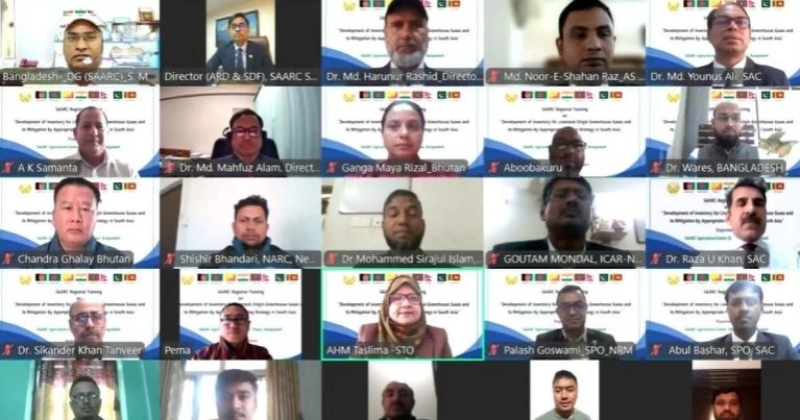
SAARC experts meet virtually to deal with livestock-induced greenhouses gases._11zon
Dhaka, Dec 22 :A three-day Saarc regional training on development of inventory for livestock origin greenhouse gases and its mitigation by appropriate feeding strategy in South Asia, began on Monday (22 December 2025) in virtual mode.
The event brings together policymakers, scientists and development professionals from South Asian countries.
The training is being organized by the Saarc Agriculture Centre (SAC) with the objective of strengthening regional capacity to assess livestock-origin greenhouse gas emissions and promote practical mitigation measures through improved feeding strategies.
The Chief Guest, SM Mahbubul Alam, Director General (Saarc and BIMSTEC) at the Ministry of Foreign Affairs, highlighted the growing importance of climate-smart livestock practices in regional and global policy discussions.
He noted that South Asia must align its livestock development strategies with international climate commitments while safeguarding the interests of smallholder farmers.
He also emphasized that regional cooperation and evidence-based policymaking are essential for achieving sustainable and inclusive growth in the livestock sector.
Tanvir Ahmad Torophder, Director (ARD & SDF) at the Saarc Secretariat in Nepal, spoke as Special Guest and reaffirmed Saarc’s commitment to promoting regional cooperation in climate-resilient agriculture and sustainable livestock development.
He emphasized that capacity-building initiatives such as this training are vital for achieving shared regional goals under climate change adaptation and mitigation frameworks.
Dr. AK Samanta, Assistant Director General (Animal Nutrition and Physiology), ICAR, India, attended as guest of honour and stressed the need to integrate nutrition research with national inventory systems and policy planning.
The keynote address was delivered by Dr. Nitin Tyagi, Principal Scientist, ICAR–National Dairy Research Institute, Karnal, India.
Speaking on the challenges and mitigation of livestock-origin greenhouse gases in South Asia, he pointed out that smallholder-dominated production systems, low-quality feed resources and limited data availability remain major constraints.
Dr. Md. Younus Ali, Senior Program Specialist (Livestock), SAC, presented the training overview and objectives.
He explained that the program aims to familiarize participants with internationally recognized methodologies for greenhouse gas inventory development, especially those recommended by the Intergovernmental Panel on Climate Change.
Dr. Md. Harunur Rashid, Director, SAC, in inaugural speech highlighted the critical role of livestock in ensuring food security, nutrition and rural livelihoods in South Asia.
He mentioned that the sector is also a significant contributor to greenhouse gas emissions, particularly methane and nitrous oxide. Emphasizing the need for balance, he stressed that reliable emission inventories and science-based feeding interventions are essential to reduce environmental impacts without compromising productivity. - UNB