

- Dhaka ranks 6th among world’s most polluted cities |
- Journalism Plays Critical Role in Disaster Response: UN |
- Iran Launches Fresh Ballistic Missile Attack On UAE |
- Only tourist police box on Kuakata beach about to disappear into sea |
- High Court Rejects Plea to Suspend Presidential Poll |
Dhaka Seeks Balanced, Mutually Beneficial Economic Ties With India
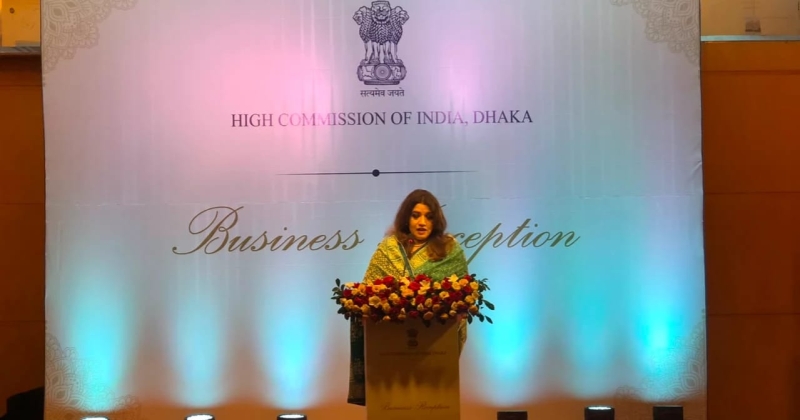
State Minister for Foreign Affairs Shama Obaed Islam.
State Minister for Foreign Affairs Shama Obaed Islam has said Bangladesh wants to build an economic partnership with India that is mutually beneficial and delivers tangible benefits for people in both countries.
“I am confident that the business communities of our two countries have both the vision and the capacity to make this happen. We can collectively identify practical solutions to the challenges,” she said at a reception in Dhaka on Tuesday night.
Indian High Commissioner to Bangladesh Dinesh Trivedi hosted the reception for leading Bangladeshi business leaders and a delegation from the Confederation of Indian Industry (CII).
CII Director General Chandrajit Banerjee and Indian Deputy High Commissioner Pawan Badhe also spoke at the event.
Earlier on Tuesday, Shama held discussions with Indian business leaders and said the meeting identified several issues affecting bilateral trade and investment.
“I have assured them that we will try our best to resolve those issues, and we want more vibrant trade, investment and communication between the two countries,” she said.
Shama stressed the need for greater predictability and ease of doing business, saying these would benefit businesses on both sides. She also called for faster issuance of business visas for Bangladeshis to facilitate more frequent travel and business engagement with India.
She said investment would be an important pillar of the future economic relationship and invited Indian companies to invest in Bangladesh, particularly in economic zones.
Bangladesh can offer Indian companies a large domestic market, a substantial industrial workforce, competitive production capacity and opportunities to connect with regional and global markets, she said.
“We would particularly welcome investments that bring technology, integrate local suppliers, and create employment,” Shama said.
She identified ready-made garments, textiles, jute and jute products, leather and footwear, pharmaceuticals, agro-processing, ceramics, plastics and light engineering as sectors where Bangladesh has competitive advantages.
Shama said bilateral trade has grown significantly but remains structurally imbalanced and below its potential.
She also pointed to non-tariff barriers, standards and testing requirements, procedural delays and infrastructure constraints as challenges affecting the movement of goods and services between the two countries.
She urged the Indian business community, particularly CII members, to share their experience with relevant authorities in India to help find practical solutions.
Indian High Commissioner Dinesh Trivedi said the private sector has an important role to play in strengthening Bangladesh-India ties.
“No government in the world can provide everything. It always needs the private sector,” he said.
Trivedi said people-to-people relations, employment, education and healthcare could be important areas for deeper cooperation.
He acknowledged that the two countries had faced difficulties in their relationship but said such challenges should not undermine their longstanding ties.
He described the desired relationship as a “partnership of equals” and said India’s Neighbourhood First policy reflects the importance New Delhi attaches to its ties with Bangladesh.
CII Director General Chandrajit Banerjee praised the reception received by the Indian delegation and expressed interest in creating more business opportunities between the two countries.
The 14-member CII delegation, led by Banerjee and comprising representatives of major Indian companies and institutions, concluded its visit to Dhaka on Wednesday.
During the visit, the delegation met senior Bangladesh government officials and explored opportunities for greater economic and commercial cooperation.