

- State Minister Amit urges global firms to join BD offshore bidding |
- Heart Disease Linked to 777 Daily Deaths in Bangladesh |
- US Tech Firms Eye Over $1b Investment in Bangladesh |
- Dhaka ranks 6th globally in air pollution on Tuesday |
- Netanyahu Secretly Visits UAE Amid Rising Regional Tensions |
Trump, Albanese Sign Minerals Deal to Counter China
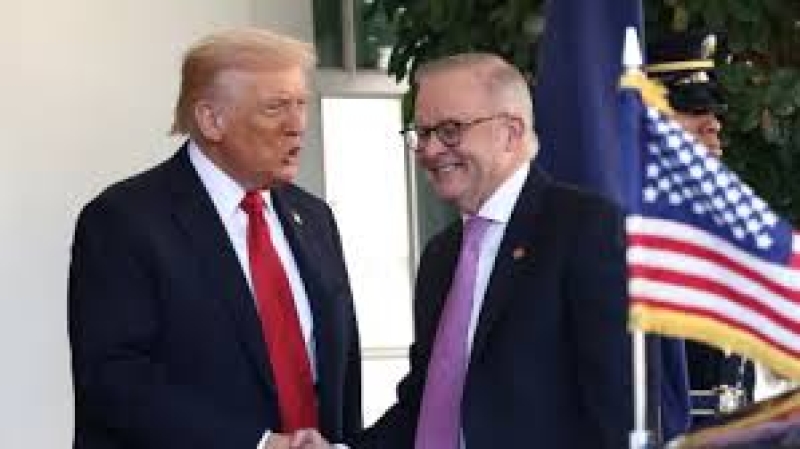
U.S. President Donald Trump and Australian Prime Minister Anthony Albanese signed a landmark critical minerals agreement on Monday, aiming to curb China’s dominance in the global supply chain for rare earths and essential industrial materials.
The agreement, signed during Albanese’s first official visit to the Trump White House, commits both countries to investing $1 billion each over the next six months to fast-track mining and processing projects. The deal sets a price floor for critical minerals and targets an estimated $53 billion in resource deposits—marking a significant escalation in Western efforts to diversify supply chains away from China.
Strategic Deal, Diplomatic Tension
Though the summit underscored deepening U.S.-Australia ties, it was not without tension. Trump, in a pointed moment during the meeting, called out Australia’s U.S. Ambassador Kevin Rudd—former prime minister—for past remarks. Referring to Rudd's 2020 criticism calling him “the most destructive president in history,” Trump quipped, “I don’t like you either, and I probably never will.”
Despite the jab, the leaders appeared aligned on strategic goals. Albanese described the agreement as an "$8.5 billion pipeline ready to go," while Trump said, “In about a year from now, we’ll have so much critical mineral and rare earths, you won’t know what to do with them.”
EXIM Bank Commits $2.2 Billion
The U.S. Export-Import Bank (EXIM) followed the announcement with more than $2.2 billion in letters of interest to support seven Australian mineral projects. Recipients include Arafura Rare Earths, Northern Minerals, Graphinex, Latrobe Magnesium, VHM, RZ Resources, and Sunrise Energy Metals.
These projects span essential minerals used in advanced defense systems, aerospace, communications, and next-gen industrial technologies. EXIM said the investments aim to support U.S. manufacturing and counter China's export dominance.
Pentagon Eyes Gallium Refinery
Separately, the U.S. Department of Defense plans to fund a gallium refinery in Western Australia, months after China blocked gallium exports to the U.S. Gallium is a critical component in semiconductors and radar systems.
The Trump administration is also pressing to simplify permitting processes for mining and processing facilities and to prevent the sale of critical mineral assets to foreign adversaries—an indirect reference to China’s global acquisitions, including its 2016 purchase of the world’s largest cobalt mine from U.S.-based Freeport-McMoRan.
Rare Earths, Strategic Supply Chains
The agreement comes as tensions rise ahead of Trump’s planned meeting with Chinese President Xi Jinping next week in South Korea. It also follows Washington’s sharp criticism of Beijing’s recent expansion of export controls on key minerals.
Critical minerals—including rare earths, lithium, and nickel—are essential to electric vehicles, smartphones, aircraft engines, and military hardware. China currently dominates the global supply chain, but Australia holds the world’s second-largest reserves.
As part of the deal, the U.S. and Australia will also collaborate on geological mapping, minerals recycling, and expedited licensing for mining operations.
Trump Backs AUKUS Submarine Pact
In a show of strategic alignment, Trump reaffirmed U.S. support for the AUKUS nuclear submarine pact—a $239 billion trilateral defense agreement signed in 2023 under President Joe Biden. The pact will see Australia purchase U.S. Virginia-class nuclear submarines and later co-develop new submarines with the U.K.
While the Trump administration had launched a review of the deal earlier this year, Trump now signals full backing: “There shouldn’t be any more clarifications. We’re going full steam ahead.”
Australia has committed $2 billion this year alone to support U.S. submarine production capacity and will begin hosting U.S. subs at its western naval base from 2027.
The summit, delayed by 10 months since Trump took office, was closely watched in Canberra amid pressure from the Pentagon to boost defense spending and accelerate industrial cooperation.