

- 3 killed in Uttara building fire; 13 rescued |
- Late-night deal ends standoff: BPL resumes Friday |
- Global Marine Protection Treaty Enters into Force |
- US Immigrant Visa Suspension Triggers Concern for Bangladesh |
- 29 arrested under Operation Devil Hunt Phase-2: DMP |
Bangladesh NSA Holds Talks with Senior US Officials in Washington
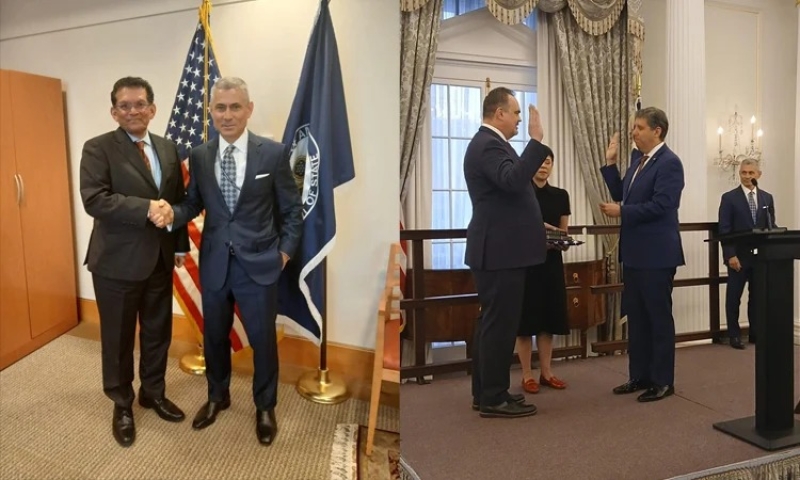
National Security Adviser Dr Khalilur Rahman met with Allison Hooker, Under-Secretary of State for Political Affairs and Paul Kapur, Assistant Secretary of State at the State Department in Washington DC on Friday last.
National Security Adviser Dr Khalilur Rahman held a series of meetings with senior United States officials at the State Department in Washington DC on Friday, focusing on Bangladesh’s forthcoming general election, bilateral trade and economic cooperation, the Rohingya crisis, and key regional and global issues.
Dr Rahman met Allison Hooker, Under-Secretary of State for Political Affairs, and Paul Kapur, Assistant Secretary of State, where the discussions covered preparations for the February election, democratic transition, trade and investment prospects, visa-related issues, and regional stability.
In his meeting with Under-Secretary Hooker, Dr Rahman briefed her on the arrangements and preparedness for the upcoming general election and expressed appreciation for continued US support for the interim government, including assistance related to the electoral process. Hooker reaffirmed Washington’s strong backing for Bangladesh’s democratic transition and said the United States looked forward to a free, fair, and credible election.
Trade and economic cooperation also featured prominently in the talks. Dr Rahman highlighted the scope for expanding bilateral trade, particularly following Bangladesh’s increased imports of American agricultural products. He requested easing travel for Bangladeshi businesspeople to the United States, including a review of the recently imposed visa bond and possible exemption of short-term B1 business visas from the requirement.
Hooker noted that the bond policy could be reviewed in the future if tourist overstays declined significantly. She also expressed appreciation for Bangladesh’s cooperation in facilitating the return of undocumented Bangladeshi nationals from the United States.
On the Rohingya issue, Dr Rahman thanked the US for its sustained humanitarian support to the displaced population sheltered in Bangladesh and requested continued assistance. Acknowledging that the United States is the largest donor for Rohingya refugees, Hooker praised Bangladesh for shouldering a significant humanitarian burden. She stressed the importance of broader international burden-sharing and underscored the need to expand livelihood opportunities for Rohingyas while they remain in Bangladesh.
Dr Rahman also sought US consideration for access to Development Finance Corporation (DFC) financing for Bangladesh’s private sector, including potential support for semiconductor development. Hooker assured that these proposals would be given due consideration.
During the meeting, Dr Rahman expressed Bangladesh’s principled interest in participating in an international stabilisation force that may be deployed in Gaza. Hooker said the United States was willing to work with Bangladesh on the issue.
In a separate meeting with Assistant Secretary Paul Kapur, the discussions covered mutual interests, including the election, bilateral relations, the Rohingya crisis, visa bond concerns, trade and investment, and wider regional developments.
As a special invitee, Dr Rahman also attended the swearing-in ceremony of Brent Christensen as the newly appointed US Ambassador to Bangladesh at the State Department. The oath was administered by Deputy Secretary of State for Management and Resources Michael J Rigas. The ceremony was attended by the Bangladesh ambassador to the United States, embassy officials, senior State Department and military officials, former US ambassadors to Bangladesh, and US business leaders.
Addressing the event, the Deputy Secretary of State reiterated Washington’s commitment to supporting Bangladesh’s democratic transition. Ambassador Christensen said the United States supported Bangladesh’s journey towards a stronger democratic future and expressed optimism about working with the next elected government to further strengthen bilateral relations.
At all engagements, Dr Rahman was accompanied by a senior official from the Bangladesh Embassy.
Later, on January 12, Dr Rahman visited the Bangladesh Consulate General in New York, where he was briefed on measures taken to facilitate the participation of expatriate voters in the greater New York region in the upcoming general election and referendum. The consul general said the mission was providing necessary assistance to voters, including information on referendum options.