

- Home Minister’s Remarks Trigger Uproar in Parliament |
- Nepal Flood Death Toll Rises to 359 |
- Bangladesh Will Never Bow to Any Country Again: FM |
- Dhaka Traffic Police Take on Bigger Role in Fighting Crime |
- Customs detect bid to import 4 luxury cars as used parts |
UNHCR condoles deaths in the collapse of a Madrasah in RR camp
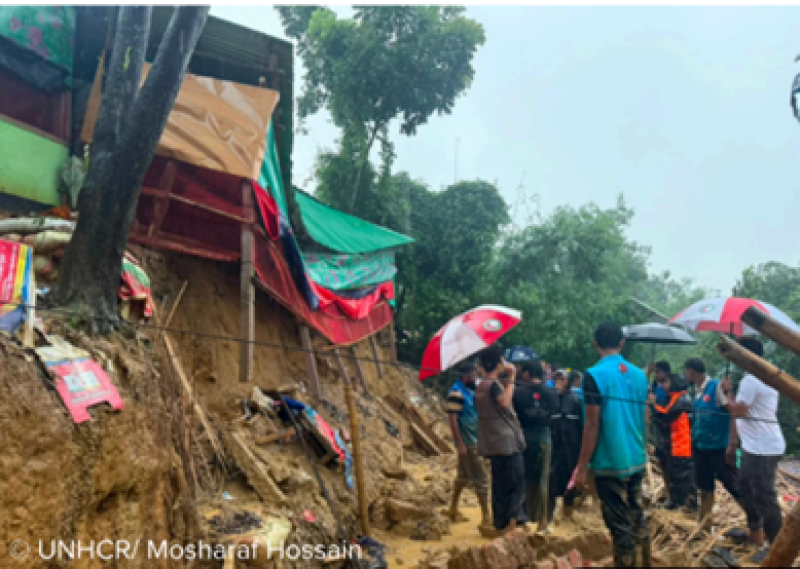
A madrasah collapsed in a landslide in the Rohingya Refugee Camp in Coxs Bazar on Wednesday 8 July 2026.
"UNHCR extends our heartfelt condolences to the families who lost loved ones in the collapse of the madrassa in the Rohingya refugee camps in Bangladesh yesterday, as well as those who perished in the deadly landslides and flash floods earlier this week, Ivo Freijsen, Representative, UNHCR Bangladesh said in a statement on Thursday .
This tragic loss of lives is a heartbreaking reminder of how vulnerable these camps are to natural disasters and the risks Rohingya families face each monsoon season. With more than 1.2 million refugees living in one of the world's most densely populated refugee settlements, far too many people remain exposed to landslides, flooding, cyclones, fires, and other environmental hazards.
Many of the dangers facing Rohingya refugees are neither unforeseen nor unavoidable, with adequate opportunities and resources for sustained disaster risk reduction. In the face of enduring funding constraints, however, investments in strong long-term disaster preparedness and resilience measures are increasingly underfunded, while a lack of allocated land further limits opportunities to decongest even the most overcrowded and hazardous locations and to plan for safer infrastructure.
Rather than implementing the strategic interventions we know can reduce risks before they become emergencies, humanitarian agencies are often forced to adopt short-term solutions, and the consequences of these constraints were tragically illustrated this week. UNHCR continues to advocate for the necessary resources, land and planning opportunities to improve safety and protect the lives of refugees living in these camps, in conjunction with the continued pursuit of durable solutions.”
Background
Heavy to very heavy monsoon rainfall continues to affect Cox's Bazar District and the wider
Chattogram Division, maintaining saturated ground conditions and a high risk of landslides,
flash flooding, localized waterlogging, and wind-related damage, particularly across the hilly
Rohingya refugee camps. According to the Bangladesh Meteorological Department (BMD),
heavy to very heavy rainfall has persisted throughout the week, and rainfall recorded in Cox's
Bazar reached 28 mm on 4 July, 240 mm on 5 July, 129 mm on 6 July, 69 mm on 7 July, and
125 mm on 8 July. BMD forecasts heavy to very heavy rainfall to continue until 11 July. A BMD
Special Warning bulletin for Landslide further indicates that 200–500 mm of cumulative rainfall is
possible between 9 and 11 July, maintaining a high risk of landslides in vulnerable areas.
The Needs Assessment Working Group (NAWG) continues to identify Cox's Bazar as one of
Bangladesh's highest-risk districts for flash flooding, driven by above-normal rainfall across the
Chattogram Division and increased upstream flows from northeastern India. An estimated
504,500 people across eight upazilas and 74 unions could be exposed to flash flooding,
including Rohingya refugee camps, where saturated soils continue to increase the risk of slope
failures, localized flooding, and disruptions to humanitarian operations.
According to the Rohingya Coordination Platform (RCP) Daily Incidents Dashboard, between 4
July and 9 July 2026, a cumulative 286 weather-related incidents were reported across the
camps, affecting 26,119 individuals (5,518 households). These included 156 wind/storm
incidents, 95 landslides, 21 flood incidents, three drowning incidents, eight fire incidents, and
two infrastructure hazards. The incidents resulted in 15 fatalities, 18 injuries, and the temporary
displacement of 4,307 individuals.
The cumulative fatalities include two children who drowned on 5 July in Kutupalong Registered
Camp (KRC) and Camp 4 Extension, eight fatalities from landslides on 6 July (Camp 7 - one
child; Camp 11 - four individuals, including three children; Camp 15 - three individuals), and five
additional fatalities following a major landslide in Block A-3 of Camp 5 on 8 July (all children).
According to the official Camp-in-Charge (CiC) report, the Camp 5 incident occurred at
approximately 14:10 hrs, claimed the lives of five refugees, and left eight others receiving
treatment at various hospitals and Primary Health Centres.
The severe weather has cumulatively partially damaged 2,809 shelters and completely
destroyed 13 shelters. In addition, 742 facilities (including 37 learning centers, 163 latrines, 38
water points, four mosques, and 500 other facilities) and 974 infrastructure components
(including 695 retaining walls, 146 pathways, 107 stairways, 14 roads, and 12 bridges) have
sustained damage.
The highest numbers of affected individuals have been reported in Camp 10 (3,818), Camp 12
(2,472), Camp 1W (1,952), Camp 11 (1,774), Camp 5 (1,524), Camp 6 (1,453), Camp 16
(1,247), Camp 9 (1,242), Camp 18 (1,005), and Camp 7 (864). The largest displacement has
been recorded in Camp 6 (1,085 individuals), while the highest numbers of damaged shelters
have been reported in Camp 11 (405 partially damaged shelters), Camp 12 (396), Camp 9
(256), Camp 16 (196), and Camp 10 (177).
Humanitarian partners continue to work closely with the Government of Bangladesh, including
the Refugee Relief and Repatriation Commissioner (RRRC), district and upazila administrations,
the Fire Service and Civil Defence, the Armed Police Battalion (APBN), and sector partners to
conduct rapid assessments, support emergency response operations, and provide assistance to
affected refugee and host communities.
Weather Outlook
According to the Bangladesh Meteorological Department (BMD), active monsoon conditions are
expected to continue until at least 11 July, with heavy to very heavy rainfall forecast across
Cox's Bazar and the Chattogram Division. A BMD landslide warning forecasts 200–500 mm of
rainfall between 9 and 11 July, maintaining a high landslide risk in Teknaf, Ukhiya, and Cox's
Bazar Sadar.
The NAWG Anticipatory Impact Analysis continues to identify Cox's Bazar as highly vulnerable
to flash flooding. Continued rainfall is expected to increase the risk of flooding, landslides,
infrastructure damage, access constraints, and displacement. Humanitarian partners should
maintain heightened preparedness, monitor weather advisories and high-risk locations,
disseminate early warning messages, support relocations where necessary, and exercise
caution during field movements.
SCCCM:
Impact Summary:
• Despite lower rainfall (92 mm on 8 July), saturated ground conditions continued to trigger
significant monsoon-related hazards across the camps. A total of 1,169 households (5,743
individuals) were affected, including 266 households (1,323 individuals) relocated to safer
locations and 327 households (1,614 individuals) temporarily displaced due to unsafe
shelters or surrounding conditions. Multiple landslide incidents caused the most severe
human impact, resulting in fatalities and injuries, predominantly among children. This
highlights the continued life-threatening risk faced by households living near unstable
slopes, erosion-prone areas, and other high-risk locations during sustained rainfall.
• A total of 992 shelters were affected, including 646 partially damaged shelters and 10
flooded shelters, reflecting the cumulative impact of prolonged rainfall and saturated ground
conditions, despite lower rainfall levels recorded on 8 July.
• Significant damage was reported to critical camp infrastructure, including 111 slope
protection structures, 20 pathways, 18 stairways, 3 roads, 4 bridges, 11 latrines, and 1 water
network, as well as retaining walls, water points, drainage systems, and community facilities.
The damage disrupted safe movement, humanitarian access, and the continuity of essential
services across the camps.
Response:
• Humanitarian partners, Site Management Agencies, CiCs, government authorities, and
community volunteers coordinated rescue operations, evacuations, rapid damage
verification, and emergency response activities. A total of 637 individuals received
immediate life-saving assistance, supported by 795 DMU volunteers, 362 Site Management
volunteers, and 90 Site Management staff.
• High-risk locations continued to be monitored through red-flag marking, door-to-door
awareness campaigns, early warning dissemination, and support for relocating households
to safer locations and Temporary Collective Shelters (TCSs).
• Site Management coordinated emergency mitigation measures, including drainage cleaning,
slope covering and repairs, debris and fallen tree removal, rehabilitation of damaged access
routes, verification of shelter damage, and planning for emergency shelter assistance and
infrastructure restoration.
Challenges/Needs:
• Continued rainfall and saturated ground conditions maintain a high risk of flash flooding,
landslides, and slope failures. Relocating households from high-risk areas remains
challenging and requires strengthened community engagement and stakeholder support.
• Affected and displaced households require timely emergency shelter assistance. Ongoing
rainfall continues to limit the safe repair of damaged shelters and critical infrastructure,
prolonging displacement and increasing vulnerability.
• Urgent rehabilitation of damaged pathways, roads, retaining walls, slope protection
structures, drainage systems, WASH facilities, and community infrastructure is needed to
restore safe access, reduce secondary risks, and maintain essential services.
Partners: UNHCR, IOM, ACTED, AAB, BRAC, DRC, MBSS, CiCs, Site Management Agencies,
government authorities, DMU volunteers, and Site Management Support (SMS) volunteers.
FSS:
Response:
• Sector partners' community volunteers are actively supporting evacuations, emergency
relocations, and the distribution of relief items, including tarpaulins, food assistance, and water
purification supplies.
• Emergency food distributions continued, with fortified biscuits provided as an immediate
response, followed by hot meals for affected families. On 8 July, a total of 624 households (3,106
individuals) received emergency food assistance, including fortified biscuits and hot meals,
across the affected camps. Cumulatively, since 6 July, WFP has distributed 3.9 metric tonnes
(MT) of fortified biscuits and 9,658 hot meals to 7,698 affected individuals (1,495 households)
across the camps.
• The evolving weather conditions may require a rapid scale-up of assistance and additional
preparedness measures to address potential increases in humanitarian needs.
Partners: WFP and its partners (YPSA, CODEC, SHED, and RIC) are providing emergency
food assistance, complemented by support from other FSS sector partners at the camp level.
WASH:
Impact Summary:
• Rapid assessments were conducted to determine damage to WASH infrastructure.
Reported damages include 667 latrines (625 partially damaged and 42 fully damaged), 197
bathing cubicles (191 partially damaged and 6 fully damaged), 13 faecal sludge treatment
plant (FSTP) sites (10 partially damaged and 3 severely damaged), 44 tubewells with hand
pumps (43 partially damaged and 1 fully damaged), and 13 tap stands (9 partially damaged
and 4 fully damaged).
• Two water reservoirs (dams) in Camp 22 were partially damaged, while 11 material recovery
facilities (MRFs) sustained partial damage.
• One water treatment plant was partially affected by a landslide.
Response:
• Daily assessments are being conducted by WASH agencies to identify new damage
resulting from ongoing rainfall.
• To date, 20 latrines, 6 bathing cubicles, 1 FSTP site, and 1 tubewell have been repaired.
• Site protection measures and the decommissioning of high-risk WASH facilities are ongoing
to mitigate safety risks.
Challenges/Needs:
• Continued rainfall has placed many WASH facilities at risk of landslides. Where relocation is
not feasible, facilities have been decommissioned, creating access challenges, particularly
for sanitation facilities.
• Three sludge transfer tanks have collapsed and been completely destroyed.
• Persistent heavy rainfall is slowing repair and rehabilitation work.
Partners: ANANDO, BDRCS, BRAC, BRAC-PF, CARE, CPI-YPSA, CARITAS, COAST, DSK,
DPHE, IRB, NGOF, NRC, OXFAM, SCI, TDH, WV, VERC and UNICEF, UNHCR, IOM as AFA
Protection (including CP andGBV):
Impact:
Protection:
• Heavy rainfall, flooding, and waterlogging continued to disrupt access to protection
services. Five Community-Based Protection (CBP) centres and Community Feedback
Mechanism (CFM) facilities in Camps 1W, 4, 5, 12, and 18 were affected by
waterlogging.
• Continued rainfall increased the risk of landslides and further deterioration of partially
damaged shelters, exposing households in high-risk areas to heightened protection
concerns while disrupting livelihoods as many refugees remained confined to their
shelters.
• Protection monitoring identified continued safety and security concerns, including theft
and looting of household belongings from affected shelters, some allegedly perpetrated
by organized groups, particularly during displacement and nighttime heavy rainfall.
Community members also reported intimidation and physical violence by these group
members, contributing to heightened fear and insecurity.
Child Protection:
• Three additional Multi-Purpose Centres (MPCs) were reported damaged, bringing the
total number of affected facilities to 39. Eight facilities are currently being used as
emergency shelters, hosting six families.
• Six additional non-fatal drowning incidents involving children and three child injuries
were reported. Cumulatively, 34 children have been involved in drowning incidents and
five children have been injured.
• Seven additional families and 10 individuals were relocated, bringing the cumulative total
to 64 families and 98 individuals relocated.
GBV Sub-Sector:
• Sixteen WGSS/WFS, one WLCC, and one Men Engagement Centre were affected by
heavy rain and flooding, disrupting services.
• Heavy rainfall has reduced access to facilities, affecting community awareness of
available services, timely identification of protection concerns, and referrals to
appropriate services. People with disabilities and older people face disproportionate
barriers to accessing essential services.
• Flooded and poorly lit pathways, displacement, shelter damage, and livelihood losses
have increased protection risks, including intimate partner violence (IPV), psychological
abuse, and delays in the response to GBV incidents.
• Protection risks are further exacerbated at night due to limited visibility and unsafe
movement, making it more difficult for women, girls, and humanitarian personnel to
safely access and deliver essential services.
Response:
Protection:
• Protection partners continued monsoon preparedness, landslide safety, drowning
prevention, and early warning awareness activities through community networks, PERU
members, religious leaders, youth groups, and other community structures, reaching
approximately 35,000 refugees and conducting over 90 awareness sessions.
• Protection partners continued providing Psychological First Aid (PFA), individual
consultations, and support to persons with specific needs (PSNs). At least 439 people with
specific needs (PSNs) received follow-up support, while approximately 100 individuals
received Psychological First Aid (PFA) and psychosocial support.
• Community-Based Protection (CBP) Centres temporarily sheltered 40 flood-affected
individuals, including eight children, six older people, and two people with disabilities.
• Protection teams coordinated with Site Management, SCCCM, CP, GBV, HLP, and sector
partners to support emergency response, monitor shelter-related protection concerns,
identify child protection risks around hazardous water bodies, and maintain community-level
monitoring throughout the emergency.
• Protection partners continued protection monitoring in flood-, landslide-, and erosion-prone
areas, identifying households at risk, promoting safe relocation, supporting relocation to
Temporary Communal Shelters (TCS), and referring protection concerns to relevant service
providers. During the reporting period, nine households at risk were identified, nine referrals
were made to specialized services, and three vulnerable individuals were referred for
specialized protection and psychosocial support.
Child Protection:
• DRR (Disaster Risk Reduction) awareness activities reached 8,849 individuals (6,916
children and 1,811 adults, including 122 persons with disabilities). Cumulatively, DRR
awareness activities have reached 11,511 individuals.
• Psychological First Aid (PFA) was provided to 556 children and 208 caregivers during the
reporting period. Cumulatively, 2,119 children and 431 caregivers have received PFA.
• Psychosocial Support Services (PSS) were provided to 1,467 children and 248 caregivers
during the reporting period. Cumulatively, 3,614 children and 356 caregivers have received
PSS.
• Two missing girls were reunited with their families in Camp 13 (Thangkhali-Burmapara) by
Save the Children, bringing the cumulative number of family reunifications to two children.
• Thirteen children (5 girls and 8 boys) were referred to specialized service providers for
further support.
Gender-Based Violence:
• Core GBV services, including case management, Psychological First Aid (PFA),
psychosocial support (PSS), referrals, and community outreach, continued with
operational adjustments as needed to ensure uninterrupted support for women, girls,
and other vulnerable populations through case workers and volunteers.
• A total of 603 individuals (283 women, 68 girls, 35 boys, and 217 men) received PFA
services across Camps 5, 11, 12, 15, and 16 to address immediate psychosocial needs
and provide timely support.
• A total of 31 individuals (15 women, 9 girls, and 1 man) received PSS services across
Camps 11, 12, 15, and 16.
• Dignity kits were distributed to 15 women and girls whose shelters were damaged in
Camps 11, 12, 15, and 16.
• Temporary shelter support was provided through Women and Girls Safe Spaces to 27
women, girls, and boys whose shelters were damaged or who were displaced due to
heavy rainfall and landslide risks, ensuring access to a safe and secure environment in
Camps 16 and 20.
Challenges and Priority Needs:
Protection:
• Many households remain reluctant to relocate from landslide-prone areas despite the
continued risk, while partially damaged shelters continue to expose families, particularly
persons with specific needs and other vulnerable groups, to heightened protection risks.
• Heavy rainfall, waterlogging, and damaged infrastructure continue to restrict access to
protection services and hinder humanitarian response efforts.
• Urgent needs include shelter repair materials, rehabilitation of damaged shelters, slope
stabilization, pathway repairs, and restoration of critical infrastructure.
• Delays in assistance for families in Temporary Communal Shelters, including food and
basic support, continue to affect displaced households, while some newly arrived
households with Joint Assistance Cards (JACs) report not receiving assistance.
• Floodwater diversion efforts in some affected blocks have triggered localized Housing,
Land and Property (HLP) disputes and increased community tensions due to competing
safety concerns.
Child Protection:
• Drowning risk continues with heavy rainfall: children were observed swimming in ponds
and floodwater in Camps 25, 3, 15, and 22, and playing near unfenced water bodies;
volunteers report difficulty preventing children from entering the water.
• Landslide risk remains elevated across multiple camps: the hillside above a shelter in
Camp 20 collapsed leaving six children without adequate shelter; families in Camps 22
and 26 continue to refuse relocation despite advisories; slippage and injuries were
reported in Camp 15 (Jamtoli).
• Emergency shelter materials (tarpaulin, rope, sandbags, GI wire, bamboo) remain
insufficient for shelter reinforcement in Camp 16 and other affected sites.
Gender-Based Violence:
• Heavy rainfall and flooding have reduced mobility for women, girls, and survivors,
leading to lower attendance at case management follow-up visits and centre-based
activities. Outreach sessions, including Girl Shine STAR and Women Support Network
(WSN) activities, have been reduced or temporarily suspended in some locations due to
safety concerns and adverse weather conditions.
Partners:
Protection: UNHCR, ActionAid Bangladesh, BRAC, IOM, Humanity & Inclusion (HI), CODEC,
DRC, NRC, BLAST, and Friends in Village Development Bangladesh (FIVDB).
Child protection: ActionAid Bangladesh, BRAC, Terre des Hommes (TdH), IRC, DSS, Save
the Children, World Vision Bangladesh, Caritas Bangladesh, GUK, Friends in Village
Development Bangladesh (FIVDB), YPSA, BITA, CODEC, COAST, Good Neighbours
Bangladesh, and ASD.
Gender-Based Violence: UNFPA, ActionAid Bangladesh (AAB), BRAC, UNHCR, UNICEF,
IRC, UN Women, Nari Maitree, CARE, Mukti Cox’s Bazar, AID Comilla, BNPS, YPSA, PULSE
BD, World Vision International (WVI), DRC.
Health:
Impact Summary:
• A major landslide in Camp 05, Block A-03, resulted in 11 casualties, including 5 deaths and 6
injuries requiring hospitalization. Despite the incident, all health facilities remained
operational, with no disruption to essential health services throughout the emergency.
• All incidents resulting in casualties were coordinated through the WHO-led Emergency
Preparedness and Response Technical Committee (EPR TC) under the Health Sector, in
collaboration with the WHO-supported Health Emergency Operations Centre (HEOC) at the
Civil Surgeon Office.
• All 13 designated Medical Hubs, 17 Mobile Medical Teams (MMTs), and the 33-ambulance
District Referral Unit (DRU) network remained fully operational, ensuring uninterrupted
trauma care, referral services, and emergency surge capacity.
Response:
• The WHO-led EPR TC under the Health Sector, through the WHO-supported HEOC at the
Civil Surgeon Office, immediately activated the Health Sector emergency response
mechanism under the Incident Command System (ICS), coordinating closely with the Civil
Surgeon Office, RRRC, CiCs, Fire Service, and Health Sector partners.
• Four Mobile Medical Teams (two Core MMTs and two Surge MMTs) were rapidly deployed,
with additional teams placed on standby. In addition, four Medical Hubs and 10 DRU
ambulances were activated to provide on-site triage, emergency stabilization, trauma care,
and referral services for affected casualties.
• The WHO-led EPR TC maintained continuous operational coordination, field supervision,
and real-time incident reporting through the HEOC, while ensuring the readiness of all 17
MMTs, 13 Medical Hubs, and the 33-ambulance DRU network to respond to any further
monsoon-related emergencies.
Challenges/Needs:
• Continued heavy rainfall and saturated soil conditions maintain a high risk of further
landslides, requiring sustained emergency preparedness and response capacity across
high-risk camps.
• Strengthened coordination and timely information sharing among Site Management
(SMSD), Camp Health Focal Points, and government counterparts remain essential to
support rapid operational decision-making and response.
• Continued reinforcement and standardized implementation of the Incident Command
System (ICS), as well as the Mobile Medical Team and Medical Hub Operational Plans,
remain priorities to ensure a coordinated and effective emergency health response.
Partners: WHO (Leadership & Coodination), IOM, UNHCR, BRAC, IRC, Friendship, GK,
BDRCS, RTMI/UNFPA, HMBDF, and other Health Sector Partners.
Nutrition:
Impact Summary:
• Waterlogging, flooding in several sub-blocks, and slippery access routes have created
significant challenges in accessing nutrition services, particularly for children under five and
pregnant and breastfeeding women (PBW) across the camps, contributing to reduced
beneficiary attendance.
• Nearly all Integrated Nutrition Facilities (INFs) are experiencing limited or no solar power
due to the complete shutdown of the camp nano-grid system. As a result, most service
points are without adequate lighting, affecting the working environment, safety and security,
and the delivery of nutrition services, particularly during periods of low natural light.
Response:
• Nutrition partners are actively tracking and following up with absent children and pregnant
and breastfeeding women to help ensure continuity of essential nutrition services despite
the ongoing challenges.
• Temporary mitigation measures have been implemented to address lighting shortages in
facilities, including the use of mobile flashlights, rechargeable LED lights, portable charger
lights, and candles.
• Nutrition partners have undertaken immediate mitigation measures, including emergency
repairs, drainage clearance, temporary roof protection, and the safeguarding of nutrition
supplies to sustain service delivery in affected facilities.
Challenges/Needs:
• Sustained low beneficiary attendance throughout the week is likely to result in a significant
increase in caseloads and service demand once access improves, potentially placing
additional pressure on facility capacity and staff.
• Flooded sub-blocks, waterlogged catchment areas, and deteriorating road conditions
continue to disrupt community outreach activities, limiting staff mobility and reducing
coverage of vulnerable populations despite ongoing efforts to maintain essential nutrition
services.
Partners: Concern, Friendship, GK, SHED, UNICEF and WFP
Education:
Impact Summary:
• A tragic incident was reported at a community-run madrasa (not supported by the Education
Sector) in Camp 5, where multiple children and a teacher were reported missing, injured, or
deceased following a landslide. As a safety and protection measure, all learning facilities
have been closed.
• Learning activities have been severely disrupted across the camps. Rapid assessments are
being conducted. Two learners were reported injured, while no injuries among volunteer
teachers have been reported.
• A total of 45 Learning Centers (LCs) are currently being used as temporary shelters by
families whose homes were damaged or destroyed. Across 29 camps (01E, 01W, 02E, 02W,
03, 04, 05, 06, 07, 08E, 08W, 09, 10, 11, 12, 13, 14, 15, 16, 17, 18, 19, 20, 21, 22, 24, 25,
26, and 27), damage has been reported to 678 learning facilities (660 LCs and 18 CBLFs),
requiring repair, reconstruction, or relocation. Many classrooms are waterlogged, while
others have lost roofs or walls, have partially or fully collapsed, or are at risk of collapse,
posing additional risks to nearby shelters.
• Teaching and learning materials, including textbooks, workbooks, floor mats, blackboards,
and other classroom resources, have also been damaged.
Response:
• All learning facilities were closed on 9 July due to concerns regarding the safety,
security, and protection of children and volunteer teachers. This closure was
implemented one day ahead of the planned academic break. Learning facilities are
expected to reopen on 26 July.
• Rapid assessments were conducted by Education Sector partners using a Day 1
assessment tool. A Day 3 assessment tool was subsequently shared with partners to
collect more detailed information on the extent of facility damage and the number of
affected children.
• Coordination is ongoing with CiC offices and other stakeholders, including the Site
Management (SMSD).
• The primary response will focus on repairing, reconstructing, or relocating damaged
facilities and replacing damaged teaching and learning materials, in coordination with
CiCs and relevant stakeholders.
Challenges/Needs:
• An extremely high number of learning facilities have been damaged.
• Due to continued heavy rainfall during the monsoon season and the scale of the
damage, reconstruction and repair efforts are expected to take considerable time.
• Landslides and soil erosion around the foundations of education facilities are increasing
risks for children attending classes and for families living near facilities that are at risk of
collapse.
Partners: BRAC, Caritas Bangladesh, CODEC, EDUCO, FIVDB, HMBD Foundation, IRC, JCF,
Mukti, NRC, UNICEF.
LSDS:
LSDS partners continue to monitor the evolving situation and remain engaged in preparedness
and coordination activities. Updates will be provided as further information becomes available.
Bhasan Char:
Continuous rainfall persists on Bhasan Char, although no movement restrictions have been
reported. Prolonged cloudy weather and limited sunlight have prevented many solar-powered
streetlights from recharging, resulting in widespread nighttime outages across the camp. The
reduced lighting has contributed to a reported increase in theft incidents within the camp.
The Navy has advised residents to remain highly vigilant and take necessary precautions to
secure their shelters and cluster areas to mitigate the risk of theft. Despite the adverse weather
conditions, operational activities continue as planned, with no major disruptions reported.