

- Tree logging in Bangladesh has fallen in last two years: Study |
- Unsafe Food Kills 1.5 Million Yearly, WHO Warns Report |
- Masud Khan Appointed New BSEC Chairman in Shake-up |
- Verdict in Ramisa rape-murder case on June 7 |
UN Ocean Report Urges Urgent Global Action
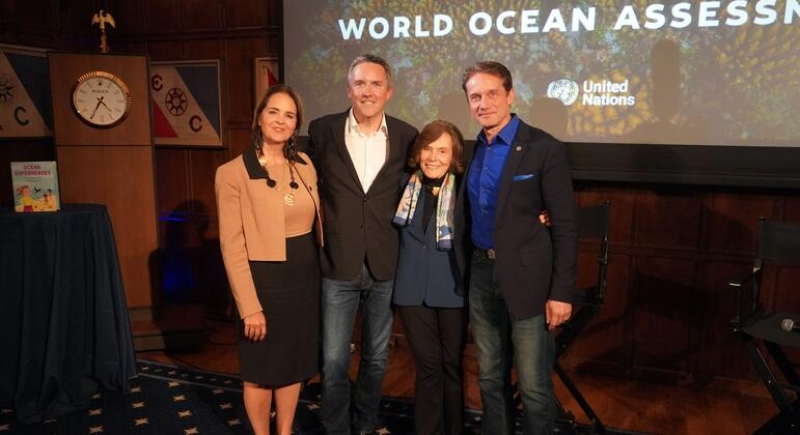
Left to right: Bahia Tahzib, Deputy Permanent Representative of the Netherlands to the United Nations, Richard Vevers, Sylvia Earle and Fabien Cousteau at the Explorers Club in New York City.
In the wood-panelled rooms of New York’s historic Explorers Club, where portraits of pioneering adventurers line the walls, diplomats, scientists, and ocean advocates gathered on Tuesday evening with a shared sense of urgency and anticipation.
They were joined by renowned ocean advocate Sylvia Earle and explorer Fabien Cousteau to mark the upcoming release of the World Ocean Assessment, a sweeping report described at the event as “possibly the most important book about the ocean ever written.”
Set to be launched on World Ocean Day on June 8, the 1,600-page assessment is the result of more than five years of work by 550 experts from 86 countries. It offers a detailed overview of the mounting pressures on the ocean and the actions needed to safeguard it.
Speaking at the event, Steven Hill, Assistant Secretary-General for Legal Affairs at the United Nations, said the assessment “reinforces a very clear message: science is indispensable.”
He said the report provides a foundation for “understanding the profound changes that are underway, from climate-driven shifts to biodiversity loss, and for shaping effective action at both the local and global levels.”
What We Still Don’t Know
Despite decades of progress, vast areas of the ocean—particularly the deep sea—remain poorly understood.
Renowned oceanographer Sylvia Earle warned that the report also highlights the scale of work that still lies ahead.
“The one thing that also must be done, and will occupy many volumes, is understanding the magnitude of what we still don’t know,” she said.
Echoing a famous quote often attributed to Mark Twain — “What gets us into trouble is not what we don't know. It's what we know for sure that just ain't so” — Ms Earle said scientists now know far more than previous generations, but must remain aware of how much is still unknown.
“We shouldn’t be too ambitious in thinking we have all the right answers,” she added.
Knowledge Alone Is Not Enough
“Knowledge alone is not enough,” Mr Hill said.
“We’re at a moment when ocean ecosystems are approaching critical thresholds, and the choices we make—grounded in the best available science—will determine the future of the ocean and the benefits it can provide.”
He added that scientific understanding must also be inclusive, bringing together different disciplines, regions, and perspectives, including those of Indigenous Peoples and local communities.
“At the end of the day, we are one community, and we must all row in the same direction. The only way we can get through this is together,” Fabien Cousteau, ocean advocate and grandson of legendary explorer Jacques Cousteau, said at the Explorers Club.