

- Midterm Election Results: One of Biggest Reversals in US History |
- Republicans face midterm backlash over Trump's economic policies, Poll reveals |
- Waterlogging in Kumarkhali: Potential farm loss Tk35 crore annually |
- Substitute Ibrahim powers Bangladesh to 1-0 win over Bhutan in SAFF |
- Trump Threatens to ‘Destroy’ What Remains of Iran |
US Stock Market Loses $2.5 Trillion in One Day
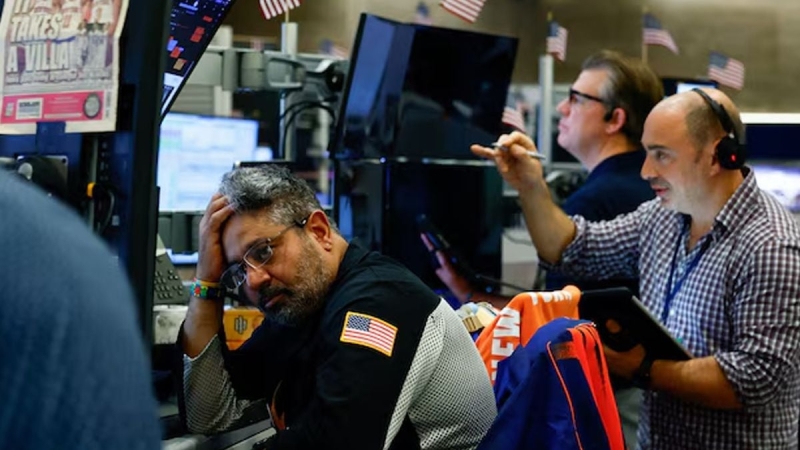
A massive sell-off on Wall Street has wiped out approximately $2.5 trillion in market value in a single day. Photo: Collected
A sharp sell-off on Wall Street has sent shockwaves through global financial markets, wiping out around $2.5 trillion in market value in a single day on Thursday (November 5).
Investor concerns over a possible slowdown in artificial intelligence (AI) investment, along with uncertainty following the Democrats' success in the US midterm elections, contributed to the sharp decline.
The sell-off also affected Asian markets. South Korea's Kospi index fell nearly 9% shortly after trading began on Friday (November 6), prompting authorities to halt trading for 20 minutes to stabilise the market.
The technology-heavy Nasdaq Composite plunged 5.52% on Thursday, entering correction territory after falling more than 10% from its record high on October 6. It was the index's biggest single-day decline since April 2025, when US President Donald Trump announced sweeping global tariffs.
The S&P 500 and Dow Jones Industrial Average also suffered their steepest declines over the same period.
The market movement came after a contrasting performance on Wednesday, following the midterm elections. The Dow Jones had surged 1,569 points, while the Nasdaq gained 1.44%.
However, on Thursday, the Dow plunged 1,833 points, wiping out all of the previous day's gains.
One factor behind the market turmoil was Democrat Gina Hinojosa's victory in the Texas gubernatorial election. Texas has attracted substantial investment in AI infrastructure from companies including Google, Meta, Oracle and OpenAI.
During her election campaign, Hinojosa pledged to temporarily halt the construction of new data centres and roll back some tax incentives for the sector.
The prospect of changes to AI-related investment policies triggered heavy losses in shares of technology infrastructure and chipmaking companies.
Nvidia shares fell 9.3%, erasing all their gains for the year. A key semiconductor index dropped 12.3%, marking its biggest one-day decline in around six and a half years.
Tesla shares fell 11%, while SpaceX shares dropped 9%. Shares of AI computing service providers CoreWeave and Nebius declined by around 10% and 15%, respectively.
Qualcomm shares also fell 9.5% after the company issued weaker-than-expected revenue and sales forecasts.
The CBOE Volatility Index (VIX), a measure of market volatility, surged nearly 70% in a single day, marking its biggest jump in almost two years.
All 11 sectors of the S&P 500 ended lower. Meanwhile, demand for safer investments increased, pushing the yield on 10-year US Treasury bonds down to a two-month low of 4.84%.
Ed Yardeni, president of Yardeni Research, said excessive investment and speculation in the AI sector needed to be reduced. He suggested that a gradual cooling of the market would be preferable to a sudden collapse of the AI boom.
Keith Lerner, chief investment officer at Truist Advisory Services, offered a different perspective, saying the market volatility could create opportunities for long-term investors.
From its October 6 peak, the Nasdaq and S&P 500 have fallen around 12% and 6%, respectively. The Dow Jones has declined about 5% from its August 5 high.
Concerns over excessive AI investment, potential new regulations and the construction of more data centres than demand may justify continue to fuel uncertainty in technology stocks.