

- Deadly floods cause widespread destruction in China, Nepal |
- 80 maunds (3 tons) of hilsa caught in one net in the Bay |
- Glacier collapse likely caused Nepal-Tibet flood, scientists say |
- UN Secy Gen Saddened Over Lives Lost in Nepal-Tibet Flash Floods |
- UGC, UN Women partner to combat sexual violence at universities |
80 maunds (3 tons) of hilsa caught in one net in the Bay
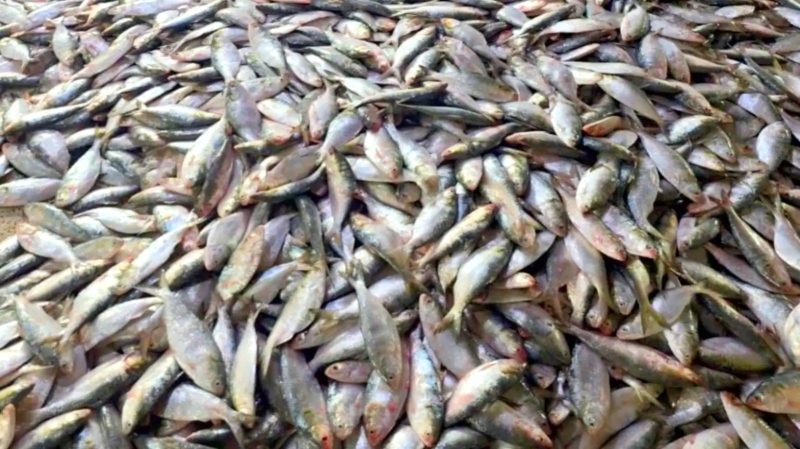
Nearly 3 tons of hilsa was caught in one net in the Bengal on Wednesday 26 August 2026.
Patuakhali: About 80 maunds of hilsa were caught in one net in the Bay of Bengal adjacent to Kuakata in Patuakhali. On Wednesday (August 26) afternoon, the FB Abdullah trawler arrived at the Alipur Fisheries Port with a huge quantity of hilsa. Later, the fish were sold at auction for about Tk 20 lakh
The trawler's boatman, Badsha, said that four days ago, they went to the deep sea with 18 fishermen. After fishing for two days, a huge quantity of hilsa was caught in their net near the last buoy of Payra Port on Tuesday. Although about 80 maunds of hilsa were found, the size of the fish was relatively small.
Meanwhile, ordinary fishermen of the Kuakata, Mahipur, Alipur and Ashakhali coasts complain that they are not getting fish like before despite being in the sea day after day. Many times, they have to return to shore with losses because they cannot afford fuel, ice, food and labor.
Fishermen complain that some trawling boats use modern technology like fish finders, GPS and radar to identify the location of fish. Then, using relatively fine nets, a large amount of fish is caught at once.
They fear that not only large hilsa, but also small hilsa, fry and other marine animals are trapped in these nets. As a result, if small fish are caught indiscriminately, the fish stock may decrease in the future.
Earlier this month, 46 maunds of hilsa were caught in the net of an illegal artisanal trawler in the sea adjacent to Kuakata. Later, the fish was sold for about 48 lakh 50 thousand taka. The recent incidents of a large number of hilsa being caught by trawling boats on the same coast in a short period of time have now raised the question of ordinary fishermen - has the abundance of hilsa really returned to the sea, or are large fish being caught at once by quickly identifying specific fish schools due to modern technology and powerful nets?
According to fisheries experts, if small hilsa are caught without giving them a chance to grow, the number of reproductive hilsa may decrease in the future. At the same time, marine biodiversity may also be affected as fry and marine animals of various species are caught in fine-mesh nets.
Dr. Rajib Sarkar, Professor of the Department of Fisheries Biology and Genetics at Patuakhali University of Science and Technology, said, "Along with climate change, the use of illegal nets is also one of the reasons for the decline in hilsa. If illegal net production is stopped and effective measures are taken against illegal trawling, there is a possibility of further increase in hilsa production."
Kalapara Upazila Senior Fisheries Officer Apu Saha said that legal action is being taken as per the schedule of the Marine Fisheries Act. Boat owners have been warned by miking for allegations of trolling using illegal nets, and several boats have been seized and cases have been filed. - Gofran Palash