

- A New Arms Race is Threatening to Take-off—Now in Outer Space |
- Equality ‘ends at doors of Security Council’, Kenya’s Ruto at UNGA |
- কলাপাড়ায় প্রাথমিক শিক্ষায় হ-য-ব-র-ল |
- BDRCS and IFRC scale up dengue response to reach 300,000 people |
- World leaders approve new declaration to tackle rising sea levels |
World leaders approve new declaration to tackle rising sea levels
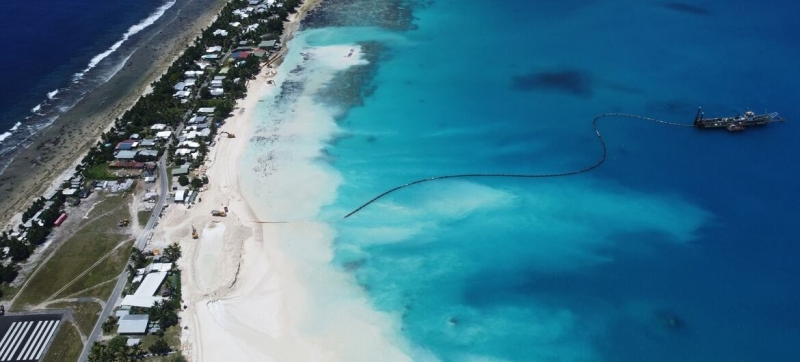
Home to around half of Tuvalus 12,000 people, Fogafale Island is vulnerable to the adverse impacts of flooding, shoreline erosion and rising sea levels along the southern lagoon coast. © UNDP-TCAP
24 September 2026 - Sea level rise is among the most visible consequences of global warming, but for some countries, it is an imminent existential threat. World leaders approved a new declaration on Thursday while debating the best ways to strengthen international cooperation and support vulnerable low-lying nations most at risk.
What you need to know:
• World leaders approved the UN Declaration on Sea Level Rise, which Member States finalised last month
• The global mean sea level is on the rise around the world and accelerating, according to the UN Intergovernmental Panel on Climate Change
• 770 million people live in coastal areas affected by sea level rise
• Just a half-metre rise in sea levels by the end of the century could force between 150 million and 300 million people from their homes
• Some small island States are already planning to be swallowed by the sea, with Tuvalu transitioning to become the world’s first “digital nation”
• Nations contributing least to such climate change consequences as sea level rise are facing the worst impact
On the margins of its high-level debate, the General Assembly met to discuss the existential threat posed by rising sea level, and the General Assembly continues its annual general debate.
Island States fighting for their future
Island States face the possibility of substantial losses of land territory and even complete submergence, which could render them uninhabitable.
Where will they go? What will happen to their nationalities? Their culture?
Global mean sea level is rising and accelerating. By 2100, the UN’s World Meteorological Organization estimates that seas will have risen by at least 0.5 metres, while the most pessimistic predictions estimate a full two metres increase.
For small low-lying nations in the Pacific Ocean like Tuvalu, Kiribati and the Marshall Islands, which lie only around two metres above the sea, this growing reality poses a very tangible threat.
‘Pacific voices have helped shape global response,’ Marshall Islands says
Speaking on behalf of the Pacific Islands Forum, the representative of the Marshall Islands welcomed the Declaration as evidence that Pacific countries have helped shape the international response to sea-level rise. Its affirmation that maritime zones can remain in place despite shifting coastlines reflects a solution long advanced by the region, he said.
The Pacific has sounded the alarm on rising seas for more than three decades, he recalled. The Declaration is an important step, but countries must follow it with stronger adaptation measures, better disaster preparedness and new financial commitments to help communities confront the growing threat.
Ways to address sea level rise
As the world grapples with rising sea levels, the UN has issued a series of forward-looking recommendations recognising the global multidimensional impacts and their implications for human rights and sustainable development, including that:
• Strategies should support the resilience of affected communities in maintaining their cultural identities and traditional ways of life in the face of rising seas
• Climate-resilient planning at the national and local levels, including nature-based solutions, flood-resilient infrastructure and inclusive zoning, will be critical to reduce long-term vulnerability
• Urgent action should target the integration of multi-hazard early warning systems, sector-wide adaptation measures and human rights-based disaster risk reduction to ensure that access and finance reach States, communities and individuals
These and other suggestions are part of the UN Secretary-General’s report Challenges related to sea level rise and ways and approaches to address it.
‘We cannot afford to be patient,’ Netherlands warns as seas rise
Centuries of living below sea level have shaped the European part of the Netherlands, its representative said. The country’s Caribbean islands face a different reality, but the same immediate threat: retreating beaches, ecosystems under pressure and growing risks of flooding, erosion and storm surges.
Caribbean sea levels are projected to rise by 20 centimetres by 2050 and by 50 to 80 centimetres by 2100, he said. The Netherlands stands ready to share its knowledge of water management, coastal protection and freshwater security.
“The sea is patient — it takes a little more each year. And what it takes, it does not easily return. We cannot afford to be patient in return,” he said.
Fast facts
What exactly is sea level rise? The phenomenon is one of the most visible, dramatic consequences of global warming.
Sea level rise has accelerated from around 1.5 mm per year for most of the 20th century to roughly 3.4 mm per year today.
As a result, an estimated one billion people living below 10 metres of elevation are increasingly at risk. – UN News