

- Dhaka ranks 6th in global air quality index |
- UN, Partners Continue Delivering Aid to Gaza Amid Restrictions |
- El Niño is surging. Months of extreme heat could follow |
- Himalayan Floods Not Just a Water Event, But a Debris Event |
- ICT chief prosecutor warns of attempts to sabotage tribunal |
ICU shortage leaves critical patients waiting at Rangpur Medical
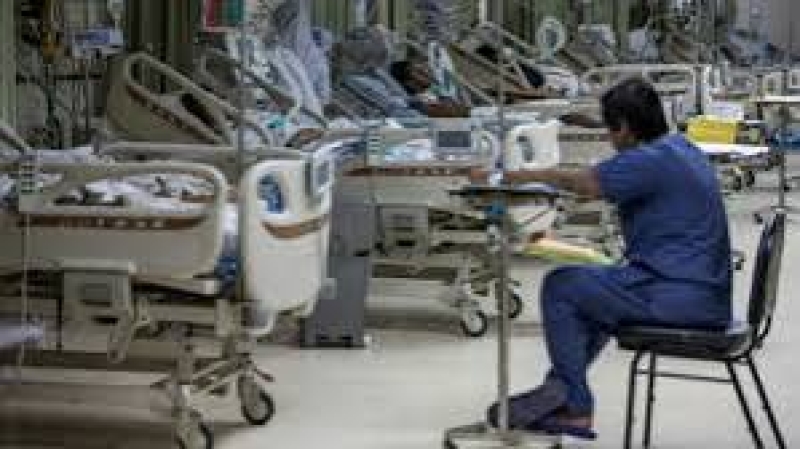
For critically ill patients at Rangpur Medical College Hospital, the wait for an intensive care unit (ICU) bed can be a matter of life and death.
With millions of people depending on a single major referral hospital and only 10 ICU beds available, the shortage remains a critical challenge for healthcare in northern Bangladesh.
For patients in critical condition, however, the consequences of the shortage are measured not in statistics but in hours—and sometimes in lives lost while waiting.
The hospital, the largest referral healthcare facility in Rangpur division, serves around 1.80 crore people across eight northern districts.
With 2,000-3,000 patients admitted on average at any given time, at least 10 percent are estimated to require ICU support.
But the hospital has only 10 ICU beds, leaving many critically ill patients waiting for lifesaving care and, in some cases, dying before a bed becomes available.
Hospital sources said they receive requests for ICU admission for at least 15-20 patients every day, against the 10 available beds.
Dr Touhid Sarker Dollar, an inspector at the ICU department, said the hospital is unable to accommodate all patients who need intensive care.
“We receive many requests for ICU admission every day, but we cannot accommodate everyone. Many patients are deprived of ICU care. The number of beds, manpower and space in the ICU need to be increased to provide adequate services to the huge population of northern Bangladesh,” he said.
Accounts from relatives of critically ill patients reveal the human cost of the shortage.
According to a list of 12 patients waiting for ICU beds at Rangpur Medical College and Hospital, most of them died without receiving ICU care. Relatives of several patients spoke about their experiences.
Shafik, a relative of a patient said his mother-in-law Mohsena Begum, a resident of Dhap Satgara in Rangpur city, was admitted to the cardiology department with severe chest pain and later developed complications.
Doctors advised immediate ICU admission, but she remained without an ICU bed for three days.
“We were told she needed ICU support urgently. We tried repeatedly but could not get a bed. Finally, we admitted her to Prime Medical College Hospital. We had to move her from one hospital to another several times. She died last Wednesday. If she had received ICU support in time, perhaps she could have lived a few more days,” he said.
Rahicha Begum, 72, from Kurigram, was initially admitted to Rangpur Community Medical College Hospital after suffering a stroke. Her relatives later shifted her to Rangpur Medical College and Hospital.
Arman Ferdous, son of Rahicha, said his mother was discharged while unconscious three days after admission, with the family being told that she did not need ICU support.
“After another day, doctors from the nephrology department advised that she be taken to the ICU. But there was no bed available. My mother died,” he said.
Another patient, Beauty Begum, 45, from Ramanagurati Para in Chilmari upazila of Kurigram, was admitted to Ward 15 of the hospital in critical condition.
Doctors decided to perform emergency surgery on June 2 but said she would need ICU support after the operation. The surgery could not be performed until an ICU bed was secured, according to her relatives.
Despite repeated attempts to secure a bed, none became available. Beauty died around noon on June 3.
Her relative Nur Alam said they could not afford ICU treatment at a private hospital.
“We could have tried to save her if an ICU bed had been available. Private ICU treatment is very expensive. While she was admitted, three ICU beds became vacant, but she was not taken in. It seems those with influential connections get the beds,” said Nur Alam.
Mohammad Sobhan, 80, from Bhurungamari upazila in Kurigram, was admitted to the neurosurgery department after sustaining serious injuries in a road accident.
Doctors advised emergency ICU admission at around 6:30pm on June 1. But he died at around 3am the following day after waiting more than 24 hours for a bed.
His granddaughter Happy Begum said the family had tried repeatedly to secure ICU support.
“My grandfather needed ICU treatment. We tried very hard, but there was no bed available. He died because he could not be taken to the ICU in time. How can such a large hospital operate with only 10 ICU beds?” she asked.
Mohammad Ripon, son of Khaybar Hossain, 65, from Sadullapur in Gaibandha, said his father was admitted to the cardiology department in critical condition.
“Doctors said he needed ICU treatment. We put his name on the waiting list, but my father died before he could be taken to the ICU,” he said.
Mohammad Hasan, son of Azharul Islam of Rangpur Sadar upazila, said his father had been suffering from kidney problems, asthma and breathing difficulties.
“Doctors repeatedly advised ICU admission. After waiting for two days without getting a bed, his condition deteriorated and we were forced to take him home. Perhaps he could have lived longer if we had managed to get him admitted to the ICU,” he said.
Mohammad Zainul, son of 70-year-old Abdul Halim of Chirirbandar in Dinajpur, said his family secured an ICU bed five days after putting his father's name on the waiting list.
“You need money or influence to get things done here. Such a large hospital has only 10 ICU beds. I saw several patients die after failing to get ICU support,” he said.
The shortage at the public hospital is compounded by the high cost of private ICU treatment.
Relatives of patients said ICU services are available at Rangpur Community Medical College Hospital, Prime Medical College Hospital and Good Health Hospital. But treatment costs between Tk 20,000 and Tk 35,000 a day, making private care unaffordable for many families.
Md Merajul Mohsin, additional director of Rangpur Community Medical College and Hospital, said the facility has a 12-bed ICU.
“Many patients receive treatment in our ICU. Depending on the patient's condition, the daily cost ranges from Tk 20,000 to Tk 35,000. We provide advanced ICU services compared with other hospitals,” he said.
As a result, many poor patients are caught between an overcrowded public ICU and private facilities they cannot afford.
Hospital authorities said the shortage is not simply a matter of adding beds, as the existing ICU department also lacks sufficient space for expansion.
Dr Touhid Sarker Dollar said the hospital currently has 2,000-3,000 inpatients and around 10 percent require ICU care.
“Every day we receive many ICU requests. We record the patients' names and contact numbers. Whenever a bed becomes vacant, we call the next patient according to the waiting list,” he said.
Rejecting allegations that beds are allocated through money or influence, he said there was no scope for such practices in the admission process.
Dr Md Wazed Ali, deputy director of the Rangpur Health Division, said the 10 ICU beds at the Rangpur Medical College and Hospital are part of a full-fledged ICU unit, but there is no additional space available for expansion.
“If there were space, we could shift the ICU beds of the children's hospital there,” he said.
He said a few ICU beds are available at private hospitals including Prime, Doctors and Good Health in Rangpur, while Dinajpur Medical College Hospital has three ICU beds, though the service is not operating fully.
“For such a large division, the existing ICU capacity is inadequate. Discussions are underway. The government's plan is to establish 10-bed ICUs in every district. If 10-bed ICUs are established in all districts, the pressure on Rangpur Medical College Hospital will be reduced,” Wazed Ali said.
He described Rangpur Medical College Hospital as the main healthcare centre for the region and said efforts were underway to address the shortage, reports UNB.
“The government has increased the allocation for the health sector. Activities under the new allocation are expected to begin from this fiscal year,” he added.