

- Bangladesh Targets 8.5-Fold Rise in Cotton Output by 2050 |
- India Jails Two 'Cockroach' Movement Leaders for Five Days |
- Iran Says Cargo Ship Sank After Hitting Mine in Hormuz |
- No Plan for Operation Clean Heart-Style Drive Now: Home Minister |
- Bangladesh Eyes $10b in UK Exports Through Diversification |
Gaza Medicine Shortages Deepen Health Crisis
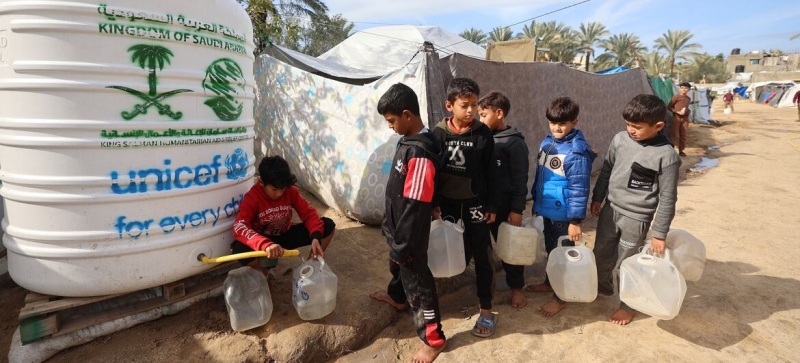
Children queue at a water point in the south of the Gaza Strip.
Dire conditions in Gaza, marked by continuing violence, rodent infestations and the spread of infectious diseases, are being worsened by restrictions on essential medical supplies, UN agencies warned on Friday.
Recently returning from a visit to the devastated enclave, Dr. Renee Van de Weerdt, the World Health Organization (WHO)’s representative in the Occupied Palestinian Territory, told reporters in Geneva: “Nothing prepares you for Gaza.”
“I thought going in a second time would make things easier. But it just doesn't,” she said.
Dr. Van de Weerdt said that since the October 2025 ceasefire between Israel and Hamas, at least 880 people have been killed in the Strip and more than 2,600 injured.
“There is perhaps less fire, but the violence continues,” she said. “We hear bombs nearby. There is gunfire every day.”
Half of Hospitals Only Partially Functional
The WHO representative described a severe health crisis in the enclave, noting that around 22 attacks on healthcare facilities have been reported in Gaza this year. She added that barely half of the hospitals are “partially functional,” while no hospital is fully operational.
“One of the key reasons these facilities are not functioning is that they are struggling with critical shortages of medical supplies,” she explained.
Vital medical supplies and equipment remain blocked outside Gaza, with serious consequences for public health.
“In Jordan, there is a prefabricated hospital that has been waiting for months to enter Gaza,” she said. “Laboratory equipment, reagents, oxygen concentrators, orthopedic items, these are not luxury items. These are essential supplies needed to make health facilities and the healthcare system function.”
She stressed that without laboratory equipment and reagents, health authorities cannot properly diagnose diseases or detect potential outbreaks.
Growing Disease Risks
“We are talking about hantavirus and Ebola virus. These are not luxury items. This is equipment needed to save lives, detect diseases, alert the world about potential outbreaks and ensure people do not die,” she said.
“With horrific living conditions, overcrowding, rodents, and limited access to water and sanitation, these supplies are urgently needed.”
Dr. Van de Weerdt explained that some items are restricted under Israeli regulations as “dual-use” materials because they could potentially have military applications. However, she questioned the inclusion of internationally recognised essential medical items under such classifications.
Prosthetic Limbs Also Restricted
She noted that prosthetic limbs are among the items considered dual-use products. Around 5,000 amputees in Gaza are currently waiting for prosthetic devices and corrective surgery to ensure proper fitting.
“For now, that surgery cannot take place in Gaza,” she said. “These unfortunate people have to wait for permission to leave.”
WHO has assisted health authorities in arranging medical evacuations for thousands of patients to more than 30 countries.
Since reopening in February, the Rafah crossing has become an important route for patients leaving Gaza for Egypt. Meanwhile, the Kerem Shalom crossing, which is available only once a week, provides a route for patients travelling to Jordan through a lengthy process.
Dr. Van de Weerdt also highlighted major challenges surrounding medical evacuations.
“Often only one or two family members can leave, and conditions for returning are uncertain,” she said.
UNRWA's Critical Role
The UN agency for Palestinian refugees (UNRWA) remains one of the main providers of healthcare services in Gaza, although restrictions on its operations have complicated its work.
UNRWA Director of Health Dr. Akihiro Seita said the agency provided 4.5 million medical consultations in Gaza last year, accounting for around 40 percent of all consultations.
"Nobody can replace what UNRWA is doing,” Dr. Van de Weerdt said.
Dr. Seita also said restrictions have prevented the agency from bringing medicines into Gaza and the West Bank and led to the closure of two health centres in East Jerusalem that previously served around 11,000 patients each year.
He added that nearly 400 UNRWA staff members have been killed during the war in Gaza, while thousands continue to work under extremely difficult conditions.
“Many of our staff still live in tents,” he said. “One staff member told me something I will never forget: ‘I feel like I’ve become an orphan of the world. No one is taking care of us. They forgot us.’”