

- CA Yunus pays homage to Liberation War martyrs on Victory Day |
- Bangladesh capital market extends losing streak for second day |
- Bangladesh celebrates Victory Day Tuesday |
- 'Different govts presented history based on their own ideologies': JU VC |
Millions Face Risk in 2026 as Global Aid Funds Shrink
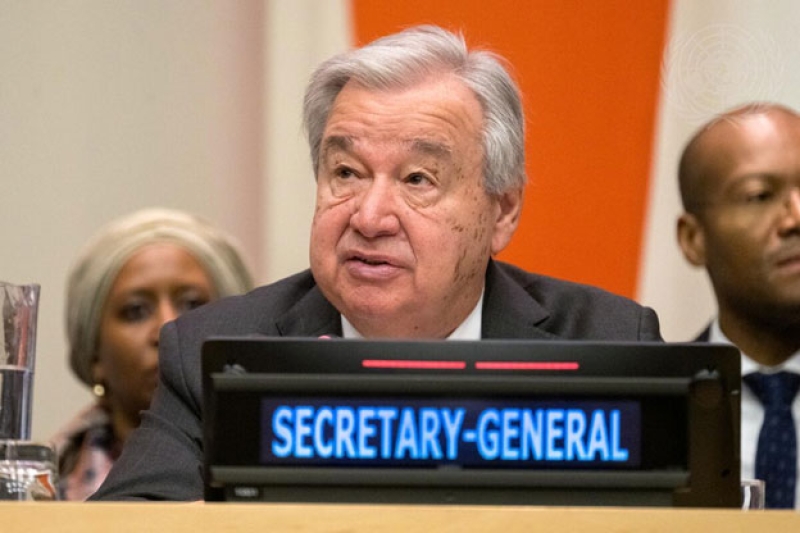
United Nations Secretary-General António Guterres addresses the high-level pledging event on the Central Emergency Response Fund (CERF) 2026.
The year 2025 has been especially turbulent for humanitarian aid operations, as global aid budgets have suffered record funding declines. As conflicts, environmental disasters and economic crises intensify—disproportionately affecting the world’s most vulnerable communities—the resources available in global emergency funds are falling far short of rapidly growing needs.
Looking ahead to 2026, humanitarian agencies warn that even more people could be left without critical support if funding gaps continue to widen. In response, the United Nations (UN) and its partners are urgently calling on the international community to boost contributions to the Central Emergency Response Fund (CERF) at an annual pledging event marking the fund’s 20th anniversary on December 12.
“The humanitarian system’s tank is running on empty—with millions of lives hanging in the balance,” UN Secretary-General António Guterres said. “We are being asked to do more and more with less and less. This is simply unsustainable.”
According to the Office for the Coordination of Humanitarian Affairs (OCHA), the UN aims to assist 87 million people next year, requiring about USD 23 billion. In addition, it is seeking roughly USD 33 billion to support 135 million people across 50 countries through 23 national aid operations, along with six additional programmes for refugees and migrants.
Despite mounting needs, funding for humanitarian appeals has dropped more sharply than ever, with contributions at their lowest levels in decades. The 2025 appeal, which sought USD 12 billion, reached around 25 million fewer people than the previous year.
OCHA reported widespread consequences, including a worsening global hunger crisis, health systems pushed to the brink of collapse, the erosion of critical education programmes and severe setbacks to protection services for displaced communities affected by prolonged conflicts. Aid workers have also faced growing dangers, with more than 320 killed this year amid what officials describe as an “utter disregard for the laws of war.”
“When we’re needed at full strength, the warning lights are flashing,” said Tom Fletcher, UN Under-Secretary-General for Humanitarian Affairs and Emergency Relief Coordinator. “This is not just a funding gap—it’s an operational emergency. If CERF falters, the world’s emergency service falters, and the people who rely on us will suffer.”
With resources in critically short supply, the UN and its partners have been forced to scale back some lifesaving services to prioritise others, leaving many urgent crises severely underfunded. As a result, assistance has been limited for displaced communities fleeing conflict in Darfur, Sudan, described as the “epicentre of human suffering.”
UN officials stressed the importance of CERF, which has delivered more than USD 10 billion in aid to over 110 countries since 2006. The fund has often provided rapid financing before other sources became available, saving countless lives.
“In many places, CERF has made the difference between life-saving help and no help at all,” Guterres said.
With CERF funding projected to fall to its lowest level in more than a decade, the UN is seeking a target of USD 1 billion and urging member states to step up support. Officials also called on governments to strengthen protections for civilians and aid workers and to reinforce accountability for violations of international law.
“We have to imagine what the next 20 years could look like with a fully funded CERF,” Fletcher said. “Not a slogan, but a survival strategy—making every dollar count for the people we serve.”