

- Lake Ontario now Lake America on Google Maps for US users after Trump order |
- Sanghai Cooperation Org meet to see Leaders of China, Russia, India |
- Illegal battery recycling plant operates after dusk in Kushtia |
- BB earns Tk 25,977 crore net profit in FY26; approves six bonuses |
- Sagar-Runi murder: ICT finds link to cultural figure |
Gaza achieves full basic food supply for first time since 2023
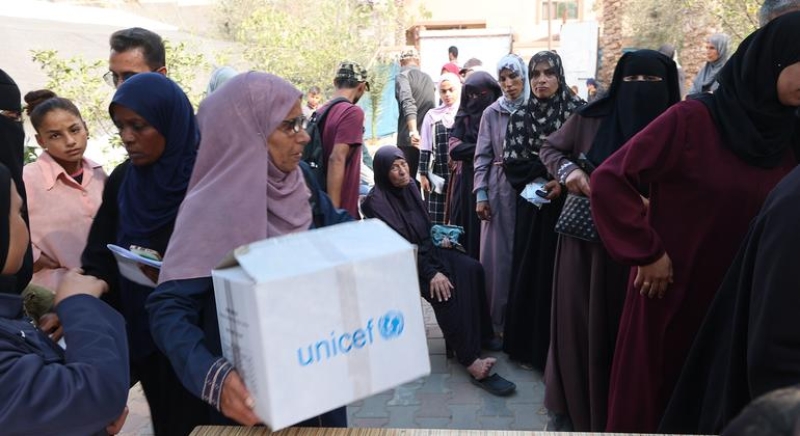
People in Gaza collect winter clothes supplies.
For the first time since 2023, humanitarian assistance will provide Gazans with enough food to meet minimum nutritional needs.
“The January round is the first since October 2023 in which partners had sufficient stock to meet 100 per cent of the minimum caloric standard,” UN Spokesperson Stéphane Dujarric told journalists on Monday.
This is an improvement compared to the end of 2025, when each family received only 50 to 75 per cent of the calories needed to stay healthy.
To further address food insecurity, the UN is supporting the production of approximately 170,000 two-kilo bread bundles daily.
Around a third of the bread is distributed free of charge to more than 400 shelters and community sites, with the remainder sold at a subsidised price.
Aid must remain ‘unimpeded’
Mr. Dujarric highlighted that last week alone, the UN and partners brought more than 10,000 metric tonnes of aid through the Karim Shalom, Karem Abu Salam, and Zikim crossings.
Supplies included food and cooking ingredients, animal fodder, soap, and other hygiene items, including diapers, winter clothing, blankets, and mattresses.
The recent announcement by Israeli authorities to suspend operations of certain non-governmental organizations (NGOs) threatens to impede critical assistance for civilians, warned over 50 NGOs.
In a statement issued on Friday, UN Secretary-General António Guterres said he was “deeply concerned” by the development and underscored that Israel must allow the “unimpeded” passage of humanitarian relief.
Violence continues
Israeli airstrikes, shelling, and gunfire continued to be reported across several areas of the Gaza Strip between Tuesday and Friday last week, the UN aid coordination office (OCHA) reported over the weekend.
Citing the Gaza Ministry of Health, OCHA said that as of Thursday, five Palestinians were reported killed and 11 others injured across the Gaza Strip over the previous 48 hours.
This comes amid harsh winter conditions and destructive winter storms that are damaging infrastructure and putting water, sanitation, and hygiene services under continued pressure.