

- Dhaka's air 5th worst in the world this morning |
- Around 7,500 Bangladeshis imprisoned in Saudi Arabia: Shama Obaed |
- Bangladesh Outperforms India in Global Hunger Index 2026 |
- Covered van hits Gazipur police patrol team, killing SI, BNP leader |
- Korean City scrambles to rescue dusky shark after it returns to canal |
UN Aid Presses On Amid Winter Hardship in Gaza, West Bank
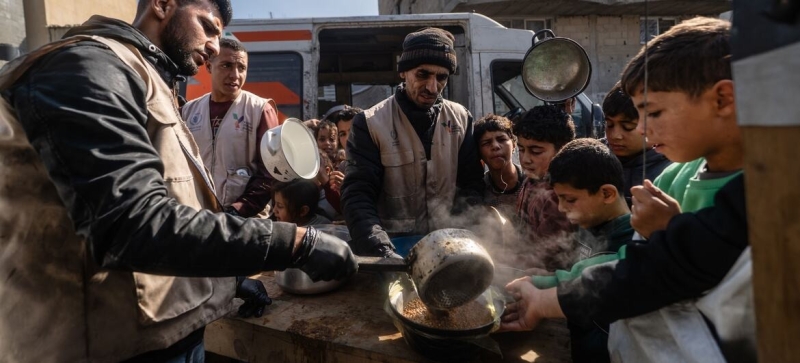
Children are served a hot meal at a WFP-supported kitchen in Khan Younis, Gaza.
Despite harsh winter conditions and ongoing access constraints, the UN and its partners are maintaining large-scale humanitarian operations in Gaza and the occupied West Bank, focusing on shelter, water, health, and education.
This was stated by UN Spokesperson Stéphane Dujarric while briefing journalists in New York on Thursday.
Citing the UN aid coordination office, OCHA, Mr Dujarric said humanitarian teams continue to support the most vulnerable families in Gaza “despite impediments” and the cumulative impact of two years of conflict between Israeli forces and Hamas militants.
“Over the past days, one of our partners distributed 7,000 dignity kits, more than 5,600 family hygiene kits, and 1.3 million bars of soap to some 200,000 people,” he said, stressing that assistance is reaching communities in both the north and south of the devastated Strip.
Just trying to survive
Emergency shelter support remains a priority as temperatures drop.
Humanitarian partners have reached more than 16,000 households across Gaza with tents, tarpaulins, and other essential materials, including kits to weatherproof and reinforce makeshift shelters. “These are people trying to survive winter in extremely fragile conditions,” Mr Dujarric noted.
Winterisation assistance has also included the distribution of thousands of blankets, mattresses, and bedding kits to improve sleeping conditions, alongside kitchen sets and clothing assistance for hundreds of households.
At the same time, water trucking operations continue across the territory. “Thirty-six partners are distributing more than 21,500 cubic metres of fresh water every day to over 2,300 collection points,” he said.
Education efforts, while constrained, are also progressing. More than 420 temporary learning spaces are now operating across Gaza, serving over 230,000 students with the support of some 5,500 teachers.
Critical to scale up
Mr Dujarric underscored that scaling up remains “a critical priority” but depends on the entry of essential supplies that are still being denied. Even so, renovation work in public schools continues, with new classrooms in Gaza City now allowing more than 1,800 children to return to learning.
On health, Mr Dujarric said the World Health Organization (WHO) recently facilitated the evacuation of 18 patients and 36 companions for medical treatment outside Gaza. “These medical evacuations remain absolutely essential,” he added.
West Bank demolitions continue
Turning to the West Bank, OCHA reported that severe winter weather has damaged or destroyed dozens of tents and makeshift shelters in Bedouin and herding communities.
The UN also warned of continued demolitions of Palestinian-owned structures by Israeli authorities for lack of permits, with 50 structures demolished over the past two weeks.
“Our message is simple,” Mr Dujarric said. “Across Gaza and the West Bank, the UN and its partners are doing everything possible to keep assistance going for people in need, despite extremely difficult conditions.”