

- 3 killed in Uttara building fire; 13 rescued |
- Late-night deal ends standoff: BPL resumes Friday |
- Global Marine Protection Treaty Enters into Force |
- US Immigrant Visa Suspension Triggers Concern for Bangladesh |
- 29 arrested under Operation Devil Hunt Phase-2: DMP |
800,000 in Gaza Living in Flood-Prone, Dangerous Sites
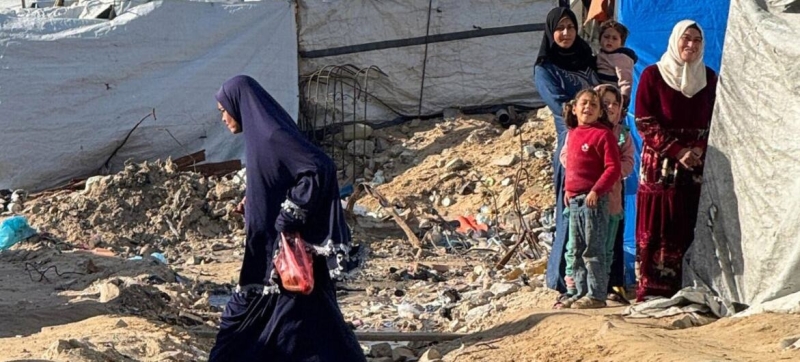
Battling harsh winter storms in Gaza, Amina stays awake at night, striking the canvas of the tent above her head to stop it from collapsing under pooled rainwater.
Inside her family’s shelter, the ground is soaked and her children are unable to sleep.
“Our situation is extremely difficult, and we want someone to help us, at least by providing a tent that truly shelters us and is fit for living,” Amina told the UN aid coordination office (OCHA) earlier this week.
Millions of others like Amina, threatened by rain, flooding and ongoing bombardment, are in urgent need of life-saving assistance. However, a recent Israeli ban on dozens of humanitarian organisations has placed much of that aid out of reach—a move that a group of independent UN human rights experts warned on Thursday violates international law.
“This strategy will create conditions that force Palestinians into chronic deprivation, threatening their very survival as a group and further violating the Genocide Convention,” the experts said. “It must be stopped.”
Green light for US Gaza peace plan
Later on Thursday, in a statement released by his spokesperson, Secretary-General António Guterres welcomed the launch of Phase Two of US President Donald Trump’s 20-point plan, announced on Wednesday.
The plan includes the establishment of a transitional technocratic Palestinian administration in Gaza and the creation of a National Committee for the Administration of Gaza.
“Any initiative that contributes to alleviating the suffering of civilians, supporting recovery and reconstruction, and advancing a credible political horizon is a positive development,” the statement said.
Mr Guterres reiterated that the UN would continue to support all efforts to end the occupation and the conflict, with the aim of achieving a two-State solution in line with previous UN resolutions and international law.
‘Uninhabitable’ shelters
OCHA said around 800,000 people—nearly 40 per cent of Gaza’s population—are now living in sites prone to flooding, where winter storms and heavy rainfall have rendered shelters uninhabitable.
As of Tuesday, UN partners reported that hundreds of tents and makeshift shelters had been blown away or severely damaged, leaving more than 3,000 people exposed to extreme weather. More than 60 inhabited buildings in Gaza City were also reported to be at risk of collapse.
Prohibited waters
OCHA noted that the Israeli military remains deployed in more than half of the Gaza Strip, beyond the so-called “Yellow Line”, where access to aid facilities, public infrastructure and agricultural land is either restricted or banned.
Demolitions of residential buildings have continued, along with bulldozer activity, including near or east of the “Yellow Line”, it said.
Access to the sea for Palestinians also remains prohibited, with continued reports of fishermen being killed or detained in waters just off the Gaza coast.
Millions worth of aid blocked
Announced as a national security measure on 30 December 2025, Israel’s new regulation bans 37 international non-governmental organisations from operating in Gaza and the West Bank.
As of 31 December, nearly $50 million worth of life-saving aid remained blocked amid repeated ceasefire violations, according to Human Rights Council-appointed independent experts. They are not UN staff and receive no salary for their work.
In early December, UN agencies and NGOs were able to deliver only 14,600 tents for 85,000 people, leaving around 1.3 million Palestinians without adequate winter shelter.
Several people, including six children, have already died from hypothermia, drowning or cold-related injuries.
“There are no words left to describe what Gaza has become,” the experts said.