

- US Ambassador visits Ctg Port to reinforce commercial coop |
- Dhaka’s air remains ‘very unhealthy’, world's 3rd worst Tuesday |
- US, Bangladesh explore expanding collaboration in energy sector |
- Tarique wraps up 2nd phase of campaign with 6 rallies in 14 hrs |
- Tigers return but deer on decline in Sundarbans |
Gaza Ceasefire Brings Relief, but Danger Persists for Children
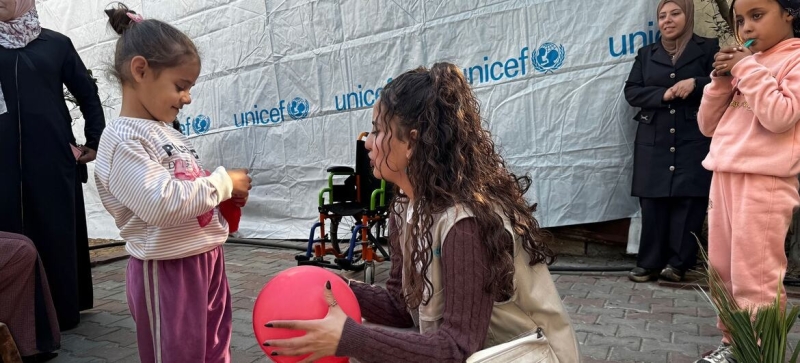
A UNICEF worker provides mental health support to a child in the Gaza Strip.
The fragile ceasefire in the Gaza Strip is making a difference to the lives of more than a million children and improving overall access to food, but more aid is still needed.
That is the assessment of two senior officials from the UN Children’s Fund (UNICEF) and the World Food Programme (WFP), who spoke to journalists in New York on Monday following a week-long visit to Gaza and the occupied West Bank.
Since the October 10 truce between Israel and Hamas, the two agencies have brought more than 10,000 aid trucks into Gaza, accounting for around 80 percent of all humanitarian cargo.
Famine reversed
Three months on, “the food security situation has improved and famine has been reversed,” said Ted Chaiban, UNICEF Deputy Executive Director for Humanitarian Action and Supply Operations.
Carl Skau, WFP Deputy Executive Director, added that most families he met “were eating at least once a day” and sometimes twice.
Commercial goods have returned to Gaza’s markets, including vegetables, fruit, chicken and eggs. Recreational kits designed to help children cope with the stress and trauma of two years of war are also being distributed.
‘These gains matter’
UNICEF and its partners have provided more than 1.6 million people with access to clean drinking water and distributed blankets and winter clothing to 700,000 people. They have also restored essential life-saving paediatric intensive care services at Al Shifa Hospital in Gaza City.
A second round of a Gaza-wide catch-up campaign for routine childhood vaccinations is now underway, while 72 additional UNICEF-supported nutrition facilities have been established, bringing the total to 196.
“These gains matter,” said Mr Chaiban. “They show what is possible when fighting pauses, political commitments are sustained and humanitarian access is opened.”
Hot meals and school snacks
WFP has significantly scaled up its operations over the past 100 days, Mr Skau said from Rome. Teams have reached more than one million people each month with full food rations for the first time since the war began.
They are serving 400,000 hot meals daily and delivering school snacks to about 230,000 children at 250 temporary learning centres, in addition to running hundreds of distribution points and around 20 warehouses.
Other humanitarian organisations are also delivering tents, blankets, mattresses and essential items through WFP’s shared logistics services. The agency is facilitating more regular aid convoys, expanding storage facilities closer to communities and scaling up cash assistance to around 60,000 households.
Situation still deadly
Despite increased aid deliveries, supplies remain insufficient to meet Gaza’s vast needs. “The situation also remains extremely precarious and deadly for many children,” Mr Chaiban said.
“More than 100 children have been reported killed in Gaza since the ceasefire in early October. Despite improvements in food security, 100,000 children remain acutely malnourished and require long-term care. Around 1.3 million people, many of them children, urgently need proper shelter.”
Families are shivering in fabric tents and bombed-out buildings amid freezing temperatures that have killed at least 10 children this winter.
Mr Skau described meeting a young woman with a 10-day-old baby who was sitting on a wet mattress inside a cold tent on the beach, calling the conditions “absolutely brutal”.
Hopes for a brighter future
Despite the hardship, signs of hope remain. UNICEF and its partners are supporting more than 250,000 children to return to learning, a crucial step for mental health and psychosocial support for over 700,000 students who have been out of school for two years.
Mr Skau recalled speaking with young girls at a temporary learning space who were happy to be back in class and eating more regularly.
“They could see a future again as nurses, engineers or restaurant owners, and they seemed impressively confident and determined to build a future for themselves,” he said.
Changing the trajectory
Humanitarian agencies say essential items, including water and sanitation supplies and educational materials, must be allowed into Gaza to help kick-start recovery and reconstruction.
Mr Chaiban said UNICEF and WFP are ready to further scale up their operations.
“The children of Gaza and the State of Palestine, including the West Bank, which is also experiencing a wave of violence, do not need sympathy,” he said. “They need decisions now that provide warmth, safety, food, education and a future.
“We have an opportunity — a window — to change the trajectory for these children. We cannot afford to waste it.”