

- Dhaka ranks world's third most polluted city this morning |
- Soldiers Guard Milan as Thousands Protest Across Europe |
- Cheese Industry Thrives In Thakurgaon Villages |
- Guterres alarmed at Israel’s sweeping closures after deadly Hebron attack |
- Bangladesh to Introduce New Law to Curb Extortion, IGP Says |
Cheese Industry Thrives In Thakurgaon Villages
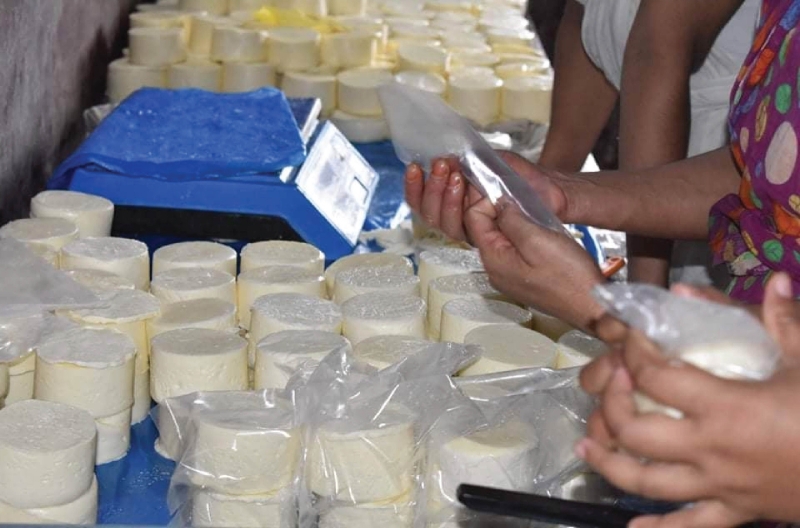
Cheese produced in Thakurgaon villages is being packaged for marketing.
By Ziaur Rahman
When Rustom Ali bought his first cow in 2006, he wanted only to ensure a regular supply of milk for his family. Nearly two decades later, that modest beginning has grown into a family-run dairy farm and cheese factory producing around 200 kilograms of mozzarella a day.
Now in his sixties, Rustom has built a family enterprise in which his elder son manages the cheese factory. He recently sold 20 cows and invested Tk 36 lakh in land to support the business's expansion. He still keeps 20 cows producing around 120 litres of milk daily, all of which goes to the factory.
A Part of his eight bighas of land is used to grow green fodder, reducing feeding costs and supporting milk production. Surplus grass is sold in local markets for an additional income.
A recent visit to Thakurgaon and some other dairy-producing areas reveals how farmers, cheese-makers and feed entrepreneurs are building an inter-connected rural economy, generating employment and linking village-based production with markets in major cities.
Bangladesh’s cheese industry is growing, creating new opportunities for dairy farmers and rural entrepreneurs. Thakurgaon has emerged as a major hub of this transformation, demonstrating the potential of rural enterprises to turn local resources into higher-value products.
According to local industry sources, Thakurgaon produces around 70 per cent of Bangladesh's mozzarella cheese. The district has about 43 active cheese factories, 18 of which hold ISO certification.
Aynul Haque, head of inclusive finance at the Eco-Social Development Organization (ESDO), said the district had around 50 small and medium-sized dairy and cheese factories. Together, they produce approximately 2,500 kilograms of mozzarella, along with 200 kilograms of ghee and buttermilk daily, generating an estimated Tk 80 crore annually.
The Palli Karma-Sahayak Foundation (PKSF), through ESDO, is supporting rural enterprises in several upazilas under the Rural Microenterprise Transformation Project (RMTP). The programme provides participating entrepreneurs with financial assistance, training, technical guidance and marketing support to improve cheese-making and other dairy businesses.
Feed accounts for more than 60 per cent of milk production costs, making locally grown fodder an important resource for dairy farmers. Across Thakurgaon, farmers are cultivating Napier and other grasses along homestead boundaries, roadsides and unused lands, supplying both their own cattle and neighbouring farms.
Yet fresh fodder is not always available throughout the year. Silage—green fodder preserved through fermentation under airtight conditions—offers a practical way to maintain feed supplies during dry periods.
Silage: A Business in off-season Feed
Golam Sarour Robin, a young entrepreneur who returned to Bangladesh after completing his master's degree in marketing in the United Kingdom, recognised the growing demand for dependable cattle feed. He established Pure Agro, a factory producing maize silage for dairy farmers.
“We now produce as much as 10,000 tonnes of silage a year,” Robin said, expressing optimism about further expansion. His venture illustrates how a challenge facing farmers can create opportunities for rural enterprise while helping strengthen the feed supply chain.
The district's dairy businesses are increasingly getting connected. Fodder growers supply feed, silage producers help meet seasonal feed shortages, farmers supply milk to collection centres and factories, and cheese-makers process the raw material into products for wider markets.
Women also contribute to the expanding industry. More than 400 workers are employed in cheese production in Thakurgaon alone, while the wider dairy value chain supports activities ranging from fodder cultivation to processing and distribution.
Similar enterprises are emerging in Bogura, Sirajganj, Naogaon, Bhola, Chuadanga and Chattogram, with some receiving support through PKSF's RMTP.
From Milk to Mozzarella, Butter and Ghee
Cheese-making allows producers to earn more from milk than by selling it raw. The process begins with heating milk to meet appropriate processing and hygiene requirements, followed by cooling it to the required temperature. Rennet, an enzyme used in cheese-making, is then added to separate the milk into solid curds and liquid whey.
The curds are cut and processed to remove excess moisture. These are heated and stretched until they develop the cheese's characteristic smooth texture and elasticity.
Other dairy products can also add value to the production process. Depending on the method used, cream can be separated and churned into butter, which can then be heated to produce ghee. Whey and other by-products may also be used for suitable dairy applications.
Local producers estimate that 100 litres of milk can yield around 10 kilograms of cheese, although the actual quantity varies according to milk quality, cheese type and processing methods.
Efficient processing and the productive use of by-products can help businesses obtain greater value from their raw materials and reduce waste.
Small Beginnings, Bigger Outcomes
Thakurgaon's growing cheese industry has opened a path for entrepreneurs who learned the trade through practical experience.
Saidul Islam once worked as a helper in a local cheese factory. In 2014, he began processing 200 litres of milk a day. He now operates his own factory, handling around 2,000 litres of milk daily and producing approximately 200 kilograms of cheese. His products reach markets in Dhaka.
His experience illustrates how practical knowledge can help turn a factory worker into an entrepreneur, with opportunities to build a business and reach markets beyond the district.
Nasima Akhter and her husband have also built a family-run cheese business, supplying resorts, restaurants and hotels, including establishments in Sylhet.
Their experiences illustrate how local producers are connecting rural production with consumers in major towns and cities.
Locally produced mozzarella generally sells for Tk 600–800 per kilogram, depending on the market and location. The demand for mozzarella is growing alongside the expansion of pizza outlets, bakeries, hotels, restaurants, supermarkets and fast-food chains, competing in some markets with imported products.
Bangladesh nevertheless continues to import cheese worth millions of dollars annually, mainly from Australia, India and New Zealand. Meanwhile, small-scale exports of locally produced cheese and cheese-based products have begun reaching markets including South Korea, Canada and India.
According to Export Promotion Bureau statistics cited for the fiscal year 2025–26, Bangladesh exported cheese and cheese products worth about US$80,000. Though modest, the figure points to potential opportunities if producers can improve product consistency, food safety, packaging, storage and marketing.
Reliable Milk, Better Quality
A growing cheese processing industry needs a dependable supply of good-quality milk. Milk collection centres are therefore becoming an important link between individual farmers and cheese factories.
Jugananda Roy operates such a centre in a cattle-farming area of Thakurgaon. His facility has a milk analyser to check quality and a chilling machine to keep milk fresh before delivery.
“I can store milk collected from farmers, and many factories collect the quantities they need from my centre,” Roy said.
The arrangement gives farmers a convenient place to sell their milk while allowing processors to collect larger quantities without visiting individual farms. Quality testing and chilling also help protect milk before processing.
Protecting Cattle in a Changing Climate
For Rustom Ali, expanding his business has also meant learning to protect his cattle from disease and extreme heat. He has lost six cows, mostly exotic, high-yielding breeds, to problems associated with heat stress and infectious diseases.
The experience has prompted him to install sprinklers and fogging or misting machines in his dairy sheds to help keep the animals cool. He has also trained one of his sons in veterinary and animal health services.
Heat stress can affect cattle health and milk production, while infectious diseases can cause substantial financial losses. Appropriate housing, adequate water, nutritious feed, cooling measures and access to veterinary services are therefore important to the sustainability of dairy farming and in turn the cheese industry.
Feed management is equally significant. Locally grown fodder reduces dependence on expensive commercial feed, while silage helps bridge seasonal shortages. Together, these can support more reliable milk production and strengthen farms against changing weather conditions.
For small dairy entrepreneurs, climate resilience is not separate from business planning. It is closely linked to animal welfare, production costs and the ability to maintain a regular supply of milk. The next challenge is to make this growth more resilient, efficient and sustainable. Email: mzrbd60@gmail.com
(From the October 2026 print edition)