

- Special prayer held at DU on 45th death anniv of Ziaur Rahman |
- 55-year-old dies in Chuadanga as fibrous mango bit blocks throat |
- Dhaka's air quality ‘moderate’ during Eid holiday |
- Thousands of tourists flock to Kuakata during Eid festival |
- 45th anniversary Ziaur Rahman's death Saturday |
Iran War Threatens Asia’s Tourism Recovery
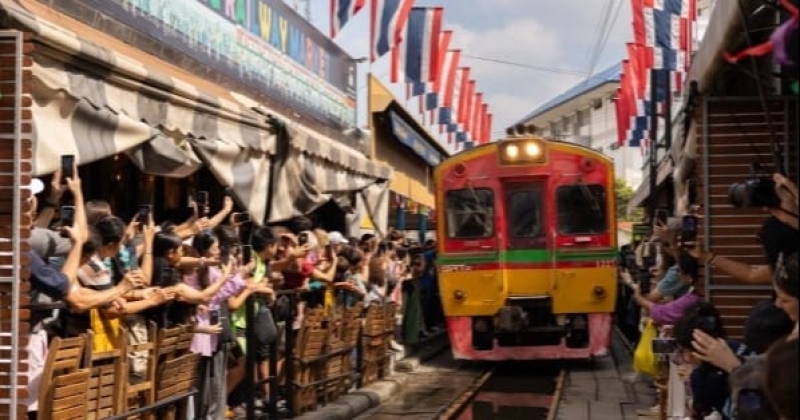
A crowd of tourists take pictures of a passing train at the Mae Klong Railway Market near Bangkok, Thailand on Dec. 6, 2025.
Rising fuel costs and economic uncertainty linked to the Iran conflict are threatening the fragile recovery of Asia’s tourism sector, just as many countries enter the peak travel season.
Tourism-dependent economies across Southeast Asia, including Thailand, Vietnam and Cambodia, are facing mounting pressure from higher airfares, weaker travel demand and flight disruptions triggered by surging energy prices.
The tourism industry, still recovering from the effects of the Covid-19 pandemic, is now confronting another major setback as transport and accommodation costs continue to rise. Industry observers warn that higher expenses are forcing many families to scale back travel plans.
The impact has been particularly severe in countries where tourism plays a major role in the economy. In Thailand, the sector contributes a significant share of national income, while millions of jobs in Cambodia and Vietnam depend directly or indirectly on travel and hospitality.
The conflict has driven up global oil prices, increasing transportation costs and disrupting aviation routes, especially for countries reliant on fuel imports and stable shipping through the Strait of Hormuz.
Airlines across the region have begun adjusting operations as jet fuel prices remain elevated. Several carriers have reduced flights or revised schedules, while longer flight paths caused by regional airspace restrictions have added to operating costs.
As a result, airfares have risen sharply, discouraging some travellers from booking international trips. Tourism operators say customers are increasingly delaying travel decisions or choosing cheaper alternatives due to uncertainty over costs.
The financial strain is also being felt by small businesses and workers dependent on tourism. In Cambodia’s Siem Reap, home to the Angkor Wat temple complex, transport operators and restaurant owners report falling incomes as visitor numbers decline and expenses rise.
Economists warn the combined effects of geopolitical tensions, inflation and reduced travel demand could slow economic growth across Asia-Pacific in the coming months.
Tourism operators across the region say recovery remains possible, but much will depend on stabilising fuel prices and easing uncertainty surrounding the conflict.