

- Dhaka’s air quality has been recorded ‘moderate’ on Saturday |
- Bailey bridge collapse disrupts direct Dhaka link to Chandpur |
- No role to play in Hasina presser, Not endorse what was said: Delhi |
- Saudi, Turkey, Pakistan sign ‘Mecca Joint Defense Agreement’ |
- Police on High Alert Over Possible Bomb Attack Threats |
Dhaka’s Middle Class Struggle Against Soaring Living Costs
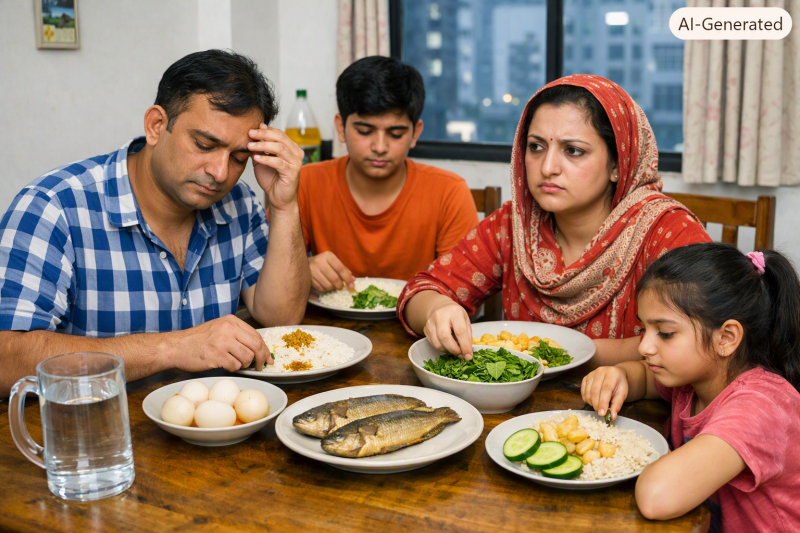
A middle class family in Dhaka City having a meal together.
Sadia Islam Raka
Long before the sun breaks over the congested horizon of Dhaka, the quiet calculus of survival begins in thousands of high-rise apartments and humble tin-roofed annexes across the megacity.
The morning whistle of a pressure cooker, the hiss of a gas stove burning low, and the soft chime of an alarm clock mark the opening notes of a daily symphony driven not by grand ambition, but by meticulous calculation.
For millions of middle-class families call this sprawling metropolis home, life has gradually transformed into a continuous exercise in balancing delicate dreams against unyielding financial realities. What was once a social tier defined by modest stability, homeownership aspirations, and the quiet assurance of upward mobility is now consumed by a far more immediate imperative: navigating the thirty days of the month without tumbling into a pit of debt.
Historically regarded as the economic and cultural bedrock of Bangladesh, the urban middle class finds itself trapped in an unprecedented vise. While nominal wages for salaried professionals have crept forward at a sluggish pace, the cost of simply existing in Dhaka has skyrocketed.
The essentials of modern life—housing, food, healthcare, utility bills, and children’s education—have expanded to absorb almost the entirety of a family’s monthly income. Where there was once a comfortable buffer reserved for weekend outings, festive shopping, and emergency savings, there is now an ever-narrowing margin for error.
The pressure begins well before dawn. To beat Dhaka’s legendary, gridlocked traffic, office-bound parents and university students rise while the streets are still bathed in grey twilight. In neighbourhoods like Mirpur, Mohammadpur, and Badda, kitchen counters become operational headquarters.
While breakfast is being prepared, mental arithmetic is already underway: factoring in the day’s rickshaw fares, bus tickets, and emergency pocket money for children who are gently reminded that every single taka must be spent with care. A commute that spans a mere eight kilometres can easily consume two hours in choked thoroughfares, bleeding both physical energy and financial resources.
For most households, budgeting has long ceased to be a simple end-of-month review; it has become a relentless daily discipline. Consider the reality of a standard middle-class family residing in a modest three-bedroom flat in Dhaka. The husband works as a mid-level executive at a private firm, bringing home a monthly salary of around Tk 45,000. His wife, balancing domestic obligations, teaches at a local coaching centre to contribute an additional Tk 18,000. On paper, a combined monthly income of Tk 63,000 appears respectable, even comfortable. Yet, as the month unfolds, this sum evaporates with startling speed.
House rent alone—often driven upward by soaring urban land values and inflation—regularly claims up to half of a family's earnings. Once the landlord is paid, a cascade of fixed utility costs follows: electricity bills inflated by summer heat, gas charges, municipal water service, internet connections essential for modern work and study, and building maintenance fees. By the second week of the month, the financial cushion has largely vanished, turning routine grocery runs into tactical missions that require visiting multiple neighbourhood vendors to compare the price of a kilogram of onions or a litre of soybean oil.
This financial squeeze has quietly reshaped the dining tables of the capital. Traditional staples that once symbolized a wholesome middle-class meal—beef, prized river fish like Hilsa or Ruhi, and seasonal fresh fruits—have increasingly shifted into the realm of luxury items.
Families now purchase these items sparingly, reserve them for guest visits, or forgo them altogether. In their place, everyday menus rely heavily on cultured tilapia or pangas, farm eggs, lentils, and locally sourced leafy vegetables. Dining out at restaurants or ordering food through delivery apps, once a frequent weekend indulgence for urban families, has been relegated to rare, carefully planned choices.
Nowhere is the burden felt more acutely than in the realm of education. In Bangladeshi society, academic achievement has long been revered as the single most reliable vehicle for social elevation. Parents will compromise on almost anything before cutting back on their children's schooling. Yet, maintaining this priority grows harder by the term. Between escalating tuition fees, mandatory coaching classes, specialized private tutors, textbooks, uniforms, and daily transport, the cost of schooling a single child can devour a big slice of the household budget. To preserve these educational investments, families make quiet, painful trade-offs, cutting out extra-curricular pursuits like music lessons, sports academies, art classes, and family vacations.
Healthcare represents another persistent source of vulnerability. In a country where out-of-pocket medical expenditure remains exceptionally high and comprehensive health insurance is largely absent; a single unexpected illness can unravel months of meticulous financial planning.
Routine clinical visits, dental care, and diagnostic tests are frequently postponed in the hope that minor ailments will resolve on their own. When there is serious illness, the financial impact is often immediate and severe, forcing families to liquidate long-term savings, sell family heirlooms, or borrow heavily from relatives or informal lenders.
The psychological footprint of this continuous strain reaches deep into family life. Evening conversations around the dinner table, which once touched on future plans, home improvements, or holiday trips, are now increasingly dominated by the cost of living, utility bills, and anxieties over price hikes of essentials.
The fundamental milestones of adulthood are being pushed further out of reach. For young professionals, the idea of purchasing a modest apartment in Dhaka—a goal that previous generations viewed as a reachable marker of success—has turned into a near-impossible fantasy as real estate prices outshine wage growth.
This economic reality is also reshaping social dynamics and family planning. Newly married couples are increasingly viewing the decision to have children through a strictly financial lens, choosing to delay starting a family until they feel financially secure—a horizon that seems to recede further with each passing year. Older parents worry about their ability to support themselves in retirement without burdening their children.
To keep pace with these challenges, the traditional concept of savings has largely broken down. The emergency funds that once provided middle-class households with peace of mind are steadily eroding. An unbudgeted home repair, a seasonal wedding invitation, or a sudden job transition can instantly disrupt a household's financial stability. To make ends meet, credit card usage has surged, alongside personal loans and informal borrowing networks.
Yet, amidst this unrelenting pressure, the narrative of Dhaka’s middle class is also one of profound, quiet adaptability. Families across the city are demonstrating extraordinary resourcefulness to supplement their main incomes. Private tuition remains a classic lifeline, with university students and schoolteachers spending their evenings tutoring neighbourhood children.
Meanwhile, the boom in digital connectivity has fuelled a wave of home-based micro-entrepreneurship. Thousands of homemakers have transformed their kitchens and living rooms into small businesses, selling homemade meals, boutique clothing, crafts, and baked goods through social media platforms.
Lifestyles have been systematically restructured to match the times. Wardrobes are updated less frequently, electronic gadgets are repaired repeatedly rather than replaced, and leisure activities have shifted away from expensive shopping malls and commercial venues toward community parks, local neighborhood gatherings, and evenings spent at home.
Technology has played a double-edged role in this transition. While digital platforms offer new pathways for remote work and commerce, social media also projects curated images of affluence that can subtly compound the emotional strain felt by those struggling to maintain their footing.
But a vibrant middle-income segment is essential for driving domestic consumption, sustaining local businesses, generating tax revenue, and fostering social innovation. When millions of households are forced to curtail their spending and forego random purchases, the ripple effects touch every sector of the urban economy, leading to sluggish market demand.
Policy experts emphasize that addressing these systemic pressures requires a multi-pronged strategy that goes beyond periodic salary adjustments. Creating lasting stability for middle-income households will depend on controlling food inflation, expanding affordable public healthcare options, scaling up efficient urban transit systems, regulating private education costs, and opening up high-value employment opportunities. Otherwise their daily struggles will only compound, but their quiet endurance continues to define the living heartbeat of Bangladesh's dynamic capital.
(From the print edition of the month of July 2026.)