

- Around 7,500 Bangladeshis imprisoned in Saudi Arabia: Shama Obaed |
- Bangladesh Outperforms India in Global Hunger Index 2026 |
- Covered van hits Gazipur police patrol team, killing SI, BNP leader |
- Korean City scrambles to rescue dusky shark after it returns to canal |
- PM inspects Mongla Port, Sundarbans, proposed economic zone |
BDR mutiny was conspiracy to destabilise BD: Inquiry chief
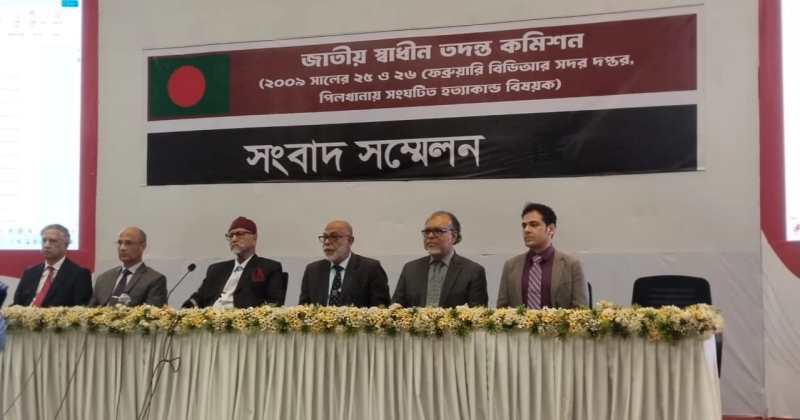
Major General (retd) Fazlur Rahman, head of the National Independent Inquiry Commission briefed reporters on theid findings in the presence of other commission members._11zon
The 2009 BDR mutiny at Pilkhana headquarters, which took place on February 25–26, was a premeditated conspiracy aimed at destabilising Bangladesh, prolonging political power, and weakening the country’s security forces, said Major General (retd) Fazlur Rahman, head of the National Independent Inquiry Commission.
Fazlur Rahman made the remarks on Sunday evening while briefing reporters at the commission’s office in Dhaka’s Science Lab area after submitting the investigation report to the Chief Adviser.
The commission found involvement of several influential political figures in the mutiny, with names of senior Awami League leaders surfacing during the probe.
Those mentioned include former Prime Minister Sheikh Hasina, Barrister Fazle Noor Taposh, Sheikh Selim, Mirza Azam, Jahangir Kabir Nanak, Sahara Khatun, then Security Adviser Maj Gen (retd) Tarique Ahmed Siddique, former Army Chief Gen (retd) Moeen U Ahmed, and former DGFI Chief Maj Gen (retd) Akbar.
Discussing the causes of the mutiny, Fazlur Rahman cited multiple factors, including dissatisfaction with the Dal-Bhat programme and the creation of the BDR Shop, which significantly increased BDR personnel workloads.
He also noted opposition among some personnel to the presence of army officers within the force, along with internal crises within BDR.
“Fundamentally, the mutiny aimed to weaken the army and destabilise Bangladesh. The main reasons were to undermine the army, with neighbouring India seeking to destabilise the country. Extending the political tenure of the ruling Awami League was also among the motives. India was a beneficiary from the incident,” he said.
On reports of missing army officers, the commission found evidence supporting claims that five army officers disappeared after the mutiny.
Fazlur Rahman said that RAB personnel were deployed at Pilkhana’s Gate 5 at the time but did not intervene, reportedly due to instructions from then RAB Additional Director General Col Reza Nur.
He stressed that RAB and police do not require special orders to act during such incidents.
On foreign involvement, he stated that the commission identified a “neighbouring country” linked to the incident, noting that Sheikh Hasina and her associates had taken refuge there.
He added that grievances tied to Operation Dal Bhat were reportedly used to mask the underlying objective of destabilising the country and weakening BDR.
The inquiry also highlighted that political decisions blocked army action during the mutiny, terming the absence of a military response a “major conspiracy.”
Witness accounts suggested participation from outsiders alongside BDR personnel, some affiliated with Awami League, Jubo League, and Chhatra League.
The commission said a group of 20–25 people entered the compound and later emerged with a procession of around 200.
Referring to intelligence lapses, Fazlur Rahman described them as “mountain-sized.”
Regarding former Army Chief Gen (retd) Moeen U Ahmed’s statement on not conducting an army operation during the mutiny, he said the former chief informed the commission online that intervention might provoke Indian involvement, warning, “they might not return to India like 1971.”
The investigation also found that 721 Indian nationals entered Bangladesh during the period, with 67 unaccounted for.
The commission recommended that the government trace them and seek explanations from India. Some perpetrators inside Pilkhana reportedly spoke in Hindi.
“If we fail to properly evaluate this incident, the country may face another BDR-like mutiny in the future. For national security, truth and corrective measures are essential,” Fazlur Rahman told journalists. - UNB