

- COP31 to Focus on Implementing Climate Policies |
- 16 Killed, 46 Injured as 7.0-Magnitude Quake Hits China's Xizang |
- Dhaka Ranks 12th Among World's Most Polluted Cities on Friday |
- 10 universities in US and UK voted the best in the world |
- Speaker sees no possibility of Hasina's return even in 10-yrs |
Building Resilient Food Systems Amid Global Shocks
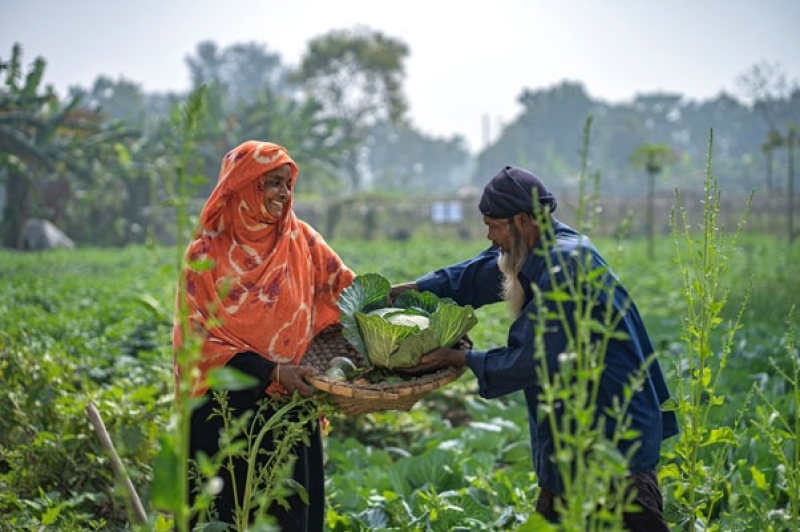
Farmers in Bangladesh.
The latest shock to global food systems, triggered by conflict in the Middle East and disruptions around the Strait of Hormuz, has once again exposed a fragile reality: the world’s food systems remain highly vulnerable to external shocks.
For Asia, especially South Asia, where agriculture underpins millions of livelihoods, the consequences are immediate and severe. Rising fuel prices, supply chain disruptions and limited access to fertilizers are pushing already fragile systems to the brink.
The Strait of Hormuz is not just a geopolitical chokepoint; it is a critical lifeline for fuel and agricultural inputs across Asia. A significant share of fertilizers and their raw materials, including natural gas, transit through or originate from this route.
For countries such as India, Bangladesh and Nepal, where agriculture employs between 38% and over 60% of the workforce, this dependency creates systemic risk. When supply chains falter, the effects cascade quickly: input costs rise, planting cycles are disrupted and farmer incomes shrink.
Even if shipping routes reopen, recovery is likely to be slow. Damage to energy infrastructure and ongoing geopolitical uncertainty mean price volatility and supply constraints can persist for months.
For smallholder farmers, this creates a dual crisis. Exporting produce becomes difficult due to logistical bottlenecks, while fuel shortages hamper domestic distribution. At the same time, the next cropping cycle approaches, with essential fertilizers either unavailable or unaffordable.
This is not an isolated disruption. From the COVID-19 pandemic to the war in Ukraine, global shocks are becoming more frequent and interconnected. Each crisis compounds the last, pushing smallholder farmers, the backbone of global food production, into deeper uncertainty. The question is no longer whether disruptions will occur, but how prepared our systems are to withstand them.
At the heart of the problem is overdependence on external, input-intensive systems: chemical fertilizers, fossil fuels and long, fragile supply chains. Reducing this dependence is central to building resilience.
Regenerative Agriculture and Renewable Energy
Regenerative agriculture and renewable energy offer a compelling pathway forward.
At its core, regenerative agriculture restores soil health, enhances biodiversity, improves water retention and reduces reliance on synthetic inputs. Practices such as crop diversification, organic soil enrichment, reduced tillage and integrated pest management shift farming from an extractive to a restorative model.
By rebuilding natural soil fertility, these approaches reduce dependence on external inputs. Instead of relying heavily on urea in rice cultivation, regenerative systems promote nutrient cycling and biological nitrogen fixation through legumes, alongside the use of compost and manure to strengthen soil organic matter and ensure a steady nutrient supply.
Integrating renewable energy further strengthens resilience. Solar-powered irrigation replaces fuel-based systems with clean, reliable energy, lowering operational costs and improving water-use efficiency, especially during periods of disruption.
The evidence base for these approaches is growing. In Bangladesh, multiple studies show that solar irrigation consistently outperforms diesel systems, improving returns, enhancing food security and reducing irrigation costs by 20–50%, while increasing profitability (Rana, 2021; Buisson, 2024; Sunny, 2023; Sarker, 2025).
Research also shows that bio-based inputs such as compost, biochar and green manure can partially replace synthetic fertilizers, often without yield loss, while improving soil health (Naher, 2021; Ferdous, 2023; Behera, 2025).
Economic Resilience Through Regeneration
Regenerative agriculture is not just an environmental solution, it is an economic one.
By reducing dependence on volatile external inputs such as chemical fertilizers and fossil fuels, it shields farmers from global price shocks while improving long-term productivity and profitability.
Evidence from Nepal and India reinforces this trend: while yields generally remain stable, reduced input costs significantly increase farm profitability (Magar, 2022; Dhakal, 2022; Berger, 2025).
A broader analysis by the Observer Research Foundation (2025) finds that although yields may dip slightly during transition, most cases report higher yields over time, alongside improved income stability driven by lower input dependence.
Similar trends are being observed globally, reinforcing that regenerative approaches can deliver both resilience and profitability across diverse farming systems.
Importantly, these outcomes are already visible in South Asia. Through programmes led by Heifer International, smallholder farmers are adopting regenerative and climate-smart practices that reduce costs, improve yields and strengthen resilience.
In Bangladesh’s Jashore district, women farmers organised into cooperatives have reduced irrigation costs, improved productivity and strengthened market access through solar irrigation, organic soil management and collective action.
As one farmer, Shirin Akter, shares: “Adopting climate-smart practices and pooling resources through my cooperative allowed me to grow diverse crops. When drought hit, I still had harvests to sell, and my cooperative helped me recover quickly.”
For farmers like Shirin, these shifts are transformative, turning vulnerability into resilience through diversified systems, lower input dependence and stronger collective support. Similar models in Nepal show how regenerative, community-based approaches can reduce resource pressure while improving incomes.
Scaling the Transition
Scaling this transition requires action beyond the farm.
Policymakers must realign incentives to support sustainable practices and reduce dependence on imported inputs. Financial institutions and insurers should recognise the lower risk profiles of regenerative systems.
Businesses need to embed sustainability into sourcing decisions and build long-term supply relationships with farmers adopting regenerative practices. At the same time, clearer communication from markets can help shape consumer demand for sustainably produced food.
The stakes are high. The World Food Programme warns that around 45 million more people could be pushed into hunger if current disruptions persist, adding to the 318 million already food insecure.
We cannot continue rebuilding fragile food systems after every shock. We must redesign them. Regenerative agriculture offers a pathway to reduce dependence on volatile inputs, restore ecological balance and build resilience where it matters most, at the farm level.
Replenishing what has been depleted is not just an environmental necessity, it is the foundation of more secure, equitable and resilient food systems across Asia.