

- ADP Implementation Hits Five-Year Low at 1.85% |
- NYC BNP leaders, activists upbeat ahead of Tarique Rahman’s arrival |
- PM off to New York to attend UNGA |
- 8 Killed in Ashulia Garment Factory Fire |
- Apratim Murder Suspects Confessed, Says Home Minister |
Kazakh Editor Links Hiroshima Legacy to Global Disarmament
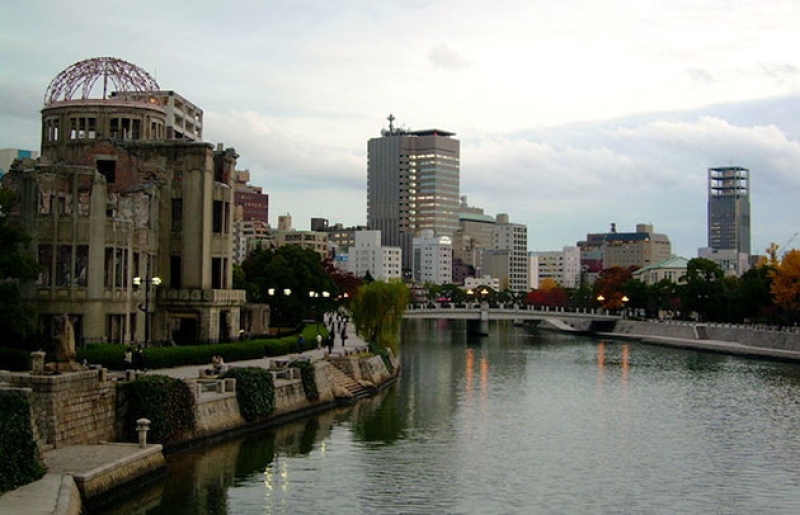
Atomic Bomb Dome by Jan Letzel and modern Hiroshima.
Eighty years ago, the atomic bombings of Hiroshima and Nagasaki left a lasting reminder of the inhuman nature of nuclear weapons. Kazakhstan, too, is deeply scarred by nuclear tests conducted during the Soviet era. Having covered the activities of Soka Gakkai International (SGI) in Kazakhstan—including its support for exhibitions and documentaries on nuclear abolition in Astana—INPS Japan recently interviewed Zhanna Shayakhmetova, editor-in-chief of The Astana Times, a leading English-language newspaper that continues to convey messages of disarmament and peace to the world.
In the interview, Shayakhmetova discussed the role of religious leaders gathering in Astana this September, the importance of passing on memories to younger generations, and the responsibility journalism holds in this endeavor.
Q: This August marks the 80th anniversary of the atomic bombings of Hiroshima and Nagasaki—tragic events that still remind the world of the catastrophic consequences of nuclear weapons. Amid ongoing conflicts and rising geopolitical tensions among nuclear-armed states, the Doomsday Clock now stands at 89 seconds to midnight. While civil society movements are intensifying their calls for disarmament, raising broader and sustained public awareness—especially among younger generations—remains a challenge. In this context, Kazakhstan will host the 8th Congress of Leaders of World and Traditional Religions in September. What potential do you see in the role of religious leaders in advancing peace and nuclear disarmament, particularly through education and moral leadership?
Zhanna Shayakhmetova:
The atomic bombings of Hiroshima and Nagasaki demonstrate the horrifying destructive power of nuclear weapons. These explosions left a lasting impact on humanity. In one interview, activist Karipbek Kuyukov said, “It was a moment of shame for the international community and of horror for the people of Japan. It is a moment upon which we should forever shine a light to ensure that nuclear weapons are never used to kill again.”
Kuyukov is among the 1.5 million Kazakh people who suffered due to the 456 nuclear tests conducted over 40 years at the Soviet Union’s Semipalatinsk Test Site. Born without arms due to his parents’ exposure, he is now a globally recognized non-proliferation activist and painter, whose artwork captures the suffering caused by nuclear testing.
Religious leaders hold a unique and powerful role in advancing peace and nuclear disarmament. Kazakhstan’s hosting of the Congress is both timely and significant. Our country has taken bold steps toward disarmament. This gathering will send a powerful message: peace is not only a political goal but also a spiritual one. When leaders speak with a united voice, especially to young people, they can shift the narrative from fear and apathy to responsibility and hope.
Q: Japan has preserved the memory of its nuclear past through museums, education, and hibakusha testimonies. How important is it for Kazakhstan to similarly preserve and communicate the experiences of those affected by Soviet-era nuclear testing?
A:
It’s vital that Kazakhstan continues to preserve and tell the stories of those affected. These aren’t just historical facts—they’re lived experiences, especially in places like Semei. Generations still feel the physical and emotional toll.
I believe personal storytelling and education are the most effective tools. Documentaries and exhibitions in schools and public spaces can bring these stories to life. Through literature, films, and digital media, students can connect on a human level—especially when survivor testimonies are integrated into curricula.
As journalists, we have a responsibility to keep these stories visible—not only on anniversaries, but through ongoing dialogue about peace. Kazakhstan has a powerful story to tell. We must not let it fade into silence.
One touching story we covered was that of Tore Naerland from Norway, co-founder of Bike for Peace. After losing his eyesight as a teen, he dedicated his life to peace activism. During a global cycling tour, he met a Hiroshima survivor whose story inspired him to focus on nuclear disarmament. Stories like this remind us why these conversations matter.
Q: Kazakhstan has earned global recognition for its leadership in disarmament—closing a major nuclear test site and voluntarily giving up its nuclear arsenal. How do you view the role of Kazakh media, including The Astana Times, in raising global awareness of this legacy?
A:
At The Astana Times, we’re committed to consistently reporting on disarmament. Our newsroom supports fact-based coverage of nuclear issues, and we see it as our mission to amplify Kazakhstan’s ongoing contributions to global non-proliferation efforts.
We also prioritize the next generation. We regularly publish young voices and have collaborated with advocates like social scientist Marzhan Nurzhan, who contributed articles to increase public awareness about the nuclear legacy.
Our correspondent Nagima Abuova covered the Third Meeting of States Parties to the Treaty on the Prohibition of Nuclear Weapons (TPNW) at the UN in March 2025. We were proud to be the only English-language Kazakh outlet reporting directly from the event, which was chaired by First Deputy Foreign Minister Akan Rakhmetullin.
Looking ahead, our journalist Aibarshyn Akhmetkali will represent Kazakh media at the SnT2025 Science and Technology Conference in Vienna, hosted by the CTBTO. This is another opportunity to amplify Kazakhstan’s voice and support a world free of nuclear testing.
Kazakhstan has something meaningful to offer the global disarmament dialogue, and we’re committed to ensuring the world hears it.
Q: Both Japan and Kazakhstan strongly advocate for a nuclear-free world. From your perspective, how can journalism help strengthen global solidarity and advance disarmament efforts such as the TPNW? What responsibilities do media professionals hold in this process?
A:
Journalism plays a crucial role in connecting nuclear-affected communities and advancing treaties like the TPNW. Kazakhstan and Japan share a tragic nuclear legacy, and this shared experience creates a foundation for international solidarity.
As media professionals, our job is to shine a light on these human stories. We must give voice to survivors, activists, and scientists whose experiences are often overshadowed by politics. Through our reporting, we help people understand the deeply personal and generational impacts of nuclear weapons.
By covering events like the TPNW meetings and CTBTO conferences, and publishing both expert and youth perspectives, we help build a more informed and engaged global public.