

- Dhaka's air 5th worst in the world this morning |
- Around 7,500 Bangladeshis imprisoned in Saudi Arabia: Shama Obaed |
- Bangladesh Outperforms India in Global Hunger Index 2026 |
- Covered van hits Gazipur police patrol team, killing SI, BNP leader |
- Korean City scrambles to rescue dusky shark after it returns to canal |
Do Resources Shape Faith-Based Engagement and Diplomacy?
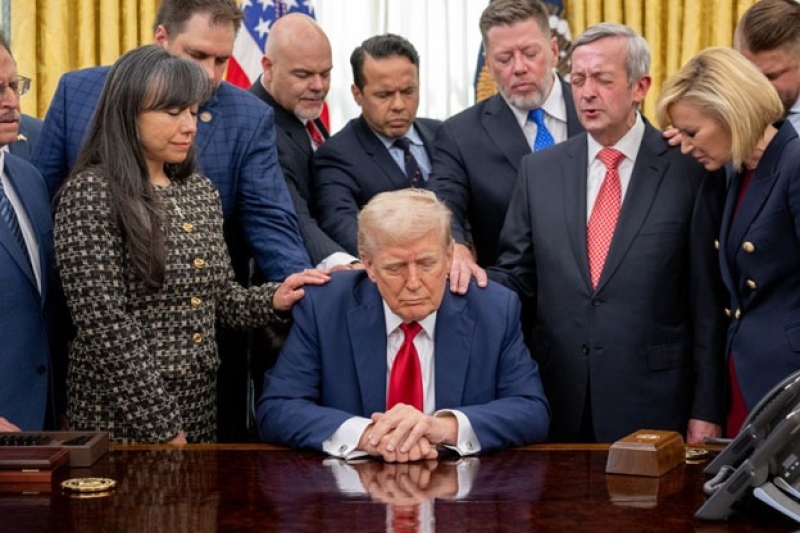
President Donald Trump Joins Faith Leaders in Prayer
Several events, meetings, consultations and initiatives taking place among faith-inspired, “faith-based” and similar efforts over the past year—particularly in the United States—have concerned me.
Coming from a background in human rights, international development and humanitarian service, I have witnessed the arc from “none” to increasing interest by Western governments in “religion”—religious engagement, religion and development, religion and foreign policy, religious freedom, religious peacebuilding, religion and peace, and more, including even religion and agriculture. Essentially, religion and everything.
Non-Western governments across Africa and Asia, including areas overlapping with what we variably call “the Middle East”, have long shown interest and have actively engaged religious leaders and institutions.
As many scholars, observers and foreign policy analysts have noted, this governmental interest has often gone beyond any genuine fascination with faith. Instead, it has leaned towards the obvious instrumentalisation of religious leaders, organisations and groups in support of specific political agendas—for example, making peace with Israel, or lending legitimacy to corrupt, violent and politically repressive leaders and regimes.
In fact, the marriage between select religious leaders, institutions or groups and political actors dates back to the empires that preceded the Westphalian state system.
I recall several stories from my time serving as a staff member at the United Nations and in other international fora. One involved an Arab and an Indian diplomat speaking with a European counterpart during a UN Strategic Learning Exchange on Religion, Development and Diplomacy, which I coordinated and facilitated in 2014.
The discussion centred on how best to “benefit” from working with religious leaders to affirm the messaging of certain political parties, particularly—though not exclusively—during elections. The Arab diplomat patted the European on the back and said, with a smile and a wink, “You are finally catching up on how to use these religious leaders—congratulations, my friend.” The Indian diplomat, looking bemused, added, “Yes. And be careful.”
Another episode took place during a meeting I organised in early 2015 in a basement conference room at the UN. The gathering brought together UN officials and a diverse group of religious actors involved in peace and mediation efforts across selected African and Asian conflict settings.
A European Christian leader from a well-known multi-religious organisation intervened to address concerns raised by some faith-based NGO leaders about the instrumentalisation of religious actors. While several faith representatives warned against being used to “rubber-stamp decisions already made by governments and intergovernmental organisations”—with both UN and EU officials present—this particular Western Christian leader stated, “I am not worried about that at all. In fact, I would like to say to my secular colleagues in this room: please use us. We can certainly benefit you. We are not common civil society actors; our mission makes us exceptional.”
My final example comes from my tenure as secretary-general of an international multireligious organisation convening religious leaders around “deeply held and widely shared values”.
Upon becoming a member of the UN Secretary-General’s High-Level Advisory Board on Effective Multilateralism, I arranged a meeting between religious leaders from my organisation and members of the Advisory Board. The goal was to foster a quiet but candid dialogue between political and religious leaders on how and why multilateralism could be strengthened through multireligious engagement.
I should note that multireligious engagement, if carefully stewarded, can be— as I have long argued—resistant to the instrumentalisation of religious actors for any single governmental agenda. This concern is hardly surprising, given developments from India to the United States, from Russia to Israel and beyond.
Once again, a religious leader encouraged members of the Advisory Board to “use” their religious wisdom because of their “exceptional” mission. Later reflections among Board members led to concerns that such multireligious engagement might be inadvisable, particularly due to apprehensions about the involvement of “Muslims” in these spaces.
Fast forward to 2026, a year into an increasingly belligerent US presidential administration. Its record includes relatively “minor” actions such as renaming the Ministry of Defence as the “Ministry of War”, alongside far more serious human rights violations affecting citizens and immigrants, and alleged manipulation of—and disregard for—the rule of law at home and abroad. Of course, one hardly dares mention support for regimes accused of committing genocidal violence under the guise of self-protection.
In this climate, I have listened to discussions among some of the United States’ most respected faith-based organisations, each with a strong history of humanitarian service worldwide. These groups are reportedly seeking to engage the administration “constructively”, praising what they describe as “unprecedented” outreach to certain Christian NGOs, leaders and faith actors—presumably in pursuit of noble objectives. This, it seems, is considered strategic religious engagement.
While some participants may have felt uneasy with aspects of this rhetoric, the diplomatic silence—including my own—was striking. The underlying message appeared clear: “We need access to the White House. We need more resources to do our good work.”
Why was I silent? Because I am the quintessential “other”, whose outspokenness has already resulted in the loss of security and a sense of home many times over. This is neither an excuse nor a justification—merely an admission of cowardice.
Within this Kafkaesque reality, I grapple with difficult questions: What does it take to speak truth to power publicly, as Minnesotans and Palestinians have been compelled to do with their own regimes? Is silence strategic diplomacy, especially when acting in the name of the “godly” and claiming to be “exceptional” actors?
Conversely, is this administration—towards which we exercise such caution—silent about its own supposed “divine mission”? Is being “kind” and doing godly work sufficient justification for partnering with regimes that disregard the rule of law at home and abroad? Does faith-based diplomacy require collusion, silence, or taking dissent to the streets?
If so, what difference does faith-based diplomacy truly make in advancing civic engagement, human rights, the rule of law or principled leadership? Or do these values no longer matter, eclipsed by the self-interests of a powerful and wealthy few?
Perhaps it is worth revisiting the advice offered by the Indian diplomat to his Western colleague more than two decades ago: how, exactly, should we “be careful”?
Professor Azza Karam is President of Lead Integrity and Director of the Kahane UN Program at Occidental College’s Diplomacy and World Affairs Department.