

- Speaker sees no possibility of Hasina's return even in 10-yrs |
- Bangladesh Ambassador to Japan returns home ahead of PM’s visit |
- Sajek Road Blockade: 2,933 Tourists Evacuated Amid Gunfire |
- Climate Crisis May Displace 7.5% of Bangladeshis by 2050 |
- NEIR Rollout Targets Tk 2,000cr Revenue Loss From Illegal Phones |
Begum Khaleda Zia, a Pragmatic Nationalist Leader
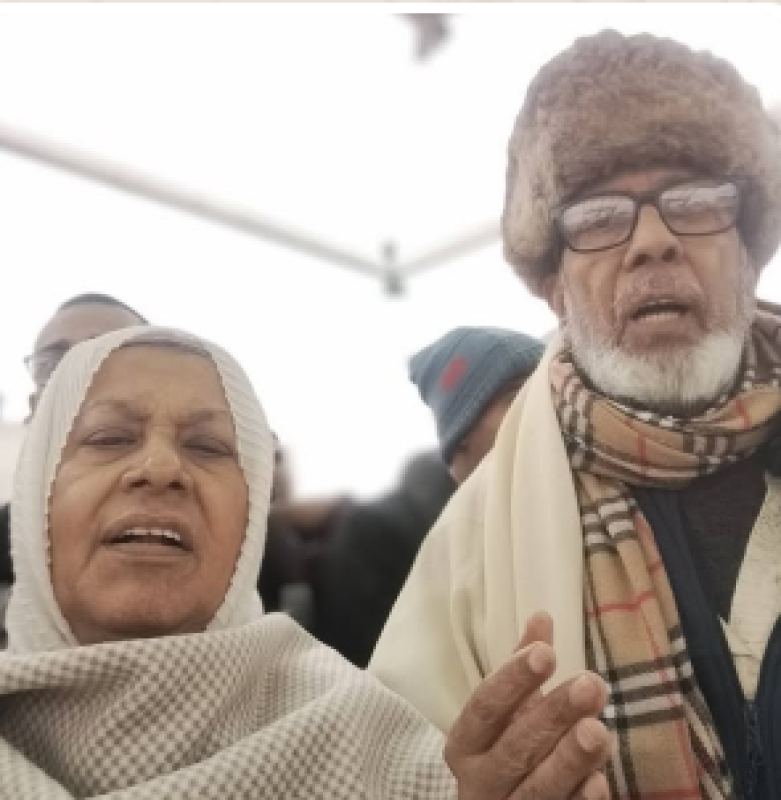
Prof. Jasim Uddin Ahman with Dr, Nazma Ahmad
Prof. Jasim Uddin Ahmad
Begum Khaleda Zia the great leader of Bangladesh left us for her eternal journey on 30 December 2025 (Innalillahe wa innaelaihe rajeun).
May Allah grant her Jannatul Ferdous. Ameen
We visited the mazar of Morhum Khaleda Zia and Late President Ziaur Rahman on 3rd January 2026 for offering Doa and Monajat.
Begum Khaleda Zia is the first woman Prime Minister (PM) of Bangladesh. She became the Prime Minister twice in the country's history from 1991 to 1996, and again from 2001 to 2006. Khaleda Zia is also the second Prime Minister in the Muslim majority countries, after Benazir Bhutto of Pakistan, to head a democratic government as Prime Minister. In the global ranking of PMs, Forbes magazine, in its list of the 100 Most Powerful Women in the World, ranked Khaleda Zia at number 14 in 2004, number 29 in 2005, and number 33 in 2006 [1,2,3].
I had the privilege and honor to meet Begum Khaleda Zia on several auspicious occasions during her tenure, as the Leader of opposition (1996-2001) and as the Prime Minister (2001-2006). I am going to mention a few important of them in the following short write-up.
In 1999, I was elected as the President of the Federation of Bangladesh Universities Teachers Association (FBUTA), the apex organization of the Teachers’ Associations (TA) of all the Public Universities of Bangladesh. I was also the President of Jahangirnagar University Teachers’ Association (JUTA) during that period. After a long period, a Teacher Association Leader from the anti-Awami League block was able to win this coveted post in a very hardly contested election. Madame Zia was very impressed and happy on my victory in the FUBTA election.
We, the FBUTA leaders, were invited to the Office of the Leader of the Opposition and joined as a group, consisting of myself, Prof. M. Faruque, Secretary General of FBUTA, Prof. Khalilur Rahman and others. Abdul Mannan Bhuiya, the then Secretary General of Bangladesh Nationalist Party was also present and moderated the discussion. Begum Zia congratulated us on our success in the election. She discussed the misdeeds of Awami rule and said there is an urgent need for greater unity of all the professional persons, teachers and other forces of the country for the coming general election in 2001 to defeat Bangladesh Awami League headed by Sheikh Hasina. She requested us to unite and form an organization of like-minded university teachers.
We visited many of the Public Universities and could come to a consensus to form an organization named “Gonotrantric Shikhak Parishad” (Democratic Teachers Parishad). I was the President and Prof. Khalilur Rahman was the Secretary General of the Ad-hoc committee. We requested another appointment with Madame Zia for discussing the progress and prospects. We went to the Office of the opposition leader and informed her about groundwork and future programmes. We requested her to be the Chief Guest in the 1st Convention of Democratic Shikhak Parishad. She gladly accepted our invitation.
The 1st Convention of Democratic Shikhak Parishad was held in the Auditorium of National Press Club, Dhaka in January 2001. Teachers’ representatives from various public universities of Bangladesh attended. Begum Khaleda Zia graced the Convention as the Chief Guest. Prof. Maniruzzan Miah, former Vice Chancellor of Dhaka University was present as the Special Guest. Leaders of many of the Pro-BNP professional organizations also attended the convention. Madame Zia inaugurated the convention and gave a historical speech outlining her vision about higher education and research in Bangladesh, emphasizing the continuation of widely accepted education policy and visions by late President Ziaur Rahman. Her speech was given lead coverage in the National dailies as headline. The news of the convention was also covered with due importance in all electronic media.
In the convention, I was elected the President and Prof. Khalilur Rahman, Secretary General of Gonotrantric Shikhak Parishad unanimously. Gonotrantric Shikhak Parishad played a significant role with Sata-Nagorik Committee (group of Hundreds of Distinguished Citizens) in mobilizing public opinion against misdeeds of Sheikh Hasina regime. As expressed by many national and international neutral election evaluators, the large participation of teachers, professionals and intellectuals took BNP to a new height, which was one of the important factors for achieving BNP’s win in the 2001 National election with two-thirds majority, and landslide victory. The important role of these teachers and professionals led to formulating pro-people policy and programmes for reformation and rebuilding the Bangladeshi national feelings.
For quite a long time, we were mobilizing National and International opinion against the unilateral upstream water withdrawal and diversion of rivers by India. We organized many International and National Conferences, Seminar and Workshops under the banner of International Farakka Committee. Atiqur Rahman Eusufzai Salu is the Chairman of International Farakka Committee and I am the President of Bangladesh Farakka Committee. On August, 2002 IFC Chairman, Atiqur R. K. Eusufzai and myself met the honorable Prime Minister in her office and apprised her about the forthcoming publication of a national documentation [4]. We published a very important documentation, entitled “National Documents on Arsenic and Farakka”, in 2003 [5]. I was the Editor for this publication.
In the 1st page of this documentation, we expressed our profound gratitude to Shaheed President Ziaur Rahman, who first, in 1976, raised the Farakka issues in the United Nations. We also expressed our great appreciation to her Excellency Prime Minister Begum Khaleda Zia for expressing the legitimate concern of Bangladeshi people due to Farakka Barrage in her speech at the United Nations General Assembly on Oct 1, 1993.
After the publication, we sought an appointment with PM Office, to present the publication to the Prime Minister. She was glad to give us an audience on August 4, 3003. Atiqur Rahman Eusufzai Salu, Chairman of International Farakka Committee, Syed Tipu Sultan, Secretary General IFC, myself, Prof. Syed Safiullah, Eng. S I Khan, Mustafa Kamal Majumder, Dr. Nazma Ahmad and others went to PM’s office and presented her the documentation. She was very happy and congratulated us for our historical works. She unveiled the cover of the Documentation [6].
We informed her that we are planning to organize a Programme on the bank of Brahmaputra river near Chilmari Bandar, Kurigram. The programme will be a “Long March and Grand Rally” and sought the support of her Government. She gladly agreed to our request and asked the Minister for LGED&C, to extend all the support.
We also requested her to give necessary directives to the Ministry of Foreign Affairs so that the Documentations could be distributed to United Nations, other International Donor Agencies and Foreign Missions. She accepted our request and instructed the Political Secretary to follow up the matter.
On March 4, 2005 the Long March and Grand Rally, was held at Chilmari Bandar, on the bank of Brahmaputra in protest and demand for the cancellation of River Interlink project of India [7]. It was a huge rally of protesters, where more than half a million people participated from all walks of life, from Bangladesh, USA, UK, Germany and other parts of the world. Prof. K M A Malik was the coordinator of the Chilmari Long March Committee in UK. It was a grand success, people raised their voices against unjust water withdrawal by India, there were slogans all around - Hamak Pani Hamak Deo (give our share of water to us). Speakers recalled and remembered the great leader of the peasants and masses, Maulana Abdul Hamid Khan Bhasani, who first led the Farakka Long March in 1983 and Shaheed President Ziaur Rahman, who first, in 1976, raised the Farakka issues in the United Nations. This event was only possible with the dedications of our leaders, hard work and mobilization of masses. It needs special mention, that without the support from Khaleda Zia’s Government, it would be really hard to successfully organize the event. This is the largest rally ever held in Bangladesh for protesting the diversion of upstream water by India.
After the Long March and Grand Rally, we went to PM Office to express our thanks and gratitude to her excellency PM for supporting us for organizing the programme. We presented her a flower bouquet and the book. She was very happy and told us, ‘you have perfomed a great job for the country, we are proud of you, rather we should greet you with a flower bouquet.’
I was appointed the Vice Chancellor of Jahangirnagar University on 21 November 2001 [8]. During my tenure I could start many development projects at the University. The foundation stone of a residential hall for female students named “Begum Khaleda Zia Hall” was laid and construction work started. Madame Zia always gave utmost importance to the University Education.
As I was also the President of Association of Universities of Bangladesh- an organization of the Vice Chancellors of Public Universities of Bangladesh, I was able to arrange meetings with the Prime Minister to discuss the scenario prevailing in different universities. She always gave patient hearing for more than two hours and gave directives to concerned authorities for solving different problems.
BNP, its front and allied organizations used to invite me as a distinguished Speaker in most of their Discussion Meeting, Seminars, Conventions, etc., especially during the period 1998-2006. In special discussion meetings on the Martyrs Anniversary of Late President Zia, she would sit in the front row of the audiences to listen to the speeches. During these meetings, intellectuals would be invited to the discussion meeting, and politicians would be in the audience. But the situation has now changed. Now the political leaders, even the leaders of different front organizations are in the Dias and intellectuals, if invited, most of them sit in the back with the general audiences.
In 2003, there was some turmoil in many universities of Bangladesh and Madame Zia invited me to the PM Office for an exclusive meeting. We discussed many issues and I proposed some suggestions, she listened and implemented them gradually.
I was awarded the Ekushey Gold Medal (Padak) for my significant contribution in Education in 2006 [9]. After that, I had the opportunity to see her during the Independence Day Reception of the President of Bangladesh at Bangabhaban. I told her, “Madame, I would like to thank you for awarding me the Ekushey Padak this year”. She smiled and replied “You deserve it”. She was always very modest.
From my close interactions with her, I have no hesitation to state that, Begum Khaleda Zia, is a unique Nationalist Leader, with a wide vision to take forward Bangladesh with progress and success in all sectors.
Like everyone else in Bangladesh we hope and pray that her son Tarique Zia can continue in the great footsteps of his parents.
Our earnest prayer to Allah, “May Allah give her a long life with good health, so that she can serve our nation in coming days. – Ameen”.
REFERNCES:
1. “#14: Begum Khaleda Zia, Prime Minister of Bangladesh, FOBES 100 Most Powerful Women in the World, 2004.
2. “#29: Begum Khaleda Zia, Prime Minister of Bangladesh, FOBES 100 Most Powerful Women in the World, 2005.
3. “#33: Begum Khaleda Zia, Prime Minister of Bangladesh, FOBES 100 Most Powerful Women in the World, 2006.
4. Ifcinfor.org
5. Ahmad J U (Edt.), National Documentation on the Problems of Arsenic and Farakka, International Farakka Committee Inc., New York, 2003.
6. The Independent, The New Nation and other national dailies of Bangladesh, August 5, 2003.
7. The Observer, The Independent, The New Nation, The Ittefaq, The Naya Diganta, The Dinkal and other national dailies of Bangladesh, March 5, 2005.
8. The daily Star, The Observer , The Independent, The New Nation, The Ittefaq, The Naya Diganta, The Dinkal and other national dailies of Bangladesh, Nov. 22, 2001.
9. The daily Star, The Independent, The Observer, The New Nation, The Ittefaq, The Naya Diganta, The Dinkal and other national dailies of Bangladesh, February 21, 2006.
(Prof. Jasim Uddin Ahmad, Former Vice Chancellor, Jahangirnagar University, Recipient of Ekushey Padak)