

- UK All-Party Parliamentary Group on BD Meets Humaiun Kobir |
- World Bank Keeps Bangladesh FY27 Growth Forecast at 3.4% |
- PM Joins Children’s Rights Day, Shishu Academy Anniversary |
- BATEXPO 2026 to showcase Bangladesh’s transformed RMG sector |
- Saudi Remittance Rises 38% as UAE, Malaysia Inflows Fall |
Critical Minerals Boost Clean Energy; Must Fuel Peace, Dev Too
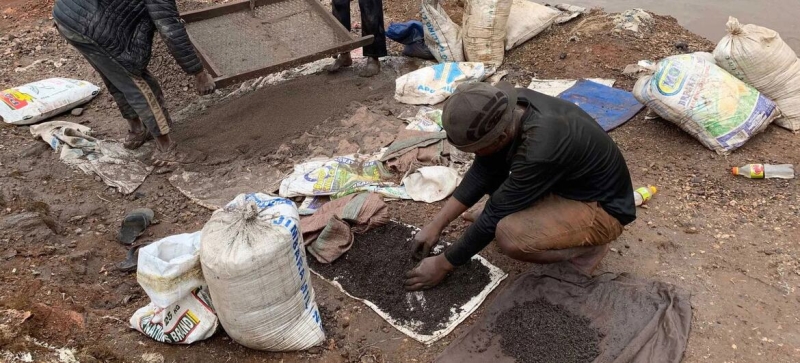
Cobalt being processed by a man at a mine in the DR Congo. © ILO via UN News
GreenWatch Desk
Critical minerals were once seen as the next trigger for global conflict. They may yet become the foundation for peace.
The world’s clean energy transition is accelerating at a pace few imagined even a decade ago. Electric vehicles, wind turbines, solar panels, smartphones and modern power grids all rely on a cluster of minerals—lithium, cobalt, nickel, copper, graphite—now labelled “critical” for their strategic importance. Demand for many of these minerals is expected to triple by 2030. As UN Secretary General António Guterres put it this week, “A world powered by renewables is a world hungry for critical minerals.”
That hunger has brought the issue to the floor of the UN Security Council, which convened in New York on 22 July to debate a question that will shape the geopolitics of the coming decades: can the minerals powering the green transition fuel peace and prosperity instead of conflict and corruption?
The question is not abstract. Natural resources have long played a role in war, instability and exploitation. From diamonds in Sierra Leone to oil in Iraq, resource wealth has often been captured by armed groups, criminal networks or predatory elites. Today, as global competition intensifies, many analysts compare the strategic importance of critical minerals to oil in the twentieth century. The fear is clear: that the rush for lithium, cobalt and nickel could ignite new geopolitical tensions, empower armed groups, or deepen corruption in fragile states.
But the Security Council debate also highlighted a different possibility—one rooted in governance, cooperation and the lessons of past resource booms. If managed responsibly, critical minerals could become a foundation for peace, economic diversification and sustainable development. The minerals themselves are not the problem. The way the world chooses to extract, trade and govern them will determine whether they become a curse or a catalyst for stability.
Across Africa, Latin America and Asia, countries with large deposits of critical minerals face an unprecedented opportunity. Electric vehicles require around six times more mineral inputs than conventional cars. Offshore wind facilities require around thirteen times more mineral resources than gas fired power plants. The global shift to clean energy is not slowing down. For mineral rich nations, this is a moment that could reshape their economies for generations.
Yet the risks are real. Poorly regulated mining can cause deforestation, water pollution, biodiversity loss and soil degradation. Many deposits lie close to Indigenous lands and environmentally sensitive ecosystems. Weak governance can allow armed groups to control mines, illegal operators to smuggle minerals across borders, and criminal networks to profit from chaos. In some regions, mining has already contributed to violence, displacement and human rights abuses.
The challenge, then, is not whether to mine. It is how to mine responsibly—and how to ensure that mineral wealth strengthens institutions rather than undermines them.
Around the world, the United Nations is working with governments, communities and companies to tilt the balance toward peace. The examples are diverse, but they share a common thread: critical minerals can support stability when local people benefit, when environmental safeguards are strong, and when national institutions are transparent and accountable.
In Argentina, home to some of the world’s largest lithium reserves, the UN is helping ensure that communities have a voice in the country’s fast growing lithium sector. The lithium boom has drawn global investors eager to supply electric vehicle manufacturers. But Argentina’s provinces want development that is inclusive, environmentally sound and economically durable. The UN supports dialogue between governments, companies, workers and Indigenous communities to address concerns ranging from water use to job creation. It is also helping provinces strengthen financial planning so that more of the revenue stays in local communities, while supporting skills training and efforts to bring more women into the sector. The goal is simple: a lithium industry that builds trust instead of tension.
In the Democratic Republic of the Congo, which produces around 70 per cent of the world’s cobalt, the stakes are even higher. Cobalt is essential for rechargeable batteries, and global demand has transformed the DRC into a critical node in the clean energy supply chain. But the country’s mineral wealth has long been associated with conflict, corruption and exploitation. The UN is supporting efforts to break that cycle by strengthening public policy, promoting responsible business conduct and helping local businesses participate in emerging battery and electric vehicle supply chains. By expanding economic opportunities beyond raw mineral extraction, the DRC can reduce the incentives for armed groups to control mines and increase the benefits for ordinary citizens.
Indonesia offers another model. A major producer of nickel, the country has chosen not to rely solely on exports of raw materials. Instead, it is expanding higher value manufacturing at home, aiming to become a hub for battery production and electric vehicle components. The UN is helping improve industrial standards, promote cleaner manufacturing and increase domestic value addition across critical mineral supply chains. It is also supporting occupational safety and health in mining, developing green skills for a changing economy, and sharing Indonesia’s experience with other mineral producing countries through South South cooperation. By capturing more value domestically, Indonesia reduces the volatility associated with commodity exports and strengthens the foundations of long term stability.
Kazakhstan, another major mineral producer, is focusing on governance. As global demand grows, the country is working to strengthen oversight of critical mineral supply chains by aligning national frameworks with international standards and identifying risks linked to crime, corruption and weak accountability. The UN is supporting efforts to improve mine safety, labour standards and responsible business conduct in line with the UN Guiding Principles on Business and Human Rights. It is also exploring ways to recover valuable raw materials from electronic waste, reducing the need for new extraction and lowering environmental pressures. Strong governance is not just a technical issue—it is a peacebuilding strategy.
In Zambia, the clean energy transition is creating new opportunities for workers, local businesses and communities. The UN is helping develop a national mining skills strategy, preparing workers for jobs in mining and battery value chains, and supporting small and medium sized businesses so they can participate in emerging electric vehicle supply chains. It is also working with artisanal and small scale miners to improve safety, strengthen environmental safeguards and support formalization. Local communities are taking part in monitoring environmental impacts alongside government, universities and mining companies, helping build trust around mining projects. Trust, in turn, reduces the likelihood of conflict.
These examples show that critical minerals do not have to follow the familiar pattern of resource exploitation. They can instead support peace when countries invest in strong institutions, transparent governance and inclusive development. They can reduce conflict when communities are partners rather than victims. They can strengthen stability when environmental protection is treated as a core part of economic planning.
The Security Council debate underscored a broader truth: the clean energy transition is not only a technological shift. It is a geopolitical transformation. The minerals that power renewable energy could become flashpoints for competition—or building blocks for cooperation. They could deepen inequalities—or help close them. They could fuel conflict—or fund peace.
The outcome is not predetermined. It will depend on choices made now, by governments, companies, communities and international institutions. The world has seen what happens when resource wealth is mismanaged. It has also seen what is possible when governance is strong and development is inclusive.
Critical minerals are at the centre of global politics because they are at the centre of the world’s future. Whether that future is peaceful will depend on whether the global community treats these minerals not as prizes to be seized, but as responsibilities to be shared.