

- Around 7,500 Bangladeshis imprisoned in Saudi Arabia: Shama Obaed |
- Bangladesh Outperforms India in Global Hunger Index 2026 |
- Covered van hits Gazipur police patrol team, killing SI, BNP leader |
- Korean City scrambles to rescue dusky shark after it returns to canal |
- PM inspects Mongla Port, Sundarbans, proposed economic zone |
NASA Finds Ammonia Compounds on Jupiter Moon Europa
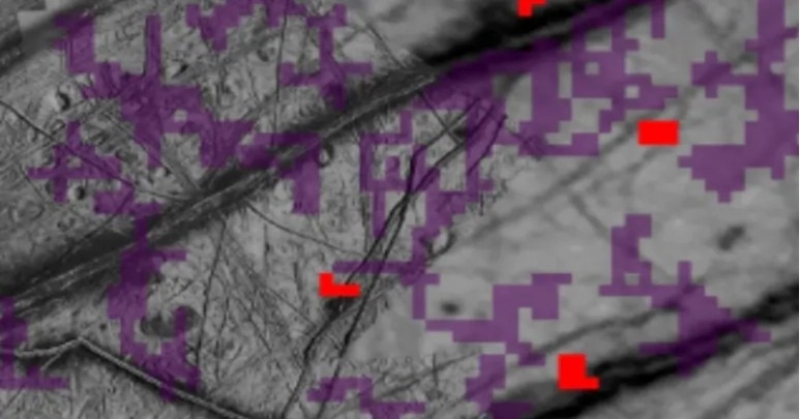
NASA scientists have identified ammonia-bearing compounds on the icy surface of Jupiter’s moon Europa, offering new clues about the chemistry of its hidden subsurface ocean.
The finding comes from a fresh analysis of data gathered by the Galileo spacecraft, which orbited Jupiter between 1989 and 2003. Researchers reprocessed images covering a 400-kilometre-wide region of Europa, revealing dark, intersecting bands that mark deep fractures in the moon’s ice crust.
To pinpoint the chemical signatures, scientists overlaid data from Galileo’s Near-Infrared Mapping Spectrometer on the images. Areas rich in ammonia compounds appeared as red pixels, while regions without them showed up in purple. The spectrometer data was originally collected during Galileo’s 11th flyby of Jupiter in 1997.
Researchers believe the ammonia-rich material may have reached the surface through cryovolcanic processes, in which slushy or liquid water from beneath the ice is forced upward through cracks. Such activity would suggest active exchange between Europa’s surface and its vast underground ocean.
The discovery adds to growing evidence that Europa is geologically dynamic and strengthens the case that the moon could host conditions suitable for life beneath its frozen exterior.