

- Rooppur NPP: Rosatom installs automated control system at Unit-1 |
- Mount Everest season opens late, despite huge ice block, high travel costs |
- 2 more children die with measles-like symptoms in Sylhet |
- Dhaka again ranks world’s most polluted city Friday morning |
- Speed up nationality verification for ‘illegal’ migrants: Delhi |
Breakfast in Dhaka, Lunch in Kolkata Soon
Rail Link Thru Padma Bridge
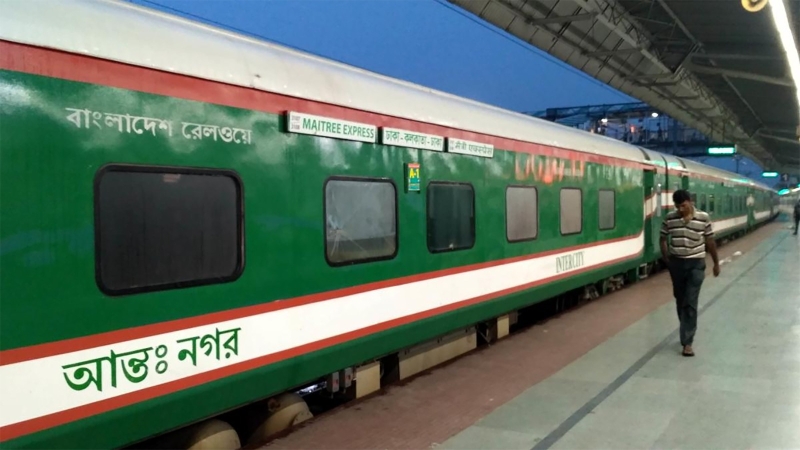
A proposed international rail service linking Dhaka and Kolkata through the Padma Bridge is moving closer to reality, raising hopes for a dramatic transformation in cross-border travel between Bangladesh and India. If implemented, the route could cut the journey time between the two historic cities nearly by half, making it possible for travellers to leave Dhaka in the morning and reach Kolkata by lunchtime.
Officials, transport planners, and tourism experts believe the initiative could
strengthen regional connectivity, boost tourism, expand trade opportunities,
and provide a faster and more comfortable travel option for thousands of
passengers who move between the two neighbouring countries every year.
Additional Secretary of the Ministry of Railways Md Rupam Anwar said Bangladesh
is hopeful about resuming train services between Dhaka and Kolkata in the near
future. However, he noted that India would likely review the commercial viability
and strategic implications of the new route before giving its final approval.
“We are optimistic about restoring rail connectivity soon,” he said. “The new
corridor through the Padma Bridge Rail Link will significantly reduce travel
time and create a more direct connection between the two cities.”
According to Bangladesh Railway officials, the new route could reduce the
Dhaka–Kolkata journey to about five hours. At present, the trip typically takes
between nine and eleven hours using the northern route via the Jamuna
Multipurpose Bridge.
The shorter route would represent a major improvement for travellers.
Currently, trains heading from Dhaka to India must first travel north before
crossing the border, creating a long detour. The Padma Bridge corridor opens a
far more direct passage through southwestern Bangladesh, dramatically
shortening the distance.
“This will provide significant relief for passengers,” he said. “It will be
particularly helpful for medical travellers who frequently visit India for treatment.”
Every year, thousands of Bangladeshis travel to Indian cities such as Kolkata,
Chennai, and Bengaluru for specialised medical care. Many patients endure long
and tiring journeys by road or expensive air travel. A faster train connection
could provide a safer and more affordable alternative. The convenience of a
five-hour train ride could turn what is currently a long trip into a
comfortable half-day journey.
The idea has already captured the imagination of many travellers. As one senior
railway official remarked, the journey could soon become so convenient that
passengers might enjoy breakfast in Dhaka and lunch in Kolkata on the same day.
Discussions between Bangladesh Railway and Indian Railways are already
underway. A Bangladeshi railway delegation recently held talks with Indian
counterparts regarding the resumption of the Maitree Express, the most popular
train service between the two countries before cross-border operations were
disrupted.
Officials said further meetings are expected soon, and an Indian delegation may
visit Dhaka to continue negotiations about restarting the service and exploring
the possibility of introducing the new Padma Bridge route.
Before services were disrupted following political turmoil in Bangladesh in
July 2024, three international passenger trains connected Bangladesh and India.
These included the Maitree Express operating between Dhaka and Kolkata, the
Bandhan Express linking Kolkata and Khulna, and the Mitali Express running
between Dhaka and New Jalpaiguri in India.
Among them, the Maitree Express was the busiest and most symbolic service.
Named after the Bengali word for friendship, the train operated six days a week
and covered about 375 kilometres between the two cities. Immigration
formalities were conducted at Darshana in Bangladesh and Gede in India.
Rail links between Bangladesh and India have a long and complex history. During
the colonial period, railway lines connected many cities across the region,
enabling trade and movement of people. However, most of these connections were
severed in 1965 during the war between India and Pakistan.
For more than four decades the rail route between Dhaka and Kolkata remained
closed, symbolising the political divisions of the region. The restoration of
train services in 2008 was widely seen as an important step towards rebuilding
trust and cooperation between the two neighbours.
The groundwork for the new route has largely been completed with the
construction of the Padma Bridge Rail Link Project, one of the largest infrastructure
initiatives in Bangladesh’s history.
The project involved building a 172-kilometre broad-gauge railway line
connecting Dhaka with the southwestern districts of the country through the
Padma Bridge. The new corridor has already transformed domestic travel across
the region.
Since December 2024, passenger trains linking Dhaka and Khulna through the
bridge have significantly reduced travel times. Services such as the Jahanabad
Express and Ruposhi Bangla Express now operate regularly along the route, demonstrating
the efficiency of the new railway infrastructure.
The project was implemented at a cost exceeding Tk37,000 crore and constructed
by China Railway Group Limited, with supervision support from the Bangladesh
Army. Financing was partly provided through Chinese loans under the Belt and
Road framework.
Chinese Ambassador Yao Wen earlier described the railway as one of the most
significant infrastructure projects undertaken in Bangladesh. He noted that the
development could benefit around 80 million people by improving transportation,
stimulating economic activity, and strengthening regional connectivity.
Businessman Alim Al Rabby said many Bangladeshis would welcome the shorter
journey time.
“India is our neighbouring country and many people travel there every year,” he
said. “Bangladesh has experienced remarkable economic growth over the past five
decades, and the number of upper- and middle-class families has increased
significantly during the last 20 years.”
“People are travelling more, especially during the Eid holidays and winter
season. Reaching Kolkata within four or five hours by train would be a dream
journey for many travellers.”
Tourism specialists also expect the new rail corridor to strengthen regional
tourism. Md Rafeuzzaman, former president of the Tour Operators Association of
Bangladesh and a governing body member of the Bangladesh Tourism Board, said
improved rail connectivity could attract more visitors to both countries.
“Tourism is the third largest industry in the world,” he said. “Better
transport links will naturally encourage people to explore neighbouring
countries.”
Professor Akbaruddin Ahmad, another former president of the Tour Operators
Association of Bangladesh, believes the train service could trigger a surge in
tourist arrivals from across South Asia.
He noted that Indian and Nepalese travellers would likely show strong interest
in visiting Bangladesh once the faster rail route becomes available.
Development experts say the Padma Bridge itself has already begun to reshape Bangladesh’s
economic geography. By linking previously isolated districts in the southwest
with the capital, the bridge has shortened travel distances and improved access
to markets, services, and employment opportunities.
A report by the World Bank noted that the bridge could unlock the economic
potential of the southwestern region, benefiting nearly 30 million people. By
reducing distances to major urban centres such as Dhaka by nearly 100
kilometres, the infrastructure is expected to stimulate economic growth and
reduce poverty.
The international rail extension would increase these benefits beyond
Bangladesh’s borders by strengthening trade and people-to-people connections
between the two countries.
Business groups share similar expectations. A director of the Federation of
Bangladesh Chambers of Commerce and Industry said faster travel would encourage
more Bangladeshi tourists to visit India while also facilitating business
meetings and trade exchanges.
Shorter travel times could even allow same-day return trips for certain
professional activities, a possibility that is currently difficult with the
existing route.
The revival of cross-border rail connectivity is also taking place against the
backdrop of evolving diplomatic relations between Bangladesh and India.
Following political changes in Bangladesh after the departure of former Prime
Minister Sheikh Hasina in 2024, bilateral relations experienced a period of
uncertainty. However, analysts say ties have begun to stabilise following the
2026 election victory of the Bangladesh Nationalist Party.
Indian Prime Minister Narendra Modi congratulated Bangladesh’s new leadership
and expressed hope for stronger cooperation between the two countries..
Officials say the extension of the railway to connect directly with India will
depend on mutual agreement, passenger demand, operational costs, and security
considerations. Despite these challenges, optimism is growing among planners
and travellers alike.
If negotiations proceed successfully, the Dhaka–Kolkata train through the Padma
Bridge could become one of the most significant transportation developments in
South Asia in recent decades.
What was once a long and exhausting journey may soon become a comfortable
five-hour train ride, reconnecting two cities that share centuries of history,
language, and culture. (This story has been
published in the March print edition of the GreenWatch)