

- Around 7,500 Bangladeshis imprisoned in Saudi Arabia: Shama Obaed |
- Bangladesh Outperforms India in Global Hunger Index 2026 |
- Covered van hits Gazipur police patrol team, killing SI, BNP leader |
- Korean City scrambles to rescue dusky shark after it returns to canal |
- PM inspects Mongla Port, Sundarbans, proposed economic zone |
Bhasani's Farakka Long March still relevant to protect Ganges flow: IFC
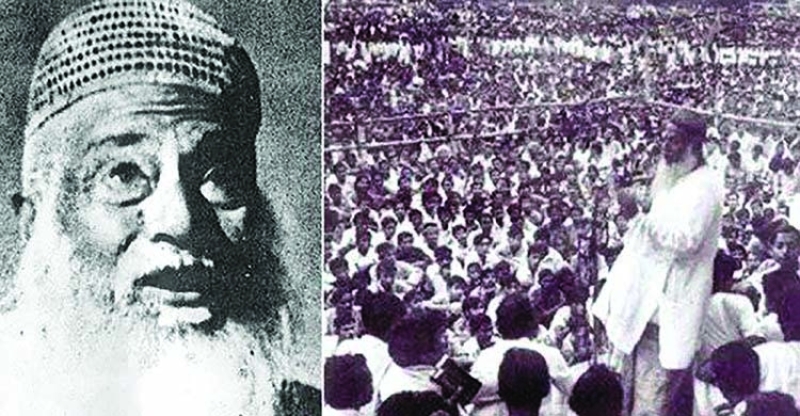
Maulana Abdul Hamid Khan Bhasani led the Farakka Long March from the Madrasah Maidan in Rajshahi on 16 May 1976.
Dhaka, 15 May 2026 - Tomorrow, 16 May, is the historic Farakka Long March Day. On this day in 1976, leader of the toiling asses Maulana Abdul Hamid Khan Bhasani organized this mass rally from Rajshahi to the Kansat border of Chapai-Nawabganj to protest the unilateral withdrawal of Ganges river water by India and publicly raised the demand for water rights of the people of Bangladesh.
After the long march, President Ziaur Rahman's government raised the Ganges water issue at the United Nations. And in its wake, the Ganges Water Sharing Treaty of 1977 was signed. The 30-year Ganges Water Treaty signed in 1996 will expire in December this year.
The leaders of the International Farakka Committee (IFC) said in a joint statement on Friday that the pledge of the Long March Day this time will be to remove the shortcomings of the current agreement and build public pressure to renew it with amendments or sign a new agreement before December.
The 1996 agreement was flawed as it did not include the issue of using water drawn from various dams built upstream of Farakka. A study has shown that as a result, Bangladesh's water intake was 30 percent less during this period. In the first year of the agreement's implementation (1997), the flow of Ganga water in Bangladesh fell to about 6,000 cusecs instead of 35,000 cusecs. If water is used indiscriminately upstream, water may not reach Farakka at all. This concern was expressed by Bangladeshi environmentalist and former Vice-Chancellor of Dhaka University, Professor Moniruzzaman Miah, immediately after the agreement was signed.
A new dimension has now been added to the issue of Ganga water. The water of the Teesta River has been diverted to the Ganges for the past two decades, depriving Bangladesh of water during the dry season. India's inter-river interlinking plan is being implemented. Dams or reservoirs have also been built upstream of the remaining 52 common rivers. As a result, annual flooding no longer occurs in the floodplains of Bangladesh. On the other hand, devastating floods occur every year in the Teesta basin and regularly in the Meghna basin.
Meanwhile, due to the deprivation of water from the Ganges and Teesta, environmental disasters have occurred in the southwestern and northern regions of Bangladesh. Small rivers in these regions have died. The environment, habitat, livelihoods, biodiversity and ecosystem have been damaged. The biodiversity of the Sundarbans, a world heritage site for mankind, is under threat due to the cessation of river flow.
The leaders of the International Farakka Committee said that Bangladesh, the world's largest delta, is created by the sediment carried by 54 cmmon rivers for thousands of years. All the rivers of the Eastern Himalayas flow into the Bay of Bengal through Bangladesh. The construction of dams and reservoirs at upstream has obstructed the flow of these rivers, thus threatening the geographical and ecological existence of Bangladesh. If the current international laws and norms on rivers, environment, habitat, biodiversity and ecosystem are followed, the flow of natural rivers cannot be stopped by man-made political borders. To get the services of the river, it must be kept flowing from its source to the sea. Despite the 30-year agreement in force, the flow is not sufficient, and the environmental disaster in one-third of the southwestern region of Bangladesh, including the Ganges, has not been resolved. Therefore, the government has decided to build a barrage on the Ganges in Bangladesh. However without an integrated management structure for the Ganges, water might not come to this barrage in the dry season.
Therefore, in order to preserve the existence of riverine Bangladesh, the struggle to save the common rivers through basin-based integrated management and protect the rights of the people of this country to river water must be strengthened by taking lessons from Maulana Bhasani's Farakka Long March.
The joint statement was signed by IFC New York Chairman Syed Tipu Sultan, Secretary General Mohammad Hossain Khan, IFC Bangladesh Chief Advisor Professor Jasim Uddin Ahmed, President Mustafa Kamal Majumder and General Secretary Syed Mahmud Hasan.