

- Key in your hands, use it wisely: Prof Yunus tells voters |
- Yunus Urges Voters to Shape a ‘New Bangladesh’ |
- Bangladesh Polls: Campaign Ends as Voters Weigh Pledges |
- Bangladesh Heads to First Gen Z-Driven Competitive Poll |
- EC Lifts Mobile Phone Ban, Bars Photos Inside Booths |
Women in Science: Closing the Gender Gap
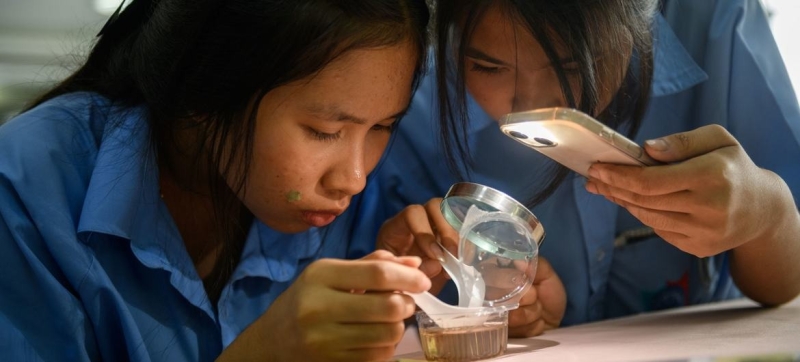
UNICEF is working on expanding STEM education for girls in rural areas.
Although women are more likely than young men to pursue higher education, they make up only 35 per cent of science graduates.
Across the world, a significant gender gap persists at all levels of science, technology, engineering and mathematics (STEM) disciplines due to a lack of research funding, gender stereotypes and discriminatory workplace practices.
UN Secretary-General António Guterres said the gap is particularly pronounced in technology, where women represent just 26 per cent of the workforce in data and artificial intelligence, and 12 per cent in cloud computing.
“Excluding women from science weakens our collective capacity to address urgent global challenges, from climate change to public health and space security,” he warned.
Greater inclusion
As societies continue to grapple with widening inequalities, the UN believes that integrating artificial intelligence (AI), social science, STEM and finance offers a way to accelerate inclusive and sustainable development.
The approach is being highlighted on the International Day of Women and Girls in Science, observed on Wednesday.
Synergising these four domains can help dismantle persistent barriers by closing gender gaps in digital skills, catalysing women-led start-ups, advancing gender-responsive AI governance and mobilising finance that embeds social inclusion as a performance metric.
“From advancing renewable energy to preventing the next pandemic, our future hinges on unlocking as much human talent as possible,” the Secretary-General said.
“Today and every day, let us ensure that women and girls can realise their scientific ambitions – for their rights and for the benefit of all.”
Scientist, entrepreneur, ambassador
Chemist and entrepreneur Asel Sartbaeva from Kyrgyzstan is a role model in this regard.
She is an associate professor of chemistry at the University of Bath in the United Kingdom and co-founder and CEO of the biotech company EnsiliTech.
Her work addresses one of global health’s most persistent challenges: making vaccines stable at high temperatures so they can be transported to remote communities without complex refrigeration.
Supporting girls in STEM
Alongside her research, Ms Sartbaeva works with the UN Children’s Fund (UNICEF) as an ambassador for the Girls in Science programme in Kyrgyzstan, encouraging girls to pursue higher education and careers in STEM.
She told UN News that in many communities, decisions about a girl’s future are shaped by her family—particularly her father.
“Most of the time, the biggest concern I’ve heard, especially from fathers, is that they think if their daughters go into science, they will not have a family,” she said.
“For me, the first thing was to show that this is not true. They can have both; it is not mutually exclusive.”
‘We need you’
The UNICEF programme combines science masterclasses with mentoring, communication training and confidence-building. Thousands of girls have taken part, and many have gone on to pursue university degrees in STEM.
Ms Sartbaeva believes opportunities for women in science are improving. Women professors were rare when she was at university, but today she sees greater balance and stronger policies supporting inclusion.
Still, more talent is needed, and she has a clear message for girls considering STEM: “We need you.”