

- Dhaka ranks world's third most polluted city this morning |
- Soldiers Guard Milan as Thousands Protest Across Europe |
- Cheese Industry Thrives In Thakurgaon Villages |
- Guterres alarmed at Israel’s sweeping closures after deadly Hebron attack |
- Bangladesh to Introduce New Law to Curb Extortion, IGP Says |
Hamas Offers Aid for Hostages if Israel Halts Airstrikes
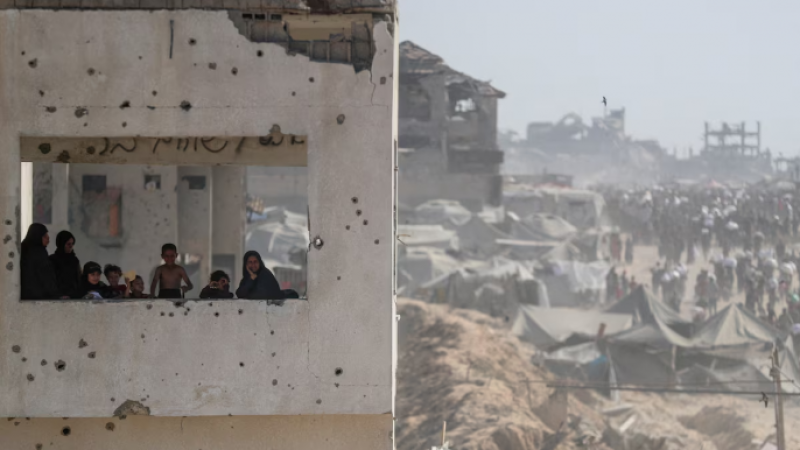
Women and children look out from a damaged building as Palestinians carry aid supplies that entered Gaza through Israel, in Beit Lahia, northern Gaza Strip, August 2, 2025.
Hamas has announced its willingness to coordinate with the Red Cross to deliver aid to hostages in Gaza—on the condition that Israel halts airstrikes and permanently opens humanitarian corridors.
The statement came after the release of a disturbing video showing Israeli hostage Evyatar David, who appeared severely emaciated, digging what he claimed was his own grave. The footage sparked outrage across Western nations.
Israeli authorities believe 50 hostages remain in Gaza, though only 20 are presumed alive. Hamas has so far denied humanitarian agencies any access to the hostages, leaving families with little information about their condition.
In response, Israel said it has urged the Red Cross to provide humanitarian assistance to the captives. Meanwhile, the UN Security Council is expected to convene a special session to address the hostage crisis.
The Hostages Families Forum said Hamas’s latest comments cannot hide the fact that it has held innocent civilians in dire conditions for over 660 days. The group demanded their immediate release, stressing that Hamas must provide for the hostages' basic needs and would bear responsibility for any deaths.
At the same time, Gaza’s health ministry reported that six more people died of starvation or malnutrition in the past 24 hours, bringing the toll from suspected famine-related causes to at least 175, including 93 children, since the war began.
While Israel has eased restrictions in response to growing international criticism, aid deliveries remain limited. Two diesel trucks carrying 107 tons of fuel were reportedly set to enter Gaza via Egypt. Israel also allowed four tankers of UN fuel to enter, aimed at sustaining hospitals, bakeries, and public kitchens.
Fuel remains scarce. Since March, when Israel restricted aid to pressure Hamas to release hostages, hospital services have been crippled, forcing doctors to focus only on the critically ill.
In recent days, Israel announced temporary pauses in combat and designated protected routes for aid convoys. Despite these steps, UN agencies say airdrops and limited land access fall far short of what's needed to prevent widespread starvation among Gaza’s 2.2 million residents, most of whom are displaced.
Belgium, in partnership with Jordan, launched its first air drop of aid into Gaza on Sunday, while France began dropping 40 tons of supplies late last week.
According to COGAT, the Israeli agency overseeing aid, more than 23,000 tons of humanitarian assistance entered Gaza last week via 1,200 trucks. However, hundreds of these trucks have not yet reached distribution hubs due to logistical delays by international agencies.
The Hamas-run media office in Gaza said that nearly 1,600 aid trucks have arrived since Israel eased restrictions in late July. However, many of these vehicles were reportedly looted by desperate civilians and armed groups.
During a ceasefire earlier this year, over 700 fuel trucks entered Gaza. That truce collapsed in March over disagreements regarding its extension, prompting Israel to resume a full-scale offensive.
On Sunday alone, at least 80 people were killed by Israeli airstrikes and gunfire, including several who were reportedly attempting to reach aid distribution points in southern and central Gaza.
Among the casualties was a staff member of the Palestinian Red Crescent Society. An Israeli airstrike reportedly hit the society’s headquarters in Khan Younis, igniting a fire in the building.
The war began on October 7, 2023, when Hamas launched a cross-border assault into southern Israel, killing more than 1,200 people and capturing 251 hostages. Since then, Israel's retaliatory air and ground operations have killed over 60,000 Palestinians, according to local health officials.