

- Apratim Murder Suspects Confessed, Says Home Minister |
- Dhaka's air decorded unhealthy for sensitive groups Sunday morning |
- Meet Earth’s newest wild cat species, the first named in over a century |
- Bus torched in Mymensingh early Sunday |
- Anthropic, OpenAI, SpaceXAI, Google deal on AI slowdown illegal? |
In Colombia’s Quake response rescuers race to find survivors
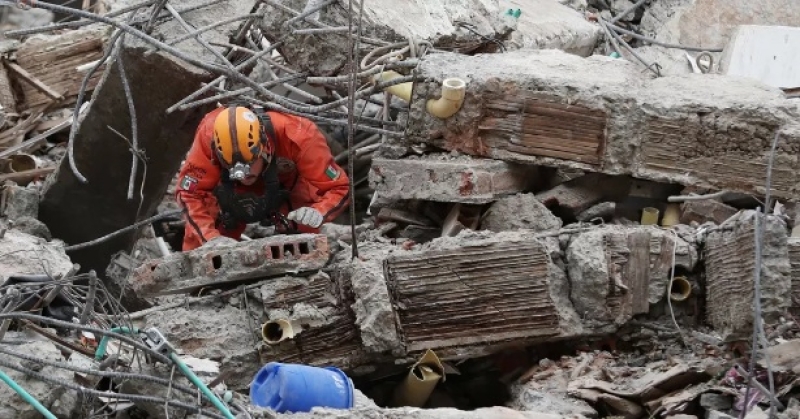
In Colombia Quake response rescuers race to find survivors
Aid from regional partners began arriving in Colombia on Wednesday as rescue teams intensified their search for survivors in the rubble left by a powerful earthquake that destroyed buildings, damaged roads and crushed vehicles.
The disaster has put pressure on Colombia’s new President Abelardo de la Espriella and his government as they work to coordinate the emergency response, while civil society groups are also mobilizing assistance for the hardest-hit communities.
De la Espriella said Wednesday evening that at least 265 people had been killed in Monday’s magnitude 7.4 earthquake that struck western Colombia. Nearly 500 people were officially reported missing, although civilian-run databases put the number at more than 4,100. More than 25,800 families have been affected, the president said.
“Our efforts are focused on the disappeared,” he told reporters in the capital, Bogotá.
Rescue teams continued searching through collapsed structures in the worst-hit cities of Cali, Pereira, Manizales and Quibdo as the chances of finding survivors alive diminished with each passing hour. Aid agencies say the first 48 to 72 hours are especially critical for rescue operations, although people trapped under rubble can sometimes survive longer if they have access to food and water.
Alejandro Eder, the mayor of Cali, said Wednesday afternoon that rescue workers were still finding indications that people remained alive beneath the rubble.
“The next 20 hours are the most critical to find and rescue people alive,” he said. “Every minute is vital.”
Survivors pulled from rubble
In Pereira, rescuers pulled Daniela Largo alive from the debris late Tuesday after a difficult 12-hour operation. Crews created a small opening to free her trapped arm, while a doctor administered intravenous fluids to stabilize her. Wrapped in a blue blanket, the young woman was carried to an ambulance as firefighters embraced and residents cheered.
In another rescue operation in the same city, however, a man was pulled from a damaged building dead and covered with a white blanket.
Authorities across the coffee-growing region, one of the areas hardest hit by the earthquake, have turned sports arenas, schools and other public buildings into temporary shelters for thousands of displaced people.
Ebert Jonathan Morales, a resident of Cali, said his family had lost everything.
“My house was completely destroyed. We can't live there,” Morales said. “It collapsed. The floor collapsed, the walls cracked. The roof came down.”
In Pereira and Cali, many families have been sleeping in parks, either because they fear aftershocks and further collapses or because they no longer have homes to return to.
Colombia’s geological service has recorded 130 aftershocks since the main earthquake.
“We have the most important things: a roof over our heads, food, water and, in my case, medical care,” said Edith Penagos, 48, who was staying with her teenage son in a white tent in a Pereira park.
Rodrigo León Loya, a seismologist and geosciences professor at the University of the Andes, said the likelihood of another earthquake of similar strength occurring in the same area is low, but he cautioned that further seismic activity cannot be ruled out.
“Let's remember that Colombia is full of active fault lines,” he said. “The question isn't whether it can happen again. The question is rather when an earthquake of similar magnitude will occur at another of Colombia's seismic sources.”
Humanitarian crisis complicates response
The official response has been particularly difficult in many parts of Choco, the region where the earthquake was centered. The area has long struggled with severe poverty and armed conflict that has displaced people for decades.
The full extent of the earthquake’s impact in the remote, jungle-covered northwest remains unclear because cellphone services have been disrupted and many affected communities can only be reached by river.
“This earthquake compounds an already severe humanitarian situation, and there is a need for increased support for the humanitarian response,” said Giovanni Rizzo, Colombia director for the Norwegian Refugee Council.
Several humanitarian organizations were already operating in Choco, supporting the 2016 peace agreement between the government and leftist rebels and responding to continued violence involving other armed groups.
Those organizations were able to quickly shift their operations toward earthquake relief, said María José Torres, the U.N. resident coordinator in Colombia.
“We have a presence on the ground. Therefore, our ability to be there, present with the people, I think, has increased exponentially,” Torres said in a statement Tuesday.
International aid arrives
Meanwhile, assistance from foreign governments and international organizations continued to arrive in Colombia.
The U.S. State Department said disaster response teams began arriving Monday. Washington has also offered more than $15 million in aid.
Mexico said it sent two military aircraft carrying 19.5 tons of nonperishable food and 19 members of its security forces to Pereira. It plans to send another 39 tons of aid in the coming days. Another 255 military specialists and 20 dogs are on standby to deploy to Colombia if needed.
El Salvador’s President Nayib Bukele offered to send two planes carrying 100 tons of humanitarian aid.
Pope Leo XIV on Wednesday expressed support for those involved in the recovery effort and said he was praying for those killed, injured and otherwise affected by the earthquake.
“I want to express my solidarity with my Colombian sisters and brothers who have suffered the effects of the recent earthquake,” he said. - AP