

- Gaza unsafe for civilians as Israeli attacks hit homes, classrooms |
- El Niño May Push 49 Million More Into Acute Hunger |
- Acting President Urges Unity on National Interest |
- Strong El Nino to dominate global climate in late 2026: WMO |
- July Mass Uprising Day Today |
October-March ideal period to begin local body elections: EC
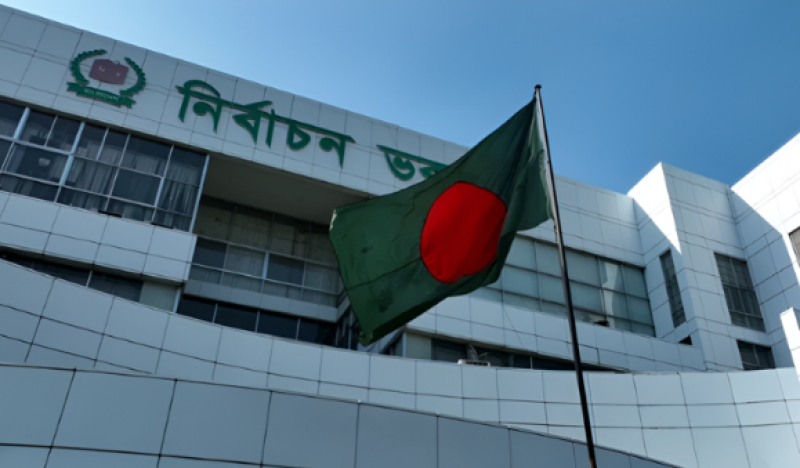
Election Commission building.
Dhaka, June 1– The Election Commission (EC) plans to complete the revision and updating of all rules and codes of conduct related to local government elections by June next, considering the period from late October to March as the most suitable time to begin elections to local government bodies.
The Commission thinks elections to union parishads and municipalities should be held first as people are being deprived of essential services due to absence of elected representatives in the grassroots bodies.
The EC plans to hold the elections to local government bodies in phases to ensure peaceful polls and avoid violence that marked many local elections in the past.
Since there are no elected representatives in almost all the local bodies, the Commission estimates that it would take 10-12 months to complete the elections to all the bodies.
As part of preparation to conduct elections to local government bodies throughout the country, the commission is now revising separate rules and election codes for city corporations, municipalities, zila parishads, upazila parishads and union parishads. The move aims to modernise the rules and also align these with amended local government laws that restored non-partisan elections to the key posts (mayor and chairman) dropping the provision for the use of political party symbols.
The interim government amended the Local Government (Union Parishad) Act 2009, Local Government (Municipality) Act 2009, Upazila Parishad Act 1998, Zila Parishad Act 2000 and Local Government (City Corporation) Act 2009. The amendments were later ratified by Parliament.
“We want to complete updating and reform of the rules and codes of conduct related to all types of local government elections by June next,” said Election Commissioner Abdur Rahmanel Masud.
Though separate rules and codes will remain for different local government bodies, the codes of conduct will be largely similar across all categories, he told UNB on Sunday.
The code of conduct for local government will also largely be similar to the code used for the February-12 parliamentary election, he added.
About the possible changes, the Election Commissioner said the use of posters will be banned, while stricter provisions will be incorporated to check misinformation and disinformation and misuse of AI particularly on social media.
The requirement for collecting signatures of a specific number of voters will be removed, while the amount of security deposit for candidates, except women contesting in reserved seats will be raised to rational level, he said.
The EC will publish draft rules on its website for at least 15 days to seek public opinions and suggestions from stakeholders, he said, adding that the Commission may also hold consultations with stakeholders on the proposed rules, although no final decision has yet been made.
About the possible timeframe for the elections, Rahmanel Masud said the period from late October to March next would be most suitable for the arrangement of elections.
Asked about the EC’s priority Rahmanel Masud, “We will suggest holding elections based on needs. In that case, elections to union parishads and municipalities should come first and elections to city corporations should be held at the last stage.”
When attention was drawn to local body elections marred by violence in the past, he said the current election commission, headed by AMM Nasir Uddin, would be very careful to make the upcoming elections free from violence like the 13th parliamentary election that was most peaceful.
“We’ll be very careful so that there are no casualties in local body elections. We’ll arrange the staggered elections to deploy a larger number of law enforcers in the election areas,” he said, stressing the need for cooperation from all stakeholders in maintaining a peaceful election environment.
The Election Commissioner said the EC would initially rely on regular law enforcement agencies, including police, RAB, BGB and Ansar, to maintain law and order during the elections. If necessary, the armed forces may be deployed later, he added.
According to EC estimates, elections to 12 city corporations (excluding newly formed Bogura city corporation), over 450 upazila parishads, more than 300 municipalities and 61 zila parishads are already overdue and can be held immediately without legal complications.
Besides, the legal timeframe for holding elections to around 600 union parishads began in April, making polls mandatory by October next. The 180-day countdown for elections in more than 2,800 additional union parishads will begin by July.
As the local body elections are arranged at the request from the local government division, the EC will announce election schedules after receiving a green signal from the government. - UNB