

- Around 7,500 Bangladeshis imprisoned in Saudi Arabia: Shama Obaed |
- Bangladesh Outperforms India in Global Hunger Index 2026 |
- Covered van hits Gazipur police patrol team, killing SI, BNP leader |
- Korean City scrambles to rescue dusky shark after it returns to canal |
- PM inspects Mongla Port, Sundarbans, proposed economic zone |
UNAIDS Early Closure Risks Harm to Vulnerable Groups
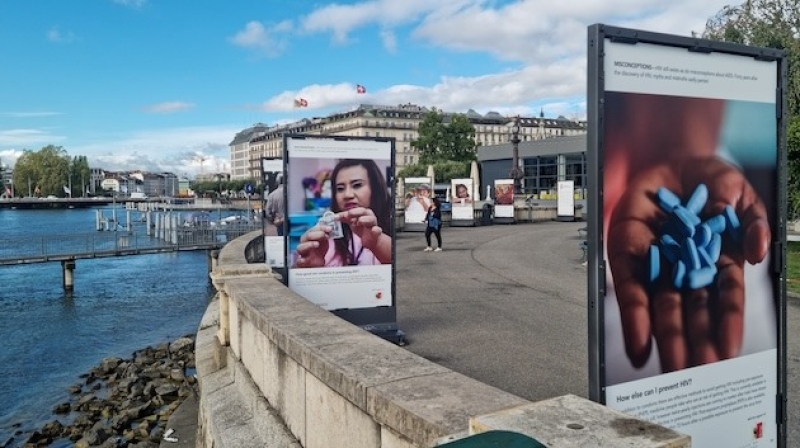
UNAIDS campaigns have dominated the global effort to end HIV/Aids as a public threat since 1999.
“It’s like adding fuel to an already burning fire,” says Aditia Taslim.
“We have not recovered from the impact of the US funding cuts earlier this year, and closing down UNAIDS prematurely will only make things worse, especially for key populations and other criminalised groups, including people who use drugs,” added Taslim, Advocacy Lead at the International Network of People Who Use Drugs (INPUD), in an interview with IPS.
Her concern is shared widely by HIV activists across the world, who were stunned by a proposal from UN Secretary-General António Guterres in September to shut down the UN’s main agency fighting HIV/AIDS next year. The proposal was included in a report on progress made under ongoing UN reforms.
UNAIDS, together with civil society groups on its board, experts, and national governments, had already been developing a transformation plan that would see the agency conclude its current form around 2030, when existing global HIV targets expire. Many activists still do not understand why closure is now being considered for as early as 2026.
“There is a lot of confusion around this right now. We’re not sure why 2026 was chosen. Perhaps it was because we were already in a process of transformation,” said Angeli Achrekar, Deputy Executive Director of the Programme Branch at UNAIDS.
The proposal, however, has been met with strong resistance. A call from the UNAIDS Programme Coordinating Board (PCB) NGO Delegation urging the Secretary-General to reconsider has been endorsed by more than 1,000 NGOs.
Many of these organisations warn that an early closure would jeopardise progress, undermine treatment and prevention efforts, and inevitably cost lives.
“If this happens, the world will be far less effective in preventing and treating HIV, which means more people dying from a disease that is entirely preventable and treatable. Closing UNAIDS will lead to more HIV infections and more deaths,” said Julia Lukomnik, Strategic Advisor at the Dutch organisation Aidsfonds.
UNAIDS, established in 1996, is unique within the UN system because its governing board includes civil society groups. Experts say this has ensured that people working directly with affected communities—not just individuals living with HIV (PLHIV) but also key populations including drug users, sex workers and LGBTQ+ groups—have meaningful input into policy and programming.
In many countries, UNAIDS serves as a vital bridge between communities and authorities at local, regional and national levels.
“If UNAIDS were to close in 2026, the impact would be significant, particularly in countries like Vietnam where community-led organisations depend on UNAIDS for data, technical guidance, coordination and representation. UNAIDS has played a critical bridging role, connecting governments, donors and civil society,” said Doan Thanh Tung, Executive Director of Lighthouse Vietnam, one of the country’s largest LGBTQ+ organisations.
Concerns are heightened at a time when the marginalisation and criminalisation of key populations and PLHIV are worsening in many regions.
UNAIDS has been instrumental in advocating for the rights of key populations, helping secure landmark legislation guaranteeing rights and access to essential services. Campaigners fear that without UNAIDS, these communities would face rising discrimination and criminalisation with no institution to defend them.
“We’re in a context of increasing criminalisation of key populations. We know—in part because of UNAIDS’ work—that violating their rights leads to more HIV cases. When you criminalise gay or trans people, sex workers or safe injection sites, HIV cases rise,” Lukomnik added.
“Closing the UN body that most strongly advocates for their rights, at a time when those rights are increasingly under threat, will almost certainly increase rights violations and HIV infections.”
UNAIDS officials acknowledge these risks.
“The question is where advocacy for key populations will be maintained without UNAIDS. UNAIDS can raise issues with governments. Will other organisations be able to do that?” said Eammon Murphy, UNAIDS Director for Regional Support Teams in Asia Pacific and Eastern Europe and Central Asia.
Achrekar emphasised that one of UNAIDS’ most critical functions is amplifying community voices.
“That voice must be safeguarded at local, regional and global levels.”
The trust UNAIDS has built with communities also means the agency often has more accurate insights into local epidemics than state authorities. Its role in collecting data, monitoring epidemics and guiding evidence-based policy is considered essential.
“UNAIDS set global AIDS targets that shaped countries’ strategic plans and enabled high-impact interventions, reducing new infections and addressing inequalities, gender-based violence and stigma,” said Tendayi Westerhof, National Director of the Pan African Positive Women’s Coalition-Zimbabwe.
“It was responsible for the Global AIDS Programme report, which tracked national progress. If UNAIDS is closed, monitoring efforts will suffer.”
The proposed closure comes as HIV groups are still reeling from major disruptions in global aid.
The withdrawal of US funding earlier this year—previously representing 73% of international HIV/AIDS financing—has already had a devastating impact, forcing many frontline organisations to shut down.
UNAIDS modelling warns that these cuts alone could lead to an additional 6.6 million HIV infections and 4.2 million AIDS-related deaths by 2029.
Activists fear that closing UNAIDS now would further imperil the HIV response, particularly for key populations in low- and middle-income countries where services depend heavily on international donors.
“We have seen the effect of abrupt US funding cuts, which have crippled harm-reduction services and forced many networks to close. Closing UNAIDS will give governments more justification to shut services and cut funding,” Taslim warned.
Tung added that dismantling UNAIDS while global HIV funding is shrinking “would erode global-to-local solidarity, reduce community engagement, and weaken independent data systems,” potentially undoing decades of progress.
Still, activists note that closure remains a proposal.
“The Secretary-General made the recommendation, but it’s ultimately up to the UNAIDS PCB,” said Lukomnik.
UNAIDS officials stress that the agency had already begun a phased transformation. Earlier this year, the PCB agreed on a restructuring plan for 2025–2027, with a review set for 2027 and a transition by 2030. The first phase involves cutting staff and offices by more than 50%.
Achrekar said the transformation reflects both funding volatility and long-term sustainability needs.
“We knew we had to transform for the future HIV response, which must be sustainable beyond 2030.”
She added that while the SG proposal may not be fully reversed, it may be possible to align it with the transition already underway.
“UNAIDS is not afraid of transforming.”
If the closure proceeds, the agency hopes other actors will step up.
“We are just one player. Global solidarity must be maintained, and what is essential for the HIV response and the people affected must be safeguarded,” Achrekar said.