

- WB ready to support Bangladesh amid external economic shocks: Khosru |
- PM, World Bank President Discuss Bangladesh’s Development |
- Bus Fares Rise by 17 Paisa Per Kilometre |
- PM arrives in New York to attend 81st UNGA session |
Food Crisis Worsens, Mozambique Aid Boosted, Uganda Tensions
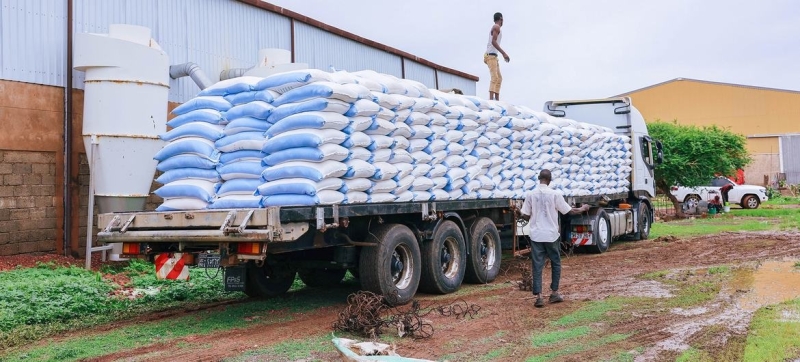
FAO staff in Gedaref facilitate the transportation of seed to Kordofan and Darfur in Sudan.
The number of people facing acute food insecurity has tripled since 2016, reaching nearly 300 million, even as food-sector funding has fallen back to 2016 levels, the Food and Agricultural Organization (FAO) said on Wednesday, launching its first-ever Global Emergency and Resilience Appeal.
FAO aims to support more than 100 million people in 54 countries by the end of 2026, with a funding goal of $2.5 billion. The agency is pushing for a more targeted and responsive approach, prioritising key interventions, sequencing them effectively, and focusing on practical solutions farmers are calling for, in line with Members’ priorities.
Around 80 per cent of people facing acute food insecurity live in rural areas, relying on farming, herding, fishing, or forestry. Yet only five per cent of humanitarian food-sector funding supports agricultural livelihoods, a persistent imbalance that traps families in a cycle of crisis and dependence.
With an emphasis on anticipatory action and rapid emergency agricultural assistance, FAO is seeking:
$1.5 billion for life-saving emergency support to 60 million people, including seeds, tools, livestock health, livelihood recovery, and cash assistance.
$1 billion for resilience programmes reaching 43 million people, focusing on climate-smart agrifood solutions, water systems, markets, and ecosystem restoration.
$70 million for global services to strengthen data, early warning, anticipatory action, and coordination across the humanitarian–development–peace nexus.
UN scales up aid for displaced in Mozambique
The UN has increased life-saving assistance for 120,000 people displaced by escalating violence in Mozambique’s Nampula province. Under Emergency Relief Coordinator Tom Fletcher, $6 million has been allocated from the Central Emergency Response Fund (CERF) to support the response.
Violence that began in 2017 in Cabo Delgado has already displaced more than 1.3 million people. “The situation has sharply worsened since mid-November as conflict spreads,” said UN Spokesperson Stéphane Dujarric.
Overcrowded and vulnerable
More than two-thirds of the 100,000 people who fled in the past two weeks are sheltering in overcrowded schools, makeshift structures, open spaces, or with already vulnerable host families, according to the Office for the Coordination of Humanitarian Affairs (OCHA).
People lack adequate shelter and have limited access to safe water, healthcare, protection, and sanitation services, while a cholera outbreak continues to spread, Mr. Dujarric added. CERF funding will prioritise water, sanitation, and hygiene services in the Erati and Memba districts, along with essential household items, shelter, protection, and livelihood support.
Uganda’s elections marked by arrests and repression
At least 550 people, including members of Uganda’s main opposition party, have been arrested or detained ahead of January’s elections, the UN human rights office (OHCHR) reported on Wednesday.
OHCHR said heavily armed security forces have been deployed to areas where rallies of the National Unity Platform (NUP) are planned. Last week, officers reportedly used live ammunition in the eastern town of Iganga, killing at least one person and injuring three others.
“It is deeply regrettable that election campaigns have once again been marked by widespread arbitrary arrests, detentions, and the use of unnecessary or disproportionate force against the opposition, as well as undue restrictions on press freedom,” said UN human rights chief Volker Türk.
Opposition held in isolation
Reports of enforced disappearance and torture of NUP supporters have increased over the past year, OHCHR warned. Security forces are accused of using unmarked minibuses known as “drones” to take people to unofficial detention sites or “safe houses,” where they are allegedly held incommunicado.
Earlier this year, the head of the military posted on X that he was holding the bodyguard of the NUP leader in his “basement.” Following public outcry, the bodyguard was later presented in court, visibly shaking and showing other signs of physical abuse.
Mr. Türk urged the authorities to investigate all allegations of ill-treatment fully and impartially. OHCHR added that at least 32 journalists and media workers were assaulted or had their equipment confiscated by security personnel during a parliamentary by-election in March.