

- Japan views Bangladesh as key dev partner: Jamaat Ameer |
- Credit cards emerge as a financial lifeline for middle-class |
- Call for a radical shift to solar, LNG to overcome energy crisis |
- Measles Death Toll in Children Surpasses 350 |
- Global Eid on Same Day ‘Not Practical’: Mufti Malek |
Tortured on Notorious Migration Route to Saudi
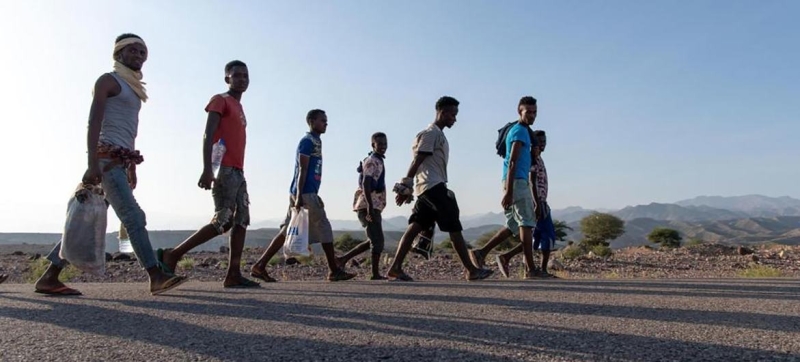
A group of migrants pass through Djibouti.
An Ethiopian man has described how he was tortured by human traffickers while searching for his nephew along a now notorious migration route from the Horn of Africa through Yemen to Saudi Arabia.
When Jamal, an Ethiopian man in his early thirties, set out on what is widely known as the eastern route, he was not chasing work, wealth or status.
He was searching for his 16-year-old nephew, who had disappeared while trying to reach Saudi Arabia through one of the world’s most dangerous migration corridors.
Each year, tens of thousands of Ethiopians travel this route, crossing arid areas of Ethiopia and Djibouti, the Gulf of Aden, and war-ravaged Yemen.
Many are fleeing conflict, displacement, poverty or climate-related hardship. Others are lured by false promises made by traffickers who profit from desperation. According to the International Organization for Migration (IOM), the eastern route has become increasingly violent, marked by kidnappings, extortion and systematic abuse.
Jamal’s nephew was among those abducted. Kidnapped in Yemen, the boy’s captors demanded a ransom. The family paid, but he was never released.
So Jamal went looking for him.
“I had no choice,” he said. “My brother had no other children. I had to go after him.”
In search of the traffickers
In Yemen, Jamal deliberately put himself in the path of traffickers, hoping they would take him to the same place where his nephew was being held.
The plan worked. He was reunited with the boy, though he pretended not to recognise him to avoid raising suspicion. As Jamal began planning their escape, he also helped other captives flee. But before he could secure his own escape, he was caught.
The punishment was immediate and brutal.
Jamal was forced to watch as other captives were beaten, mutilated and burned.
Then it was his turn. His captors wrapped his feet in plastic and set them alight again and again. The burns left permanent damage, affecting how he walks, how he sleeps and how he continues to live with the memory of that night.
Their escape came only after fighting broke out between rival trafficking groups. Amid the chaos, Jamal and his nephew ran.
After months in Yemen, surviving by washing cars to earn enough money to leave, Jamal eventually reached Djibouti. There, he was referred to an IOM Migrant Response Centre in Obock, where he received medical treatment for his injuries and psychosocial support to begin processing what he had endured.
For the first time since his ordeal, he said, someone asked not only where he had come from, but how he was coping.
Today, Jamal is preparing to return to Ethiopia.
He has not yet told his mother what happened. Even now, his greatest concern is for her, not himself.
“She saw me leave in good health,” he said. “I am worried about her seeing me like this. I will have to explain it to her gently.”