

- ADP Implementation Hits Five-Year Low at 1.85% |
- NYC BNP leaders, activists upbeat ahead of Tarique Rahman’s arrival |
- PM off to New York to attend UNGA |
- 8 Killed in Ashulia Garment Factory Fire |
- Apratim Murder Suspects Confessed, Says Home Minister |
Nuclear Test Ban at Risk Amid Rising Global Tensions
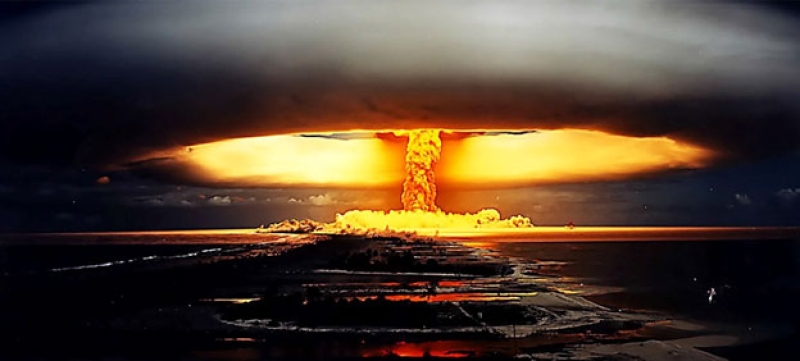
A nuclear test is carried out on an island in French Polynesia in 1971.
On 16 July this year, I was at the University of Chicago attending a Nobel Laureate Assembly and visited the site where, at 3:25 PM local time on 2 December 1942, nuclear physicist Enrico Fermi achieved the first self-sustaining atomic fission chain reaction.
Three years later, at precisely 5:30 AM on 16 July 1945, the nuclear age began with the detonation of the "Trinity" nuclear device over the New Mexico desert.
At approximately 8:15 AM Hiroshima time on 6 August 1945, the US Air Force dropped “Little Boy”, a 9,700-pound uranium gun-type bomb, over the city. While the exact number of deaths is unknown, it is estimated that at least 70,000 people died from the initial blast, heat, and radiation effects.
Three days later, on 9 August 1945 at 11:02 AM, the US Air Force detonated the plutonium bomb “Fat Man” at an altitude of 1,650 feet over Nagasaki. With an estimated explosive yield of 21,000 tonnes (kilotons)—about 40% more powerful than the Hiroshima bomb—it is estimated that 40,000 people died initially, with 60,000 more injured.
By January 1946, the death toll in both Hiroshima and Nagasaki exceeded 150,000, potentially doubling within five years due to long-term effects.
From 16 July 1945 to 3 December 2017, it is estimated that 2,121 nuclear test detonations involving 2,476 nuclear explosive devices were carried out by ten states: the USA, USSR, UK, France, China, India, Israel/South Africa, Pakistan, and North Korea.
Though the 1996 Comprehensive Nuclear-Test-Ban Treaty (CTBT) prohibits all nuclear tests in any environment, and has been signed by 187 states and ratified by 178, it has yet to enter into force.
For the CTBT to enter into force, 44 specific states must ratify it. However, nine of them still haven't: China, Egypt, India, Iran, Israel, North Korea, Pakistan, Russia, and the USA. The last among them to ratify was Indonesia in February 2012. No other progress has been made since.
Although the CTBT is not yet in force, it has created a strong global norm against nuclear testing. Yet, all nine nuclear-armed states are modernizing their nuclear weapons. Many of their scientists and engineers are pushing for limited explosive testing to validate new warhead designs and ensure the reliability of older ones.
Only the CTBT stands in their way. Should any of the nine resume testing, others would likely follow. While not confirmed, speculation suggests pressure to test is strongest in India, followed by Russia, China, North Korea, Pakistan, and the USA.
The USA and Russia have developed advanced simulation programs using quantum computing to certify warheads without explosive tests. Still, designers strongly prefer real-world detonation data for reliability and safety assurance.
In conclusion, the moratorium on nuclear testing is hanging by a slender thread amid heightened tensions: USA vs. China and Russia, India vs. China and Pakistan, and North Korea's provocations in the Korean Peninsula. If so-called "friendly" proliferation occurs—through countries like Germany, Poland, or South Korea—or if new nuclear states like Iran or Taiwan (China) emerge, the threat of renewed nuclear testing will grow.
We are living in lawless times, where might prevails over right. The global challenge remains to preserve disarmament norms, including the ban on nuclear testing.
The views expressed are personal comments by Tariq Rauf, former Head of Verification and Security Policy at the Vienna-based International Atomic Energy Agency (IAEA).