

- ADP Implementation Hits Five-Year Low at 1.85% |
- NYC BNP leaders, activists upbeat ahead of Tarique Rahman’s arrival |
- PM off to New York to attend UNGA |
- 8 Killed in Ashulia Garment Factory Fire |
- Apratim Murder Suspects Confessed, Says Home Minister |
Haiti Faces Crisis Amid Aid Cuts and Escalating Violence
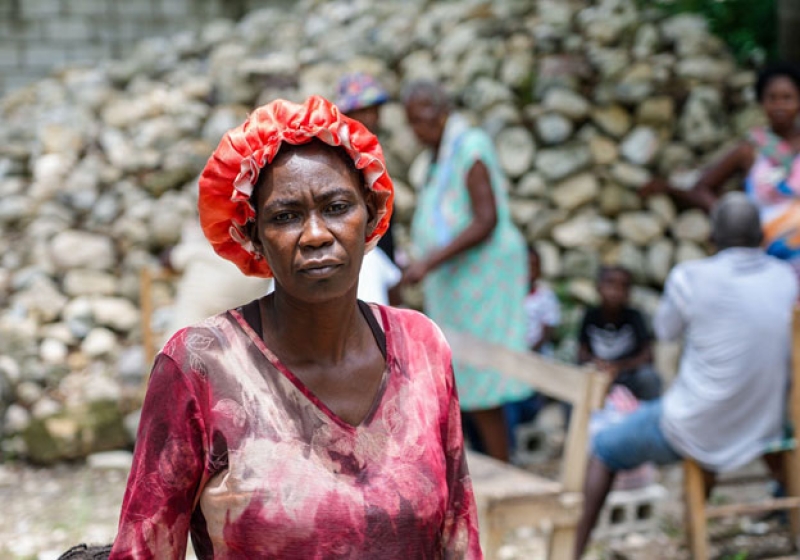
Christiana, a mother of six, fled repeated waves of armed violence, first from her home in Morne Blanc, where her husband was killed in 2024, then from Mirebalais in March 2025, seeking safety in Boucan Carré.
The humanitarian situation in Haiti has deteriorated significantly in recent weeks, with the United Nations (UN) highlighting a growing list of abuses committed by armed groups, including killings, kidnappings, and sexual violence. The gap between the vast scale of needs and the available resources has widened, leaving millions of Haitians in desperate need of humanitarian support.
Humanitarian experts have expressed concern that Haiti is at a “critical turning point,” with millions projected to face worsened living conditions if needs are not met soon. Current deliveries of humanitarian aid are being disrupted due to heightened insecurity at key entry points and widespread budget cuts to USAID programs by the Trump administration.
“The rise of armed groups in Haiti and their increasing control of strategic locations—particularly major roads and ports of entry to the capital—is a major obstacle to the safe and efficient delivery of humanitarian aid,” said Modibo Traore, Haiti’s country director for the Office for the Coordination of Humanitarian Affairs (OCHA). “The deteriorating security situation poses a major challenge for mobilizing and maintaining financial commitments. Donors have expressed concerns about operational risks, particularly regarding securing supply chains, preventing exploitation, and ensuring accountability.”
On August 1, the United Nations Integrated Office in Haiti (BINUH) released a report detailing the escalation of hostilities from early April to the end of June. According to BINUH, humanitarian operations and civilian mobility have been severely restricted in the Artibonite and Centre departments due to intensified violence, with critical entrance and exit points in the Mirebalais and Saut d’Eau communes under gang control.
BINUH also highlighted rampant human rights abuses committed by both armed gangs and local self-defense groups. From April to June, an estimated 1,520 people were killed in armed violence, and over 609 were injured. Roughly 24% of these casualties were caused by gang violence, 12% by clashes with local defense groups, and 64% by clashes with security forces.
Although these numbers mark a slight decrease from the first quarter of 2025—attributed to security forces containing gang expansion in Port-au-Prince—BINUH warns that the security situation remains “exceptionally volatile,” with armed groups beginning to establish “sketches of governance” in Artibonite and Centre.
The second quarter also saw a sharp increase in kidnappings-for-ransom, with over 175 recorded cases—62% occurring in the Artibonite region. BINUH reported multiple killings, with bodies burned by gangs.
Gang rape remains pervasive, with 628 recorded cases between April and June. Rape accounts for roughly 85% of all sexual violence incidents, and sexual slavery is widespread. Many victims are minors from vulnerable families, and many were assaulted in their homes. BINUH stated that several victims were killed after being raped, while others remained in captivity until June.
Figures from the International Organization for Migration (IOM) show that approximately 45,000 people were displaced in June in the Centre and Artibonite departments, bringing total displacement nationwide to over 1.3 million. As of July 19, OCHA reported at least 15,000 new displacements across Artibonite. Many now live with host families and struggle to access basic services.
According to Traore, the cessation of USAID funding has significantly disrupted relief efforts during a crucial period for Haiti.
“The interruption of U.S. programs has worsened the crisis. USAID’s technical partners—many of whom managed community health programs—have ceased operations, depriving hundreds of thousands of people of vital services,” he said. “Approximately 80% of U.S.-funded programs were halted. NGO staff were laid off, payments suspended, and supply chains disrupted.”
Around $908 million is needed to sustain humanitarian operations and provide relief. Yet only 8% of that funding has been secured. Traore noted that the lack of support has forced humanitarian agencies to make “complex and often painful” trade-offs, prioritizing some services over others.
For example, psychosocial support services for victims of gender-based violence have been scaled back, putting women and girls at greater risk. Traore warned of a “multidimensional regression” of women’s rights with long-term effects.
Programs for nutrition, healthcare, cash transfers, and resilience-building have also seen deep cuts. As a result, many children have dropped out of school to support their families through labor.
UNICEF projects a major spike in food insecurity, with children most affected. Some 129,000 children are expected to need malnutrition treatment over the next year. Maternal mortality is also expected to increase.
“The current crisis reveals Haiti’s growing isolation. Unlike past emergencies that drew international solidarity, the 2025 humanitarian response has been slow and limited,” Traore said. “This limited response only reaches a fraction of the 3.6 million people targeted for aid.”