

- Dhaka ranks world's third most polluted city this morning |
- Soldiers Guard Milan as Thousands Protest Across Europe |
- Cheese Industry Thrives In Thakurgaon Villages |
- Guterres alarmed at Israel’s sweeping closures after deadly Hebron attack |
- Bangladesh to Introduce New Law to Curb Extortion, IGP Says |
80 Years On, Fears Grow Over Return of Nuclear Testing
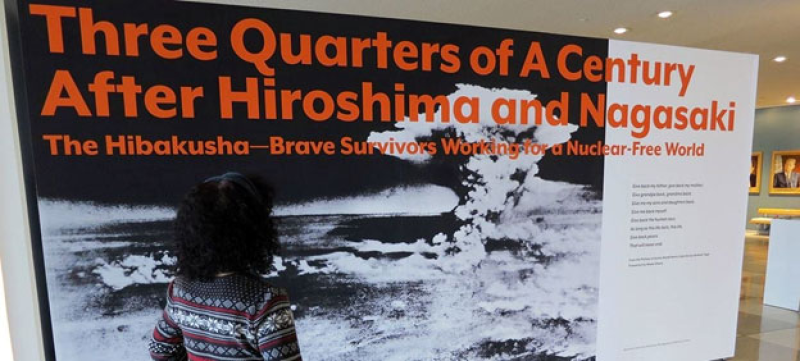
Erico Platt looks at the disarmament exhibition that she staged, "Three Quarters of a Century After Hiroshima and Nagasaki: The Hibakusha—Brave Survivors Working for a Nuclear-Free World". On 6 and 9 August 1945, the United States detonated two atomic bombs over the Japanese cities of Hiroshima and Nagasaki, during World War II.
The 80th anniversary of the atomic bombings of Hiroshima and Nagasaki during World War II has revived a haunting question: Is nuclear testing dead, or is it still alive—and threatening?
The August 6–9 anniversary marks the devastating attacks that claimed between 150,000 and 246,000 civilian lives. These bombings remain the only use of nuclear weapons in an armed conflict.
Have any lessons been learned? And will the unpredictable Trump administration resume nuclear testing?
The New York Times quoted Senator Jacky Rosen (Democrat-Nevada) as saying her state hosted nearly 1,000 nuclear tests, mostly underground, during the Cold War.
While the U.S. signed the 1996 Comprehensive Nuclear Test Ban Treaty (CTBT), it has yet to ratify it. The Senate rejected the treaty in 1999.
To this day, the Nevada Test Site remains contaminated with an estimated 11,100 PBq of radioactive material in the soil and 4,440 PBq in groundwater.
In the aftermath of the tests, thousands of residents developed cancers and other diseases they believe were caused by nuclear exposure. These individuals—known as “downwinders”—have been fighting for nearly 80 years for government recognition.
The last U.S. nuclear test was on September 23, 1992, at the Nevada Test Site, under Operation Julin. It was known as the “Divider” test.
Brandon Williams, expected to be the next head of the U.S. nuclear arsenal, told the Senate Armed Services Committee in April that he would not recommend resuming U.S. nuclear testing.
Meanwhile, former President Donald Trump last week ordered two "nuclear submarines" to be positioned near Russia in response to threats from former Russian President Dmitry Medvedev. It remains unclear whether they were nuclear-armed or simply nuclear-powered.
“I have ordered two Nuclear Submarines to be positioned in the appropriate regions, just in case these foolish and inflammatory statements are more than just that,” Trump posted on social media.
Dr Natalie Goldring, the Acronym Institute’s representative at the United Nations, said the 80th anniversary offers an opportunity to recommit to a world free of nuclear weapons—including through a permanent ban on nuclear testing. In contrast, reports suggest the Trump administration is considering a return to testing.
She warned that the Heritage Foundation’s “Project 2025”—a policy guide for a future conservative administration—explicitly calls for rejecting CTBT ratification and preparing for renewed testing.
“Implementing these recommendations would mean resuming nuclear weapons testing without even proving adversary actions,” Goldring said. “This aggressive stance could be a self-fulfilling prophecy.”
She added: “President Trump’s impulsive nature makes him unpredictable. He could resume testing to project strength—without considering the consequences.”
According to her, the only real solution is the complete abolition of nuclear weapons. The Treaty on the Prohibition of Nuclear Weapons offers a practical blueprint for that goal.
Tariq Rauf, former Head of Verification and Security Policy at the IAEA, said that from July 16, 1945, to December 3, 2017, ten countries conducted 2,121 nuclear test detonations using 2,476 nuclear devices.
Though the CTBT bans all nuclear detonations and has 187 signatories and 178 ratifications, it has yet to enter into force. Nine key countries, including the U.S., China, and Russia, have not ratified the treaty.
Rauf warned that any renewed testing by one nuclear state could trigger others to follow. He identified India, Russia, China, North Korea, Pakistan, and the U.S. as the most likely candidates to resume tests under pressure.
Senator Edward Markey and four other U.S. Senators introduced a resolution urging the U.S. to lead global disarmament efforts, renounce first use of nuclear weapons, and maintain the testing moratorium.
“Eighty years after the Trinity test, we’ve made progress—but much remains to be done,” Markey said. “If Washington and Moscow do not replace the New START Treaty before it expires next year, we may enter a new and more dangerous arms race.”
Jackie Cabasso, Executive Director of the Western States Legal Foundation, said the U.S. bombings of Hiroshima and Nagasaki instantly incinerated over 210,000 people or caused deaths from burns and radiation sickness by year’s end.
Survivors continue to suffer, and radiation-related illnesses persist across generations.
She pointed out that authoritarian nationalists control seven of the nine nuclear-armed states today. Over 90% of nuclear weapons are in U.S. and Russian hands, and disarmament efforts have reversed.
Since 1945, there have been 2,056 nuclear test explosions by at least eight countries, many of them on indigenous or colonised lands. The U.S. alone conducted 1,030 tests.
“Project 2025’s prioritisation of nuclear programs over other security needs is alarming,” Cabasso said. “A full-scale test would break the decades-old moratorium and spark an uncontrollable arms race.”
Former Trump security advisor Robert O’Brien has also called for renewed testing to counter Russia and China.
Cabasso concluded: “If the U.S. resumes full-scale nuclear testing, others will follow. It would be the final nail in the coffin of arms control and disarmament.”
Nihon Hidankyo, the organisation of Japanese atomic bomb survivors and recipient of the 2024 Nobel Peace Prize, warns: “Nuclear weapons and human beings cannot coexist.”
As UNESCO’s 1945 Constitution said, “Since wars begin in the minds of men, it is in the minds of men that the defences of peace must be constructed.”
It is up to all of us to contribute to this noble goal.